The Roses of Versailles: Embodied Politics in Jacques Demy’s Lady Oscar

MINI SERIES: THE ROSES OF VERSAILLES
Embodied Politics in Jacques Demy’s Lady Oscar:
A Cinematographic Take on Class, Gender, and
the French Revolution
by Alessandra Aloisi
04 July 2025
In this essay, Alessandra Aloisi offers a fascinating critique of how Lady Oscar, the main protagonist in Riyoko Ikeda’s manga The Rose of Versailles, was portrayed in Jacques Demy’s 1979 film version. Lady Oscar has offered, in various media, radical reimaginings of gender, class, and power against the backdrop of the French Revolution. This essay is the third and last instalment of a three-part series that approaches Lady Oscar, the main protagonist in Riyoko Ikeda’s manga The Rose of Versailles, from different perspectives. Aloisi’s essay follows the introduction by Patrick Bray, Christina Parte’s take on the tradition of the shōjo manga and Frances Clemente’s charting of Lady Oscar’s move from a feminist queer TV icon to a character at the heart of contemporary Italian debates.
Lady Oscar as a Modern Myth
Like many Italian children born in the 1980s, I first encountered Lady Oscar through the anime TV series. I watched it for the first time when I was ten, without much awareness of its historical and political context. I watched it again at twenty, while babysitting my younger brother – an ideal excuse! Recently, more than twenty years later, I rewatched it in preparation for a paper that I gave at the event ‘Lady Oscar: Between Genres and Genders,’ which inspired this mini series. I find it fascinating how, each time, Lady Oscar captivated me and spoke to me, though for different reasons, and in spite of all its possible clichés. As Patrick Bray suggests in his introduction to this series, The Roses of Versailles, Lady Oscar’s persistence through time, but also across different cultures and media, suggests that perhaps what we are dealing with is a proper cultural event, a “modern myth,” worthy of further investigation1.
In the 1980s and 1990s, around the same time as Lady Oscar, Italian television was broadcasting another anime inspired by the success of the manga The Rose of Versailles: Ra Senu no Hoshi (The Star of the Seine), originally produced as an anime (1974-1975) and later adapted into a manga.

At first glance, the setting and the story resemble those of Lady Oscar. We are once again in Paris, on the eve of the French Revolution. The protagonist is another pucelle guerrière (warrior maiden): Simone Lorène [Fig. 1], a poor girl whose name may allude to the famous heroine from the Lorraine region, Joan of Arc. After abusive aristocrats kill her parents, Simone decides to become a skilled swordswoman and, in disguise, begins fighting against social injustice, helped by her adoptive brother, the Black Tulip. However, right before the outbreak of the Revolution, Simone discovers that she is in fact the half-sister of Queen Marie Antoinette. When the Revolution turns into the Terror, Simone resolves to be loyal to her newfound family ties and defend the monarchy. She liberates the queen’s children and runs away with them, while their mother is sent to the guillotine.
Reading these two stories side by side can help us appreciate the novelty and distinctiveness of Lady Oscar as a modern myth. Simone’s story follows a trajectory that, in many ways, is the opposite of Oscar’s. While Simone draws closer to the monarchy as the Revolution progresses, Oscar gradually distances herself from Marie Antoinette and her aristocratic origins, ultimately siding with the Revolution. Both stories revolve around the motif of disguise, though its function is quite different in each case. Simone’s disguise is temporary and primarily serves to conceal her true identity. By contrast, Oscar’s “disguise” – her cross-dressing – has a performative dimension: rather than hiding an identity, it enables the construction of a new identity, distinct from the biological one assigned to her at birth.
Jacques Demy’s Lady Oscar
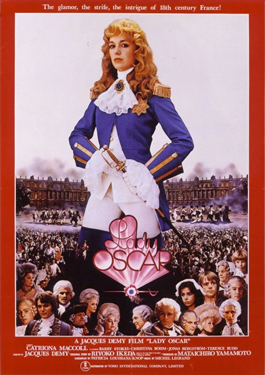
The film Lady Oscar was released in 1979 [Fig. 2], just a few months before the anime. Jacques Demy was commissioned to direct it by the Japanese producer Yamamoto, who became fascinated with his work after watching Les parapluies de Cherbourg (The Umbrellas of Cherbourg, 1964). A “truly transnational production” – shot in France with British actors and written in collaboration with the American screenwriter Patricia Knopp – Lady Oscar was a major success in Japan. In France, however, it was almost a complete failure2.
Coming to the film with all my childhood expectations shaped by the anime, the first time I watched Demy’s Lady Oscar, my initial reaction was one of mild disappointment. Several key aspects of the story are either missing or drastically simplified. For instance, Rosalie’s touching backstory is reduced to a few superficial scenes, the Black Knight subplot is entirely omitted, André does not lose his sight at the end of the story, and Oscar does not die during the storming of the Bastille. Moreover, compared to the anime, which adheres closely to the manga, the characters in the film appear slightly trivial and one-dimensional, lacking the moral and spiritual depth that they have in the original version. Marie Antoinette is portrayed as an entirely frivolous and capricious woman. Fersen, her elegant and beautiful lover, is depicted as a cheeky tombeur de femme. Girodelle (renamed Girodet in the film) becomes a ruthless libertine, who seeks to dominate Oscar and subjugate her to satisfy his perverse sexual fantasies, ostensibly inspired by the Marquis de Sade. André – Oscar’s devoted servant, secretly in love with her since childhood – emerges as a strong, masculine, and confrontational figure, whereas in the anime he is portrayed as a romantic, gentle, and sensitive character (despite the disturbing near-rape scene, for which see Christina Parte’s essay)
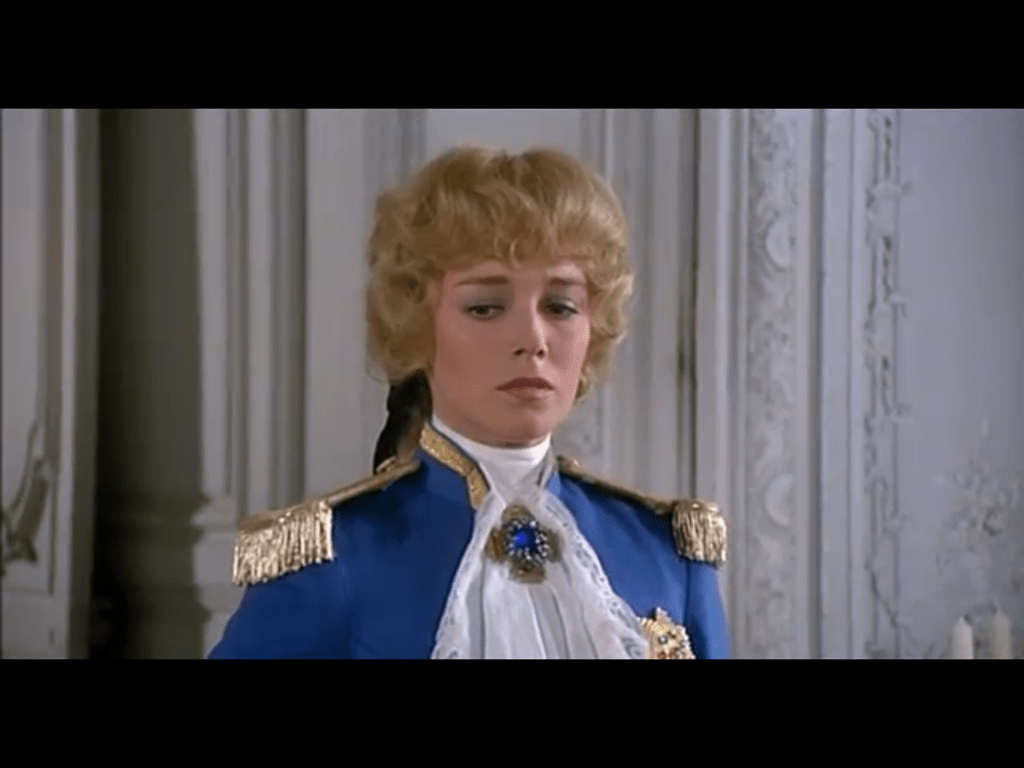
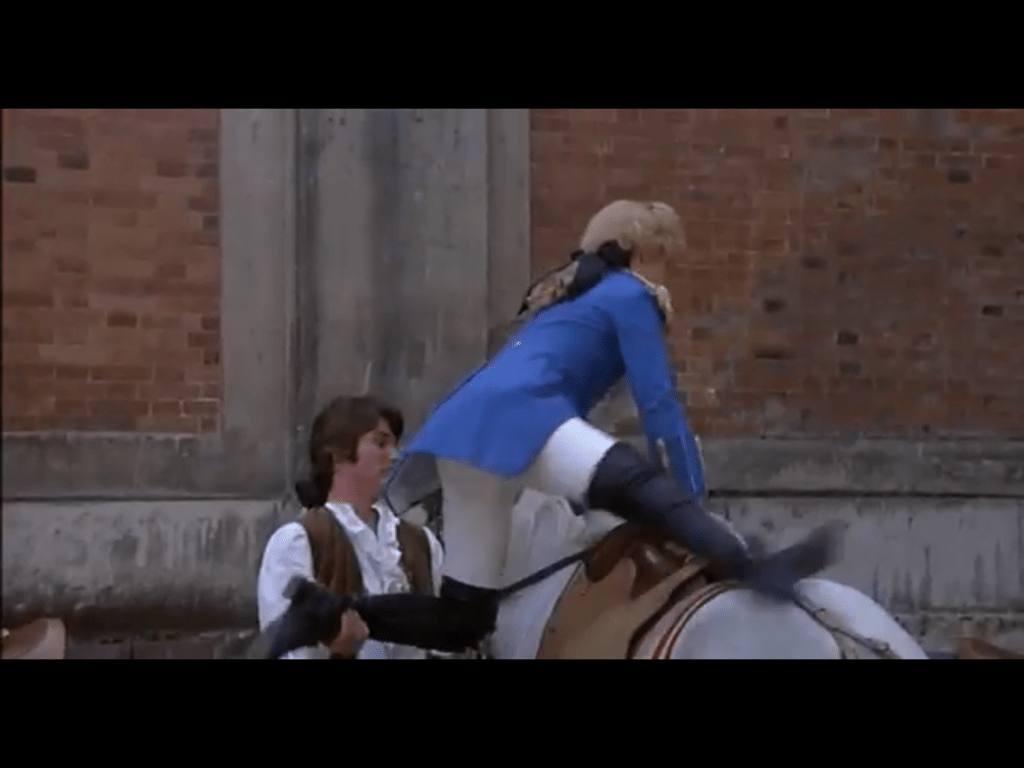
Lastly, Oscar appears overly feminine in the film, in contrast to her androgynous characterisation in the anime and manga. Demy was, in fact, criticised for his casting choice. Catriona MacColl, who plays the heroine, did not seem to have the right body type3: she was too curvy to wear a uniform and too short to mount her horse without André’s help [Fig. 3]. It seems that, in the characterisation of Oscar, the film intentionally accentuates traits that are traditionally perceived as feminine: she appears shy, weak, and fearful, always dependent on André’s protection. Moreover, she wears heavy make-up even while dressed in full military uniform [Fig. 4]. All this makes it hard to believe that Fersen could mistake her for a man the first time he sees her at court. The blue eyeshadow, matching her military uniform, may have been a marketing concession to the cosmetics company which sponsored the film4. And yet, whereas in the manga and anime Oscar is portrayed as a beautiful masculine woman, in the film her overflowing femininity is constantly on display. At first sight, compared to the manga, the film appears to lose something of the way in which Ikeda was able to empower Oscar as a character whose gender remains ambiguous and undefined5.
However, I would like to show that these apparent flaws and weaknesses in the film can be read as deliberate aesthetic strategies that allow Demy to subtly convey a powerful political message, in which questions of class and gender are deeply intertwined6.
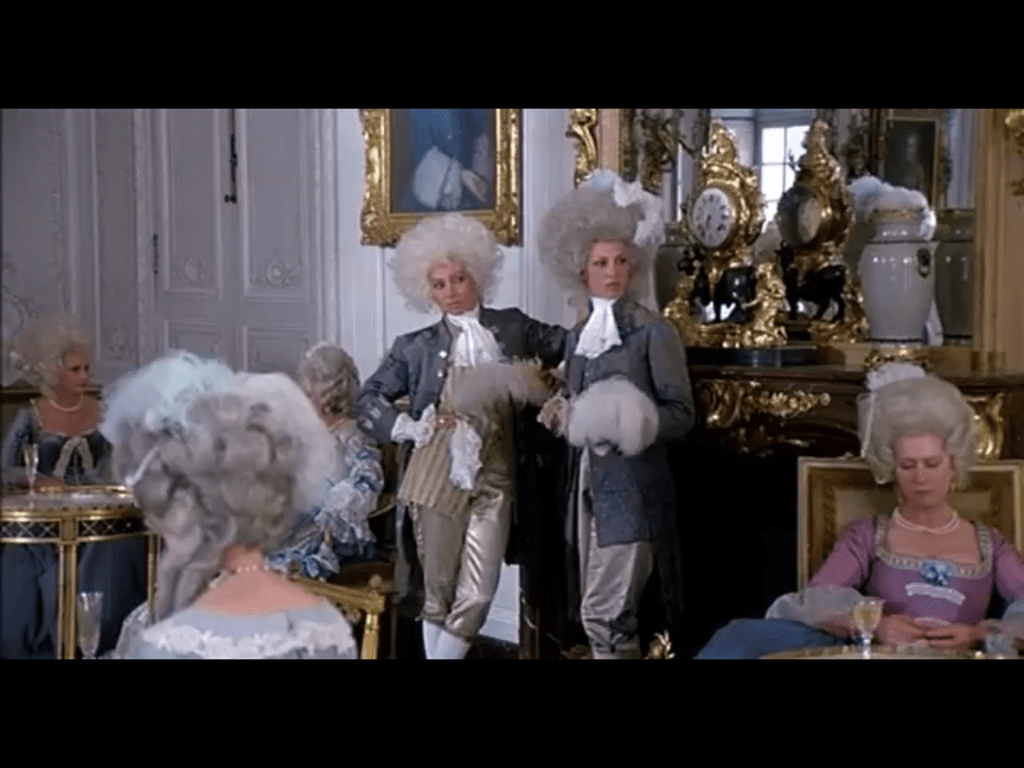
I will begin with discussing the film’s treatment of gender. By emphasising Oscar’s ‘feminine’ traits, the film makes certain sexist dynamics and stereotypes about gender roles more visible. That Oscar is a woman in men’s clothing is no secret at court. In the film, Marie Antoinette addresses her as “she” and treats her as any other woman in her entourage. She even finds Oscar’s clothing charming and fashionable. Indeed, the other women at court begin to imitate her style [Fig. 5], and some even find her attractive.
While the female characters in the film recognise, admire, and sometimes even emulate the ambiguity and the queerness of Oscar’s position between genders and public roles, the male characters, on the contrary, consistently refuse to acknowledge her as anything other than a man. For instance, the King addresses her as “young man”, and so does Fersen, who, in front of her, mocks women who dress like men. When he eventually discovers that Oscar is a woman, his reaction is telling. He patronisingly reduces her to her physical appearance, remarking that indeed she is far too “lovely” to be a man. He also visibly shows that he is not attracted to her because she dresses and acts like a man. It soon becomes clear that, like Marie Antoinette, Oscar has a crush on him. Yet Fersen does not reciprocate her love and prefers a woman like Marie Antoinette, who conforms to gender norms and does not challenge his role and identity as a man. Fersen’s behaviour is not so different from that of the French Guards, whom Oscar joins after leaving the Royal Guard. Just like him, they mock Oscar’s gender ambiguity: they address her as “sir”, but at first refuse to obey her orders because she is a woman.
In other words, compared to the positive reactions on the part of the women in the film, most of the men are incapable of – or rather, unwilling to – accept Oscar’s unconventional position: that of a beautiful and feminine woman who challenges gender norms by dressing like a man and holding a position of power. Faced with her unconventional position, they either, like the King, reduce her to the identity of a man – holding power, to them, necessarily implies “being a man” – or they refuse to respect her as a woman who challenges gender roles. Ultimately, their defensive behaviour serves to uphold the established sexual and patriarchal order that Oscar implicitly calls into question.
Oscar, for her part, never asserts a fixed gender identity. Perhaps, like the protagonist of Théophile Gautier’s 1835 novel Mademoiselle de Maupin, she sees herself as belonging to a “troisième sexe à part”, a third sex which does not have a name yet7. Certainly, Oscar is very much aware that her social position as a man affords her greater freedom and autonomy, which is why she refuses to marry Girodet and take on the social role of a woman.
Another film by Jacques Demy comes to mind: L’événement le plus important depuis que l’homme a marché sur la lune (translated in English as A Slightly Pregnant Man, 1973). Marco Mazetti is, in many respects, a character remarkably close to Lady Oscar. When he becomes pregnant, both his wife and child have to accept his pregnancy without questioning his virility or masculinity. However, despite a few homophobic jokes from a male colleague at work, Marco is never emasculated. His pregnancy even becomes a marketing phenomenon that eventually starts a pandemic, with other men all over the world experiencing the same symptoms. Compared to Lady Oscar, who faces social obstacles, Marco seems to be in the position of adopting a traditionally feminine role with relative ease, and without having to compromise his masculinity. His ambiguous – or queer – position as a pregnant man does not lead to social punishment, as it does in Oscar’s case.
Among all the male characters in the film Lady Oscar, three stand out for the way in which they relate to the protagonist: her father – General de Jarjayes –, the Count de Girodet, and André. Oscar’s father claims the authority to change his daughter’s gender at will – first at birth, when he declares her to be a boy in order to secure a male heir for the family, and later, when he reassigns her to the status of woman to arrange a socially and financially advantageous marriage with Girodet. Oscar’s biological sex subordinates her to her father’s capriciousness and authority – a position that could be compared to that of the protagonist of another film by Jacques Demy, Peau d’Âne (Donkey Skin, 1970), in which a princess disguises herself as a repulsive donkey to escape an incestuous marriage with her father.
As for Girodet, he wishes to marry Oscar despite her male clothing and high military rank – but only to dominate and subjugate her. He is perversely excited by her cross-dressing, and, in his eyes, Oscar is just a woman, as such she is only an “object of consumption and exchange within the patriarchal economy”8. In stark contrast to all the other men, André is the only character who genuinely seems capable of recognising and respecting Oscar’s gender ambiguity. Their bond is not based on domination or on rigid gender roles, but on equality. André never asks her to “compromise either her masculinity or her femininity”9 and with him she can experience a relationship that exists outside the rules of the heteronormative patriarchal society.
However, as mentioned earlier, compared to the manga or the anime, in the film, André stands out as a less servile and more independent figure. Not only does he protect Oscar, but he also assumes a more active role in her political awakening and emancipation. Despite being of a lower social class, André is the one who reads Voltaire and Rousseau, and who keeps Oscar informed about the political unrest sweeping through France. This re-evaluation of André’s figure could be perceived as a disempowerment of Oscar’s character: “By depicting Oscar as the weaker partner in the couple”, the film seems to restore the “patriarchal order” and reproduce “essentialist notions of gender”10. Upon closer examination, however, this choice is more complex than it first appears. This brings me to my second point concerning the representation of class.
As film scholar Anne Duggan has rightly observed, by granting greater agency to a lower-class character, the film is able to reassess the model of aristocratic heroism that remains very much central in the manga and in the anime. Aristocratic heroism is further undermined by the way in which the film visually depicts historical events such as the storming of the Bastille, through long shots that emphasise collective rather than individual action and displace “agency from the aristocratic heroine to a collective subject”, empowering the lower-class11.
By doing so, the film also suggests that the equality between Oscar and André involves transcending both gender and class boundaries. Throughout the film, the class separation between Oscar and André is visually emphasised: they wear different clothes, André never appears at court and is always positioned as socially inferior in public spaces. It is only in the stables – where Oscar and André used to spent time together as children – that these distinctions dissolve, and it is here that they make love. It is also in the stables that André tells Oscar that they are equal because they “breathe the same air” – perhaps an implicit invitation to con-spire (literally, to breathe together) against the social and sexual order that oppresses them both. The film’s ending reinforces this reading: as Oscar and André merge into the revolutionary crowd heading toward the Bastille, they wear almost identical clothes (trousers and a light white shirt) [Fig. 6 and 7]. This could be an allusion to their childhood, when they used to dress, play, and act as equals. But this could also suggest that Oscar does not renounce her men’s clothing at the end, reaffirming both her gender nonconformity and commonality with the lower class.
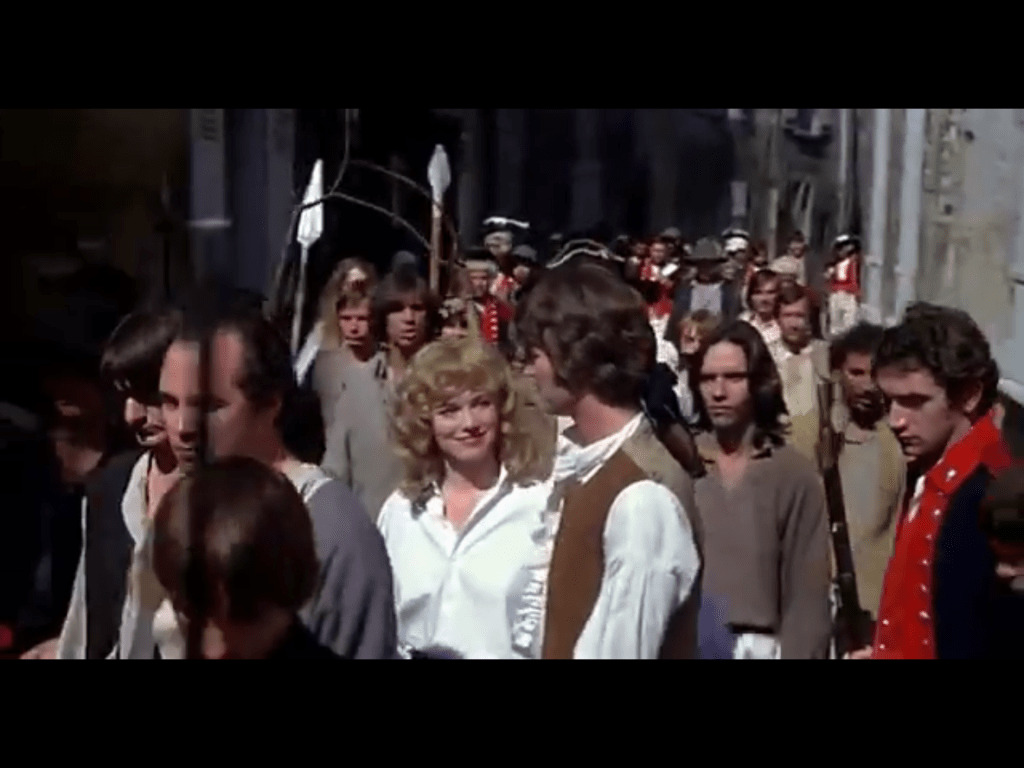
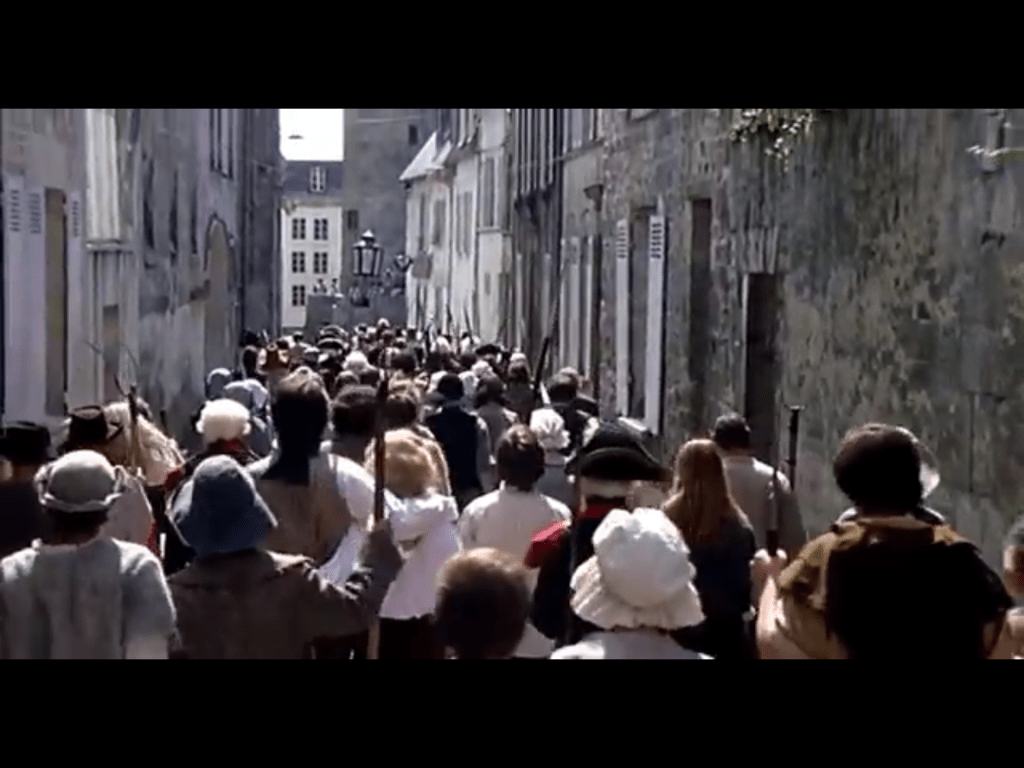
The film’s decision to not kill Lady Oscar at the end is particularly interesting. In the final sequence, Oscar and André are separated by the crowd. André is shot just a few moments before the fall of the Bastille, while Oscar searches for him in desperation. The ending emphasises – also through the music, jubilant at first and then progressively more melancholic – the contrast between Oscar’s personal despair and the explosion of the collective joy. In many ways, this ending is crueller than the one of the manga, where the two lovers die together, united in their sacrifice. This bittersweet ending might certainly echo other films by Demy, such as Lola (1961) or Les parapluies de Cherbourg, which also deny the spectators a complete and conventional happy ending12. However, I also like to think that perhaps Demy didn’t want to kill this new democratic heroine that his cinema had just invented. As the camera zooms out, and Oscar disappears into the crowd, the music shifts again and takes on lighter tones. Lady Oscar – the final sequence of the film seems to suggest – is now part of the people and, as such, has to go on living and reinventing herself.
ALESSANDRA ALOISI is a Lecturer in French at the University of Oxford. Her research explores modern and early modern literature and philosophy, with a focus on the eighteenth and nineteenth centuries. Her book The Power of Distraction (Bloomsbury Academic, 2023) also appeared in Italian and Spanish.
***
Edited by MARTHE LISSON
Standfirst and Proofreading by NICHOLAS LACKENBY
Lead image: Collage © Think Pieces
Categories