The Roses of Versailles: Lady Oscar – Shōjo Warrior at the Crossroads of S Relationships and Queer Desire

MINI SERIES: THE ROSES OF VERSAILLES
Lady Oscar – Shōjo Warrior at the Crossroads of
S Relationships and Queer Desire
by Christina Parte
13 June 2025
This essay is the first instalment of a three-part series that approaches Lady Oscar, the main protagonist in Riyoko Ikeda’s manga The Rose of Versailles, from different perspectives. Following the introduction by Patrick Bray, Christina Parte looks at the genre of shōjo manga – manga for girls. In the 1970s, Ikeda was at the forefront of Japanese female artists who revolutionised this genre. Whether the depiction of cross-dressing, androgynous looking youth subverting Japanese heteronormativity is limited to the world of shōjo manga or goes beyond it, has been hotly debated and, in this piece, will be revisited from a transnational perspective.
Japan has a long history of transgender practices and tolerance for same-sex desire1, which, except for a moment in the nineteenth century, has never been criminalised. The fact that a cross-dressing, gender fluid warrior maiden is the protagonist of a shōjo manga, a manga for girls, is by no means unusual.
In Ryoko Ikeda’s shōjo manga The Rose of Versailles (1972-1973) gender performativity, the notion of gender as a series of repeated performative acts, is a prominent feature. The main protagonist Lady Oscar’s subversion of the assigned gender role of ‘masculine woman,’ who serves father and fatherland as a warrior maiden, follows and at the same time undoes the trope of the warrior maiden so prominent in French and Chinese literary traditions2. At birth, Oscar Jarjayes3 is interpellated as baby boy by the father, a general in the French Royal Army at the dawn of the French Revolution. Due to the lack of male offspring, Oscar must uphold the military tradition of the family. Oscar’s oscillation between the culturally prescribed gender roles of conventional masculinity and femininity and their enabling as well as disabling effects on desire, have not only won the hearts of the predominantly female readers of the manga in the 1970s but revived a genre, whose focus until then had been passionate female friendships in boarding school settings. While Oscar’s ambiguous gender performativity and status as eternal warrior maiden have made Oscar a feminist and queer icon – passionately embraced by an increasingly diverse readership – I argue that within the narrative and visual space of the manga, transgression of Japanese heteronormativity and compliance are kept in surprising balance.
Osamu Tezuka’s manga Princess Knight (1953-1956) is generally regarded as one of the first major postwar works of shōjo manga. It features a princess who, due to an angel’s mischief, has been born with a male and female heart. Raised as a prince, Sapphire has to cover up her femininity and defend her country as a warrior maiden against her relative’s claim to the throne. After a series of adventures, Sapphire’s femininity is fully restored, her male heart removed, and Sapphire marries her love interest, Franz Charming. At the time, Tezuka’s light-hearted story of gender ambiguity, drawn in a style that resembled Walt Disney’s, was catering to a predominantly pre-teen female readership. 20 years later, in the liberal atmosphere of the 1970s, female mangaka– manga artists – innovated the genre in radical ways. While indebted to Tezuka, they had been active in the Japanese women’s liberation movement and used shōjo manga as a privileged site for the exploration of gender and sexuality. Known as the Year 24 Group, born in the twenty-fourth year of the Shōwa era (1926-1989), they not only addressed formerly taboo subjects such as politics, religion, sex and sexual abuse but also revolutionised the genre on a formal level. Abstract page compositions, facial close-ups, densely layered panels, floral designs, allegorical imagery, full-body portraits, female characters with huge sparkling eyes, together with fragmented interior monologues, created a melodramatic intensity. This was meant to reflect the shōjo’s inner world of longing and give room for the exploration of female teenage subjectivity.
The distinct category of shōjo, the Japanese teenage girl, emerged during Japan’s modernisation period in the late nineteenth century. As Mizuki Takahashi points out, the term shōjo “refers to a socially conservative gender role” (Takahashi 116), crafted by the state and its legislation regarding girls’ higher education. While girls gained entry to higher education in all-girls’ schools in 1899, they were trained to become future ryōsai kenbo, wise mothers and good wives4. Despite heteronormative efforts to contain female desire in a sex-segregated environment, the young girls formed close emotional bonds, known as S kankei, S relationships. S stands for shōjo, the English word sister, sex and even the German word for a beautiful woman: Schöne. S kankei describes, according to Deborah Shamoon, passionate friendships as spiritual and/or erotic same sex relations, formed between an older and a younger girl exhibiting “the same modes of dress, speech and behaviour.” (Shamoon 140-141) In Japanese girls’ literary magazines of the 1920s, stories of young schoolgirls caught up in complicated S relationships were very popular and beautifully illustrated by male artists such as Junichi Nakahara, at a time when men still dominated the shōjo manga production. This was going to change.
In the 1970s, female mangaka transferred the literary and visual conventions of their prewar predecessors into the shōjo manga genre; however, same sex relations between young girls were soon replaced by same sex relations between androgynous looking boys known as shōnen ai or Boy Love (BL). As shōjo manga had become more sexually explicit, only beautiful youth could transcend the boundaries of heteronormative gender and sexual orientations. Lorna Piatti-Farnell argues that the bishōnen, the beautiful youth, served as a safe metaphor for young girls, who wanted to explore their sexuality in a fantasy space, which would not automatically subject them to the demands of normative femininity and ‘the wise mothers, good wives’ – paradigm (Piatti-Farnell 446). Often, stories of beautiful youth involved love triangles in boarding schools, personal traumas such as the loss of a parent, unrequited love or sexual abuse, as in Moto Hagio’s groundbreaking 1974 shōjo manga The Heart of Thomas. Most critics agree that the bishōnen, like the shōjo constitute their own gender where favourable masculine and feminine traits are combined. (Buruma 1984; Robertson 1998; McLelland 2000; McLelland et al. 2015). As Midori Matsui argues in her psychoanalytic study of displaced femininity, the category of beautiful youth and with it the ambiguous charm of androgyny and sexual indeterminacy undoes the referentiality of sex and “provides a space for play and defiance” (Matsui 194).
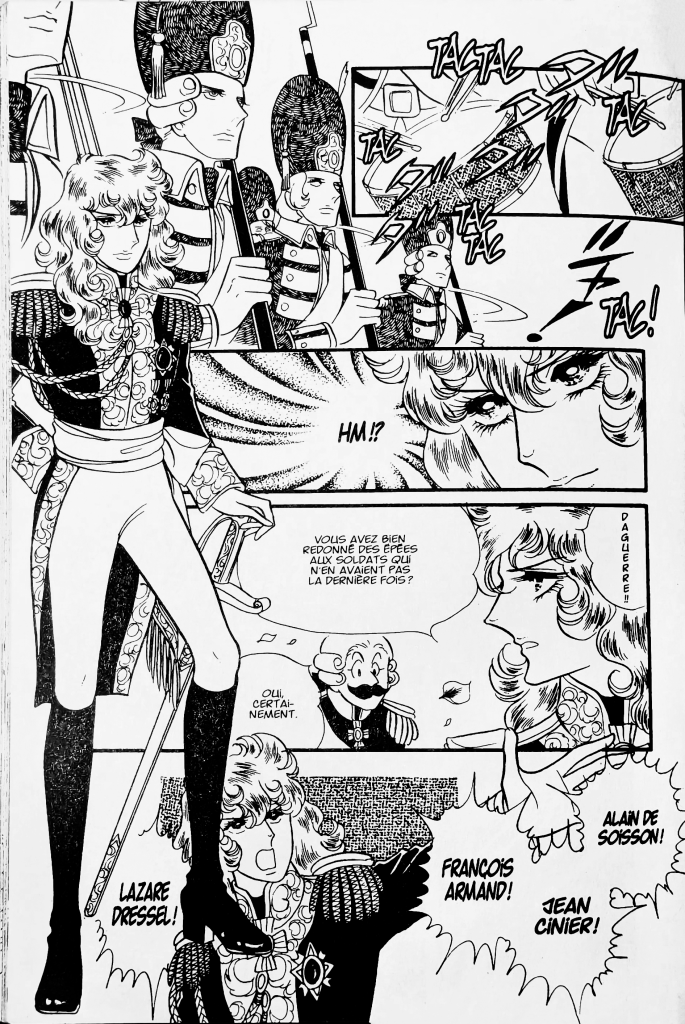
This may be the reason why young Japanese teenage girls reading The Rose of Versailles in the 1970s were soon more interested in Lady Oscar, the cross-dressing French palace guard, in charge of safeguarding the failing French monarchy and its unruly Queen, Marie Antoinette, at the dawn of the French Revolution (Fig. 1). Originally based on Stefan Zweig’s biography, Marie Antoinette (1932), Ikeda shifted the focus from Marie Antoinette to Lady Oscar as the narration progressed due to Oscar’s popularity.
While The Rose of Versailles is not set in a boarding school at the beginning of the twentieth century but at the dawn of the French Revolution, many modern shōjo manga conventions such as the exploration of gender and sexuality, cross-dressing, the depiction of beautiful youth, S relationships and the potential queering of desire inform the manga. Lady Oscar, born female, is assigned the male gender at birth to succeed in a family of generals. As cross-dressing royal palace guard Oscar can be placed into the tradition of the warrior maiden while at the same time queering it, as Anne Duggan points out. As warrior maiden, Oscar must put on male attire to maintain the father’s honour and protect the royal family and the kingdom. However, Oscar gradually awakens to the plight of the common people and increasingly realises the impossibility of shedding the male persona and with it the privilege of male agency. Oscar eventually rejects the patriarchal system embodied by the father’s demand of filial loyalty and future marriage, as well as the absolutism and entitlement of the Ancien Régime by renouncing the noble title, loving a commoner and joining the revolutionaries (Duggan 104). Oscar dies for the people when storming the Bastille.
Drag, as Duggan explains, referring to Judith Butler’s concept of performativity, “prompts queer possibilities” (Duggan 105), simultaneously opening up spaces for heterosexual as well as homosexual interaction. Oscar, as an androgynous, beautiful youth, is worshipped by the women at court as well as, eventually, by the soldiers of the Royal Army and the French Guards. Oscar’s flirtations with the women and men in the immediate environment, remind us of Japanese S relationships, where homogender romanticism was tolerated, even encouraged, as long as the shōjo was prepared to submit to Japanese heteronormativity later.

When Rosalie Lamorlière, raised as a commoner though in fact the biological daughter of the Queen’s confidante, is given refuge by Oscar and accepted in the Jarjayes family’s household, spiritual love between a beautiful youth and a shōjo nearly crosses the line of conventional respectability. In one scene, Rosalie, who is treated like a younger sister by Oscar, finds herself alone in Oscar’s room and lovingly embraces Oscar’s uniform. She bemoans the fact that Oscar is a woman (Fig. 2). When Rosalie leaves the household to pursue familial and female obligations, Oscar despairs of biologically being a woman and thus unable to properly protect and fulfil Rosalie’s desire. While the queer subtext is foregrounded it is not consumed. Rather, the failed transgression resembles what Judith Butler calls ‘gender melancholia’; the realisation that “heterosexualized genders form themselves through the renunciation of the possibility of homosexuality” (Butler 180).
Oscar is not only a woman, but a woman raised as a man. Oscar’s secondary gender, as Jennifer Robertson points out, is always kept in check by the primary gender of Oscar as a woman. Robertson compares Oscar to the otokoyaku, the male impersonators in the all-female Takarazuka theatre revues. Both, the otokoyaku, who plays Oscar in the musical version of The Rose of Versailles, and the character in the manga display honorary masculinity but not model masculinity (Robertson 78). This stands in stark contrast to another popular Japanese cross-dressing theatre tradition: Kabuki. In Kabuki, all roles are played by men and the onnagata, the female impersonators, have traditionally been perceived as a model women, other women should try to emulate (Robertson 78). Apart from conventional, binary constructions of masculinity and femininity, cross-dressing also follows a gendered hierarchy in the Japanese context.
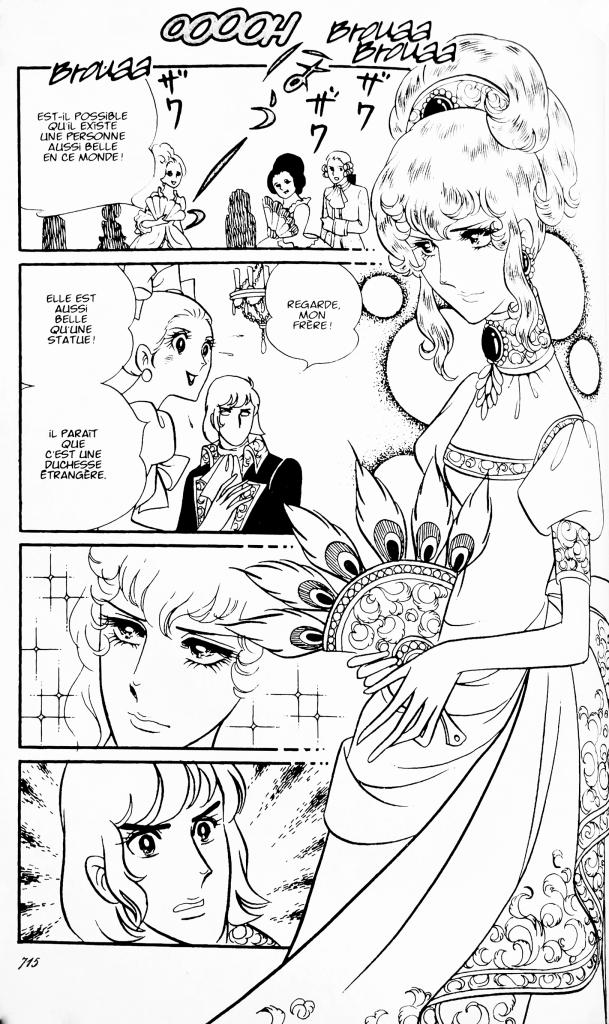
Oscar cannot easily shed the secondary gender at will, a realisation that will lead to the abandonment of Oscar’s first love interest, the Swedish Count Fersen. When, in female disguise, Oscar meets Fersen at a royal ball, Fersen is vaguely reminded of Oscar, the royal palace guard and beautiful youth, but is seemingly unable to place Oscar in the category of ‘only woman’ (Fig. 3). The impossibility of fully inhabiting the primary gender will even become more obvious, when Oscar is supposed to marry a fellow royal captain and aristocrat. Oscar defies the legitimate pursuit of Victor de Girodelle, because marriage to the aristocrat would mean the end of Oscar’s symbiotic relationship with André Grenadier, commoner and long-time childhood friend.

Oscar’s decision to remain a beautiful youth has severe consequences. Oscar and André’s spiritual love turns into something more carnal, reminiscent of bishōnen ai, beautiful boy love. This is noticeable in their depiction, as they increasingly resemble each other. Both display markers of conventional femininity and masculinity, such as submissiveness as well as aggressiveness, depending on the context. While Oscar does not shy away from any military conflict, Oscar shows a surprising submissiveness when confronted with André’s increasingly aggressive desire and outspoken love for Oscar, which culminates in a near-rape scene (Fig. 4). André, Oscar’s personal bodyguard, is not only physically disabled, being partially blind after combat, but his social status as commoner also makes a marriage proposal impossible. The lovers are granted one sexual union, before their tragic deaths after siding with the revolutionaries in the French Revolution. The homogender romance seemingly turns into a homosexual act, fitting for bishōnen characters in shōjo manga. However, their union is only momentary and at the same time elevated to the mythical level. Oscar and André’s impossible union resembles the mythical twin ‘couple’ Castor and Pollux in Greek and Roman mythology. They are twins despite having different fathers: Castor’s father is the king of Sparta and human, whereas Pollux’s father, Zeus, is divine. Their desire for gemination to love and be loved on an equal level is eternal but only briefly real (Fig. 5).

Shōnen ai, as ideal form of love, follows in the footsteps of the Japanese samurai tradition, where according to Ian Buruma, love between men was seen as worthy of true warriors and women considered inferior (Buruma 125). For Buruma, the tradition of homosexual Japanese chivalry helps to explain the homoerotic overtones in Japanese manga for girls in general and sheds light on the closed world of shōjo within The Rose of Versailles in particular. Buruma argues that Oscar’s and André’s eventual death and simultaneous apotheosis signify the shōjo’s desire of prolonging gendered and sexual indeterminacy forever, since compulsory heterosexuality and marriage as the necessary condition for Japanese adulthood awaits them otherwise (Buruma 121-124).
As beautiful youth, Oscar defies Japanese heteronormativity, while simultaneously being bound by it; or in Judith Butler’s words: “[…] the queer appropriation of the performative mimes and exposes, both the binding power of the heterosexualizing law and its expropriability” (Butler 177), Oscar’s queer agency does not go beyond the safe space of the world of shōjo. Oscar’s desire is held in check by the heteronormative expectations of Oscar’s primary gender as woman; a woman who was raised in an aristocratic environment. While the advent of the revolution promises radical change, Oscar, the warrior maiden, fighting on the side of the revolutionaries but still in full regalia, dies and is shown travelling heavenwards to be forever reunited with André, another beautiful youth. The oppressive father and fatherland have been abandoned and the 1970s Japanese sexual revolution displaced into the eighteenth-century French context is seemingly on the horizon, but readers are not yet allowed the taste of the real.
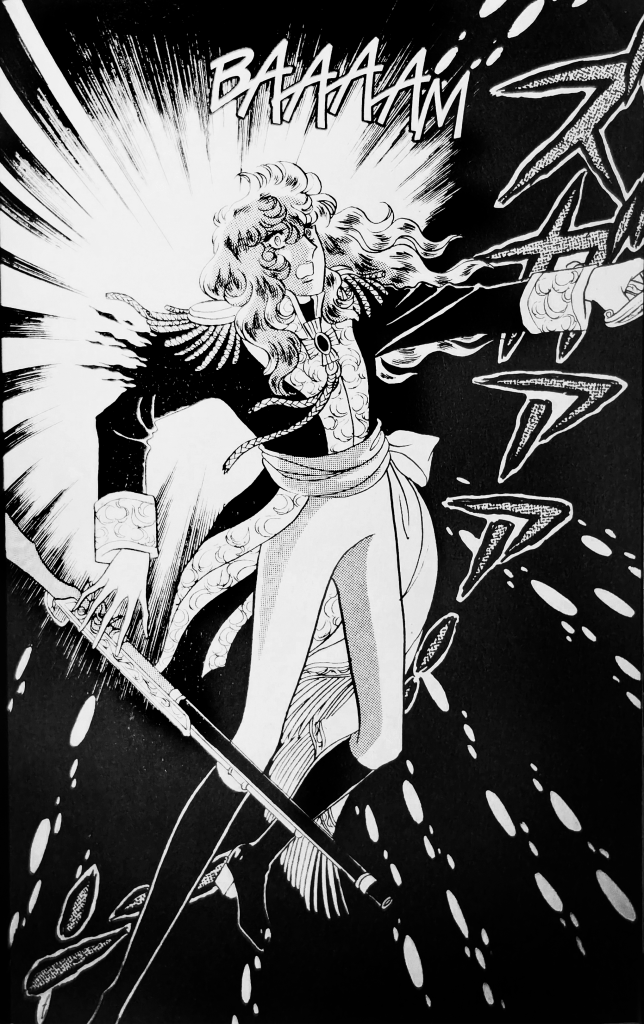
Oscar’s “most splendid death” (Buruma 119) – it takes fifteen melodramatic pages for Oscar to die – make not only the death scene but the whole shōjo manga a site of camp aesthetics (Fig. 6). Page after page, Oscar’s androgynous body, flowing hair and beautiful uniform can be admired from all angles, while her pain-stricken face moves Rosalie to tears. Rosalie is not the only one despairing; many shōjo readers are in tears at this point. Indeed, as Takahashi stresses, the shōjo manga’s style lends itself to the expression of intensely felt moments, “allowing the reader the freedom to pause and fully experience the emotions of the characters” (Takahashi 134). Not the historical events, but the way the characters feel about them are foregrounded in The Rose of Versailles, continuously pushing the limits of melodramatic intensity further.
The incredible success of The Rose of Versailles – 12 million copies were sold in Japan – caused a boom in the study of French and holidays in Versailles. The manga was adapted into a Japanese television anime series in the 1970s and, as Lady Oscar, was turned into a feature film by Jacques Demy in 1979. A musical version continues to be staged by the Takarazuka Revue and, in 2025, Ai Yoshimura’s anime film The Rose of Versailles was released. Well received, nationally and internationally, Oscar’s legacy can be felt in other manga and anime, such as Sailor Moon (1991-1997) and Revolutionary Girl Utena (1996-1998), where women characters in uniform save the world and, as Piatti-Farnell reminds us, do not shy away from openly expressing their queer desires (Piatti-Farnell 453). As forerunner of the yuri manga or Girl Love genre (GL) of the 2000s, with its open depiction of female-to-female romantic or erotic relationships, it contributed to the creation of a space, where young girls not only consumed gender non-conformism and queer desire but also acted on it. Fan letters in shōjo and yuri manga magazines have allowed like-minded female readers to interact and express their feelings about same sex desire, creating, in Kazumi Nagaike’s view, a lesbian continuum as Adrienne Rich envisioned it in the 1980s: a female-oriented community where a lesbian experience is not made invisible by compulsory heterosexuality anymore. Shōjo manga fan culture has gone global and demonstrates that despite Oscar’s very bounded transgressiveness, many readers of The Rose of Versailles have crossed gendered and sexual lines.
BIBLIOGRAPHY
Ian Buruma, A Japanese Mirror: Heroes and Villains of Japanese Culture, (Atlantic Books, 2012).
Judith Butler, Bodies That Matter: On the Discursive Limits of Sex, (Routledge, 2011).
Anne E. Duggan, Queer Enchantments: Gender, Sexuality, and Class in the Fairy-Tale Cinema of Jacques Demy, (Wayne Sate UP, 2000).
Anne E. Duggan, “The Revolutionary Undoing of the Maiden Warrior in Ryoko Ikeda’s Rose of Versailles and Jacques Demy’s Lady Oscar,” Marvels & Tales 27 (2013), 34-51.
Moto Hagio, The Heart of Thomas, (Fantagraphics Books, 2012).
Ryoko Ikeda, La Rose de Versailles, (Vol. 1-2, Kana, 2024).
Shizuko Koyama, Ryōsai Kenbo: The Educational Ideal of ‘Good Wife, Wise Mother’ in Modern Japan, (BRILL, 2013).
Midori Matsui, “Little Girls were Little Boys: Displaced Femininity in the Representation of Homosexuality in Japanese Girls’ Comics,” Feminism and the Politics of Difference, ed. Sneja Gunew and Anna Yeatman. (Allen & Unwin, 1993), 177-195.
Mark McLelland, Male Homosexuality in Modern Japan: Cultural Myths and Social Realities, (Curzon Press, 2000).
Mark McLelland, “Living More ‘Like Oneself’: Transgender Identities and Sexualities in Japan: Transgender Identities and Sexualities in Japan,” Journal of Bisexuality, (2003).
Mark McLelland et al., Boys Love Manga and Beyond: History, Culture, and Community in Japan, (Mississippi University Press, 2015).
Kazumi Nagaike, “The Sexual and Textual Politics of Japanese Lesbian Comics: Reading Romantic and Erotic Yuri Narratives,” Electronic Journal of Contemporary Japanese Studies, (2010).
Lorna Piatti-Farnell, “An Age of Sparkle and Drama: Exploring Gender Identities and Cultural Narratives in 1970s Shōjo Manga,” in The Routledge Companion to Gender and Sexuality in Comic Book Studies, ed. Frederick Luis Aldama (Routledge, 2021).
Adrienne Rich, “Compulsory Heterosexuality and Lesbian Existence,” Signs, 4 (Summer 1980) , 631-660.
Jennifer Robertson, Takarazuka: Sexual Politics and Popular Culture in Modern Japan, (California University Press, 2008).
Deborah Shamoon, “Situating the Shōjo in Shōjo Manga: Teenage Girls, Romance Comics, and Contemporary Japanese Culture,” in Japanese Visual Culture: Explorations in the World of Manga and Anime, ed. Mark W. Macwilliams (Taylor & Francis Group, 2008), 137-154.
Deborah Shamoon, Passionate Friendship: The Aesthetics of Girl’s Culture in Japan, (University of Hawaii Press, 2012).
Susan Sontag, “Notes on ‘Camp’,” in Camp: Queer Aesthetics and the Performing Subject: A Reader, ed. Fabio Cleto (Edinburgh University Press, 1999), 53-65.
Mizuko Takahashi, “Opening the Closed World of Shōjo Manga,” in Japanese Visual Culture: Explorations in the World of Manga and Anime ed. Mark W. Macwilliam (Taylor & Francis Group, 2008), 114-136.
Zoe Taylor, “Girls’ World: The ‘Fabulous Year 24 Group’ & The Shōjo Manga Revolution,” The Illustration Report 33 (2016), 34-42.
Osamu Tezuka, Princess Knight, ( Kodansha, 2022).
CHRISTINA PARTE is lecturer at the School of European Languages, Culture and Society at UCL. Her research interests are gender studies, visual culture and border studies.
***
Edited by MARTHE LISSON
Proofreading by EYLUL BOMBACI
Lead image: Collage © Think Pieces
Pictures in the text are pages from Ryoko Ikeda, La Rose de Versailles, Vol. 1-2. Kana, 2024.
Categories
2 thoughts on “The Roses of Versailles: Lady Oscar – Shōjo Warrior at the Crossroads of S Relationships and Queer Desire” Leave a comment ›