The Roses of Versailles: Queer and Feminist Paladin, and Enemy of the Right

MINI SERIES: THE ROSES OF VERSAILLES
Queer and Feminist Paladin, and Enemy of the Right:
Lady Oscar in Italy Today
by Frances Clemente
20 June 2025
This essay is the second instalment of a three-part series that approaches Lady Oscar, the main protagonist in Riyoko Ikeda’s manga The Rose of Versailles, from different perspectives. Following the introduction by Patrick Bray and Christina Parte’s take on the tradition of the shōjo manga, Frances Clemente charts the intriguing ways in which Lady Oscar has moved from a feminist queer icon on television to become a lively character at the heart of contemporary Italian debates about gender, family, and childhood. Characters from the animated world, Clemente shows, can be consequential figures and emotive points of reference in the political sphere too.
On 3 September 2020, during the political campaign for Italy’s local and regional elections, the city of Caserta was covered in a series of election posters that asked Italian citizens to vote for the “Animated Party with Orazio President”1. One of those posters portrayed Oscar, the heroine of Riyoko Ikeda’s manga The Rose of Versailles, in the white uniform of commander of the Royal Guards of Queen Marie Antoinette. Next to her were the words “Genitore 1 Genitore 2” (“Parent 1 Parent 2”). [See this article in the Corriere della Sera for images]. The expression “Genitore 1 Genitore 2” has been at the centre of Italian political debates in recent years after a woman, in 2013, proposed to replace the words “father” and “mother” with “parent 1” and “parent 2” in Venetian schools to avoid discrimination against children with parents of the same sex or with single parents. From then onwards this expression has been the subject of numerous distortions, manipulations, and deceptions reminiscent of a Pirandellian story2. It has become the focus of political campaigns of far-right politicians, including the secretary of the Lega, Matteo Salvini, as well as the secretary of Fratelli d’Italia and current Prime Minister Giorgia Meloni. During a demonstration of the centre-right in Rome on 19 October 2019. Meloni asserted her anti-LGBTQIA+ values proclaiming:
They want us to be Parent 1, Parent 2, LGBT gender, Citizens X, codes. But we are not codes, we are people and we will defend our identity. I am Giorgia, I am a woman, I am a mother, I am Italian, I am Christian. You will not take that away from me! You will not take that away from me!3
By satirically mocking Italian far-right politics and its discriminatory convictions on gender identity and sexuality, the poster in Caserta testifies not only to the enormous success the heroine of the Japanese manga is having in Italy to this day but also to the distinctively political responses her figure has occasioned in this country. This piece sheds light on the power fictional characters like Lady Oscar can have; how they can influence not only individual experiences but also the collective political life of a country.
From The Rose of Versailles to Lady Oscar
Written by Japanese artist Riyoko Ikeda, the manga Berusaiyu no bara or The Rose of Versailles first appeared between 1972 and 1973 and was then adapted as an anime TV series in 1979. The story of Oscar, who was born as a woman, raised as a man, and acts as a man, as well as the ambiguous relationships she entertains with other characters against the backdrop of the impending French Revolution, presents a narrative which challenges normative expectations around gender roles and sexuality. Ikeda’s work was influenced by the deep social changes occurring in Japan at the time, which were affected by the worldwide 1968 protest movement that advocated for, among other things, a redefinition of women’s political, social, economic, and sexual roles. Mirroring these changes in The Rose of Versailles, Ikeda’s creation participated in the transformation of the genre of the shōjo manga, giving rise to more complex narratives which addressed questions of sexuality, gender, and politics and revealed an innovative attention to female characters. While, on the one hand, Susanna Scrivo sees the identification of Oscar with queer, feminist models as a trap – Oscar’s anti-conventional gender charge seems to disappear the moment she surrenders to the love of her male lover André4 – Ikeda’s manga was, on the other hand and nevertheless, revolutionary at the time and anticipated discussions that would be at the core of later feminist and queer movements.
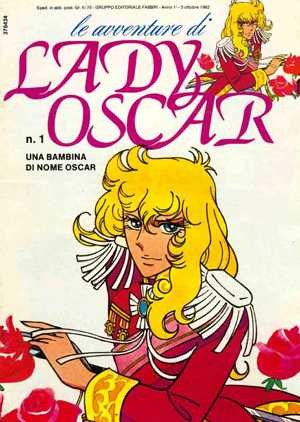
Ikeda’s heroine first reached Italy’s shores in 1982, when Le avventure di Lady Oscar was published by Fabbri Editore as a supplement in another shōjo manga, Candy Candy. In the same year, it was released as the anime Lady Oscar on the new commercial TV channel Italia 1, which was and is part of the network Mediaset, owned by Silvio Berlusconi. In 1983, Fabbri Editore also published a novel entitled Il romanzo di Lady Oscar and its sequel Il ritorno di Lady Oscar; the latter creating a new narrative for Oscar, who comes back to life after dying in the storming of the Bastille. While there have been numerous editions of the manga in the following years, the success of Lady Oscar’s story in Italy, as pointed out by Manuela Di Franco and Lorenzo Di Paola, has always been linked to the anime rather than the manga5. This is also due to the prominent role Italy played in the reception and broadcasting of Japanese anime, whereby from the late 1970s a wave of anime invaded Italian television programming to the point that, as Marco Pellitteri remarks, Italy became the first western country for a number of anime to premier6. After 1982, Lady Oscar was re-released several times across the 1990s and then the early 2000s. Its success was reflected in the decision of Mediaset to broadcast Jacque Demy’s film version of the anime on Christmas Eve, 25 December 1982 (Oscar’s birthday).
The Italian release of the anime was subjected to censorship that aimed to expunge elements which were considered troubling and offensive for the Italian audience7. Scenes that carried explicit sexual connotations were removed, including the love scenes between Marie Antoinette and Prince Fersen and between Oscar and André. Dialogues were reworked to eliminate any mention of prostitutes and homosexuality. The explicit fascination of many of the women at Versailles with Oscar, including Antoinette’s, was attenuated. Some interesting linguistic choices were made, too. Both, the Italian anime and manga, were stripped of the original Japanese title which means “The Roses of Versailles.” Instead, the character of Oscar was singled out, explicitly qualifying Oscar as a “lady” and thus as female. Compared to the Italian translation of the manga, which respected the original gender ambiguity of the protagonist, the Italian anime version pushed towards a more stereotypical representation through its insistent depiction of Oscar as a woman who dresses in masculine clothes, so that, as pointed out by Di Franco and Di Paola, “any trace of queerness disappears”8.
Lady Oscar as a model of freedom for feminist and queer activism
Notwithstanding the changes made in the Italian adaptation of the anime, the impact Lady Oscar had on Italian audiences, due to her ambiguous gender status, was significant. According to a questionnaire conducted by Di Franco and Di Paola, among the elements that most attracted Italians was Oscar’s gender ambiguity. The anime offered generations of Italian children born between 1979 and the 2000s different ways of thinking about gender identity, ultimately providing, in Di Franco and Di Paola’s words, “important lessons” that “rarely found space in traditional school curricula”9. This was especially true for those that identified or would later identify as queer. For them, Lady Oscar represented a model of freedom as well as gender and sexual self-determination unseen on TV or in everyday life.
The reclamation of Oscar as a queer and feminist icon has marked a generation of activists that still look at Lady Oscar as a queer, feminist paladin today. In a 2017 article in Falla, the journal of the historic Cassero LGBTQAI+ centre in Bologna, Lady Oscar is referred to as “our holiness” and “as a gender fluid emblem” who will always live “in the hearts of entire generations”10. On 14 July 2021, the anniversary of Lady Oscar’s death, the transfeminist collective Non una di meno in Palermo celebrated Ikeda’s heroine on their Facebook profile, portraying her as “the super blonde androgynous warrior, symbol of an emancipation conquered to the sound of duels with her proud and indomitable bearing, [who] subverted the stereotypical female image of the cartoons of the past”11. More recently, Lady Oscar was the subject of a queer stand-up comedy performed by transfeminist activist Milo Serraglia on Radio Sonar as part of the podcast Queerazionario12. In the first episode, streamed on 15 December 2023, Serraglia explains that the title of the episode, then kept for the entire series, Non volevo essere Lady Oscar, comes from his experience during his high school years when, due to the difficulties of coming out as trans, he presented himself as lesbian and was immediately associated with Lady Oscar. However, he never wanted to be Lady Oscar but Hans Axel von Fersen, the Swedish count both Marie Antoinette and Oscar fall in love with. Ikeda’s work allowed Serraglia to identify his queer trans self.
Lady Oscar enters the Italian political debate
While the figure of Lady Oscar has been present in Italian feminist and queer culture and activism for a long time, it did not enter mainstream Italian politics until a few years ago, when the rise of far-right parties and the widening of their consensus through discriminatory campaigns against LGBTQIA+ people paved the way for a comeback of Lady Oscar in Italian public discourse with openly political implications.
In July 2021, during discussions around the approval of an anti-homotransphobic bill proposed by democratic senator Alessandro Zan, Barbara Masini, senator of right-wing party Forza Italia and in favour of the law, came out and talked about her homosexuality in a speech to the Senate. Shortly after, she conceded in an interview for the Corriere della Sera: “I’m glad I can be a role model. In my day there were no role models. For us lesbians born in the seventies there was only Lady Oscar […] a great animated woman who was very useful to me as a child”13. Despite members of her own party being against the anti-homotransphobic bill, Masini not only spoke out in favour of it, but also used episodes of her own personal life, to promote awareness around non-hetero-cis sexualities and identities and the importance of protecting them from discrimination.
In December 2022, Cristina D’Avena, the renowned Italian singer of anime theme songs, sang at the celebrations for the 10th anniversary of Fratelli d’Italia. Her participation aroused controversy among her fans, since she was looked upon as a gay icon who had often sung at Italian Prides and LGBTQIA+ events. While on stage, however, D’Avena surprised Fratelli d’Italia’s members by performing Lady Oscar’s theme song, wearing a rainbow-coloured skirt and declaring: “You know the story of Lady Oscar: it is a hymn to love, to universal love, without distinctions. And that is why I must sing it with you to express everything, because love is everything”14. D’Avena used Lady Oscar to promote her LGBTQIA+-friendly views among declared detractors of the LGBTQIA+ community, responding to those who accused her of betrayal by participating in Fratelli d’Italia’s celebrations and reiterating her allegiance to the cause. In February 2023, when Elly Schlein won the primary elections and became leader of the Democratic Party, she was portrayed by journalist Antonio Grassi as “the democratic party’s Lady Oscar”15.
In March 2023, there were ongoing parliamentarian discussions about the possibility of including the children of gay couples, born abroad through ART procedures or surrogacy, on the Italian civil registry. During an appearance on the TV programme Otto e mezzo Michela di Biase of the Democratic Party, criticised the conservative and homophobic position of Italo Bocchino, an ex-member of the right-wing party Alleanza Nazionale who was fiercely against the right to register these children. She said: “I was born in 1980. When I was a little girl there was a cartoon called Lady Oscar […]. Lady Oscar was born as a girl but her dad always considered and treated her as a boy. I assure you that I have never had any kind of problem recognising myself in the gender I was born into”16. De Biase’s comment resonds to the discussion on the ascribing of children to the so-called “teoria gender” or “gender agenda”, which right-wing politicians and figures such as Bocchino proclaim to be a rhetorical tool used by LGBTQIA+ activists to promote gender propaganda and cultural products (including books and cartoons) that negate the reality of biologic differences and confuse children around their sexual identities. Finally, in September 2024, in an interview with Radio Rock, Francesca Pascale, ex-partner of Silvio Berlusconi, ex-member of Forza Italia, and now a fierce advocate for LGBTQIA+ civil rights, sang the theme song of Lady Oscar and dedicated it to Giorgia Meloni, ironically claiming that Meloni was just like Lady Oscar and that she would understand it when she would finally make her “real LGBTQ+ turn”17. Once again, the figure of Lady Oscar is evoked in relation to Italian politics and politicians’ views on LGBTQAI+ rights.
Conclusion
Characters of other animated series have been at the centre of Italian political debates for similar reasons to those which have brought Lady Oscar into political vogue. In March 2018, Meloni reacted to Disney’s proposal to make Elsa from Frozen a lesbian with a social media post which stated “ENOUGH! We are fed up with you! Hands off the children”18. In September 2022, Fratelli d’Italia railed against the appearance of a family of polar bears with two mothers in an episode of the cartoon Peppa Pig, which was broadcasted in the UK, and demanded a ban on the episode in Italy. Federico Mollicone, the party’s spokesperson for culture, deemed the episode as “unacceptable”, claiming that “[o]nce again the politically correct has struck, at the expense of our children”19. Echoing Fratelli d’Italia’s indignation, the Pro Vita & Family Onlus even launched an online petition entitled “No to ‘gay cartoons’ for children on the RAI”, to prevent “gay cartoons” from being shown on the Italian state broadcaster20. Lady Oscar’s entrance into the Italian mainstream political arena, along with other cartoon figures such as Elsa or Peppa Pig, must be understood in the context of the incessant attention far right parties have been devoting to children and, more specifically, to their shielding from allegedly concerning and troubling human experiences and relationships. It is striking that, compared to the 1980s when concerns around cartoons with overly erotic connotations or non-normative gender and sexual expressions such as Lady Oscar were mostly voiced in the private space, prime ministers, leaders of the opposition, senators and deputies today express their political views through the figures of anime and cartoons.
From her first appearance on Italian television as a model of freedom and an inspiration to Italian children, to the reclamation of her feminist queer charge on behalf of feminist and LGBTQI+ activists, to her debut in the Italian mainstream political arena in the last decade, Lady Oscar provides a significant example of how characters of the animated world can deeply affect a community, demonstrate the power of media products and the extent to which their narrations are absorbed by a process of negotiation and renegotiation of meaning that can play a significant role in both the personal and collective political spheres.
FRANCES CLEMENTE is a Postdoctoral Researcher and Lecturer in Italian at the University of Oxford. Her research focuses on the notions of alterity and otherness, and how they relate to normative patterns of thinking and behaving, drawing on methodologies taken from cultural studies, literary criticism, psychoanalysis, (eco)feminist and queer criticism.
***
Edited by MARTHE LISSON
Standfirst and Proofreading by NICHOLAS LACKENBY
Lead image: Collage © Think Pieces
Categories