Of Media, Multiplicities and Monsters

OTHER CITIES: LONDON MEMORYSCAPE
Of Media, Multiplicities and Monsters:
Mapping European Literary London
by Uta Staiger
21 February 2025
What is the city and how do we map it? Its multiplicities, polyphony and chaos? Not in cartographic terms, from above, but from the ground up – walking it, thinking it, writing it? Like the many European writers, artists, philosophers who came to London over the centuries and wrote about it, who wrote themselves into the city’s memory and who, in return, were shaped (written upon?) by the city. Who makes the city? Uta Staiger critically and playfully maps an answer to these questions, wandering and meandering, physically and philosophically, taking us with her.
Stop. Listen.
I am throwing you in at the deep end. As spoken text fragments mingle and overlap with environmental sounds, some words recognisable in languages we speak, some most definitely not. This soundscape echoes, perhaps, the hustle and bustle of the metropolitan city. Does it? It echoes what breezes past us as we walk, weaving in and out of snippets of conversation, temporarily brushing against anonymous others on pavements or in tube carriages – sometimes, though accidentally, involving physical contact, sometimes, though accidentally indeed, involving eye contact. Great cities, a famous definition goes, “differ from towns and suburbs in basic ways, and one of these is that cities are, by definition, full of strangers”1.

Echo, I should note, is an apt term. Echoic memory after all is what we call the type of sensory memory that registers and temporarily stores auditory stimuli – fleetingly, no more than 3-4 seconds – until this information is processed and understood2. As such, echoic memory may be urban memory par excellence: experienced by individual passers-by, pedestrians, commuters, these traces of sensory information are held for the briefest of moments, and just as quickly they degrade – and are lost again.
Those passers-by, incidentally, don’t just move in the city. By walking, they make the city, compose it. At least this is how French critic Michel de Certeau phrased it: the walkers “follow the cursives and strokes of an urban ‘text’ they write”3. However, and this is important, they write it without reading. His is the vision of a street-level, disconnected, enchanting if opaque experience of the city; a metaphorical city which, de Certeau says, escapes visibility, eludes legibility. Its poetry and strangeness reside precisely in the unpredictability and incomprehensibility of movement and temporary encounter performed, if un-self-aware, by the multitude of passers-by.
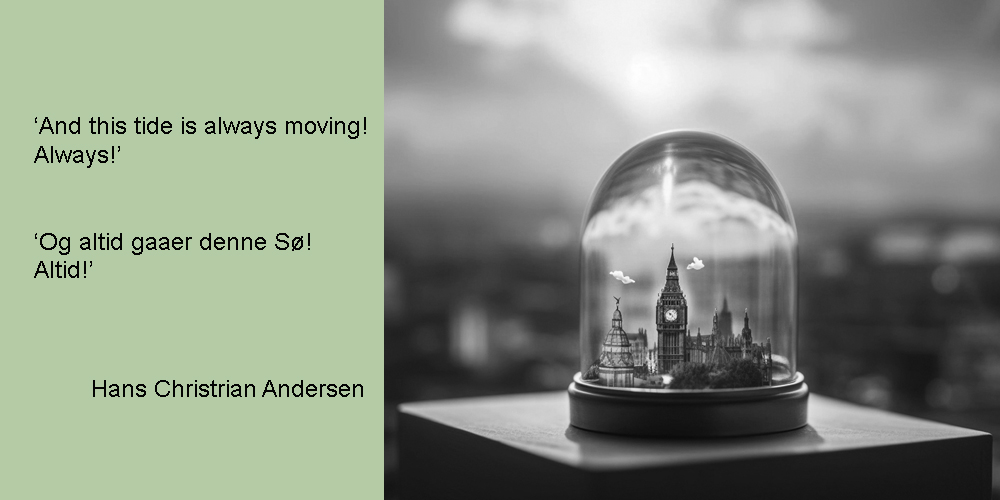
But what if these ‘ordinary practitioners of the city’ are writers? Writers who are not only writing the city by transversing it, but writing about the city in which they move or reside – and which they, therefore, very much note? And what if these writers, writing about the city, were not only strangers in the Jane Jacobs sense, quoted above – but doubly alien by virtue of being foreigners: visitors, guests, refugees, tourists, students, migrant workers? When the rhetoric of space, the illegible urban poem de Certeau had in mind, slips not just into written text, but into a language that is, literally, out of place?

Because this is the actual source of the soundscape that opened this article: a polyphonic piece recording readings of texts by novelists, poets, visual artists, musicians, philosophers and scientists from across Europe who have come to London throughout centuries. Who, speaking over twenty different languages, write in them about London.

For centuries, London has been re-imagined and rewritten in literature, memoirs, letters, lyrics, diaries, articles and poetry: English, European, otherwise. This is all but surprising. London is the capital, literally and figuratively, of one of Europe’s most urbanised societies. Home to almost 9 million inhabitants today – a good million more than just a decade ago, 8 million more than in the early nineteenth century – it receives 20 million visitors annually. The largest city in Europe, it is also among its most diverse. 41% of today’s Londoners were born outside of the UK (Trust for London, 2024).
Room, depth and variety there surely is enough. London has been a linchpin of empire, industrialisation, parliamentarisation, book production; sprawling technologies from subterranean transport to digital economy. But it is London’s imaginary power that is likely more important still. The idea of London is not only “central to the self-image of the British people” – but it also “deeply penetrates the rest of the world’s view of British life”.4
You’re beautiful! Stop!
(There was a little place in a pretty row / Where we mostly did not go […] / Stop! You’re beautiful! Nick Cave chants from the stage of an inner-city music venue in late 2024).
Echoic memory, so rapid in its genesis and decay, may be reminiscent of the urban experience; but the way we most frequently recall, and thus ultimately understand, the built environment, is by emplacing our own story, our own experiences within it. This form of memory is episodic: a recollection of autobiographical events, independent of, but often working alongside our context-independent factual knowledge5, it tends to come with a specific temporal and spatial context.
Indeed, “it is the stabilizing persistence of place as a container of experiences that contributes so powerfully to its intrinsic memorability … memory is naturally place-oriented or at least place-supported.”6
And of course, memory of the episodic kind does not only give us pause, make us stop. It also lends itself inherently to plot, to narrative (or, as the case may be, incantation). We turn recollection into story.
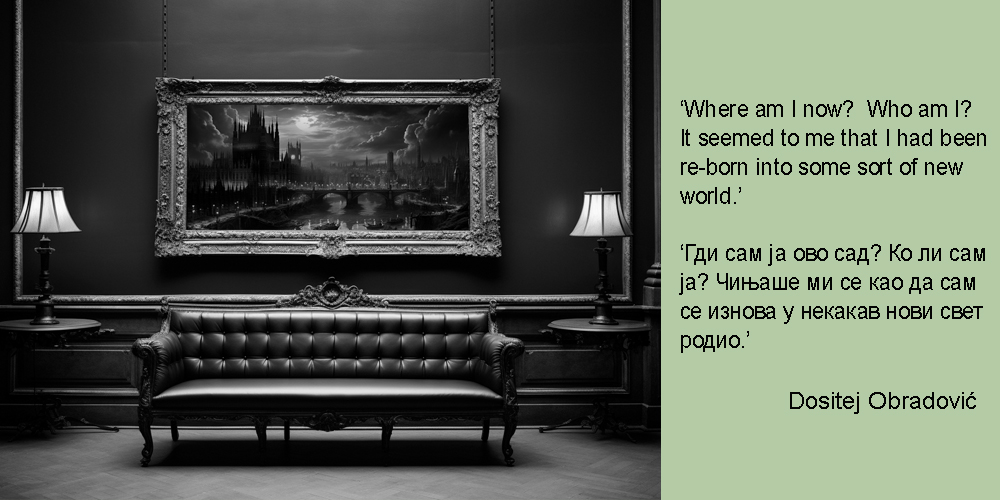
Turning experience into story involves an ordering, usually a temporal and causal interpretation of events, often identifying, or presuming, motivations that bind these events and experiences into a coherent whole.
Literary and non-fiction texts, in turn, are made of narrative and thus of order – though not necessarily causal, consistent or chronological. If literature is, inter alia, a form of mapping the world7, texts about place also position the narrative self in the urban environment, situating, negotiating, and making sense of its distinct spaces.
In fact, the soundscape we started this piece with, apparently so fragmentary and immediate, is itself only a by-product of a project that is in principle anything but. A European literary map of London, it seeks to uncover and chart the literary traces left by writers, artists and intellectuals who have come to London across the centuries. If literature maps the world, we are looking at a map of mappings.
Now, maps are perforce abstracted from the messy, unselfconscious poetry of the street-level. Transforming its complexity into grid, cartographers and planners, to speak with de Certeau again, make the city legible, knowable. As they look down from up high, they are engrossed in the fiction of omniscience. A “solar Eye” or “God’s regard”, their view of the city is an “exaltation of a scopic or a gnostic drive”8.
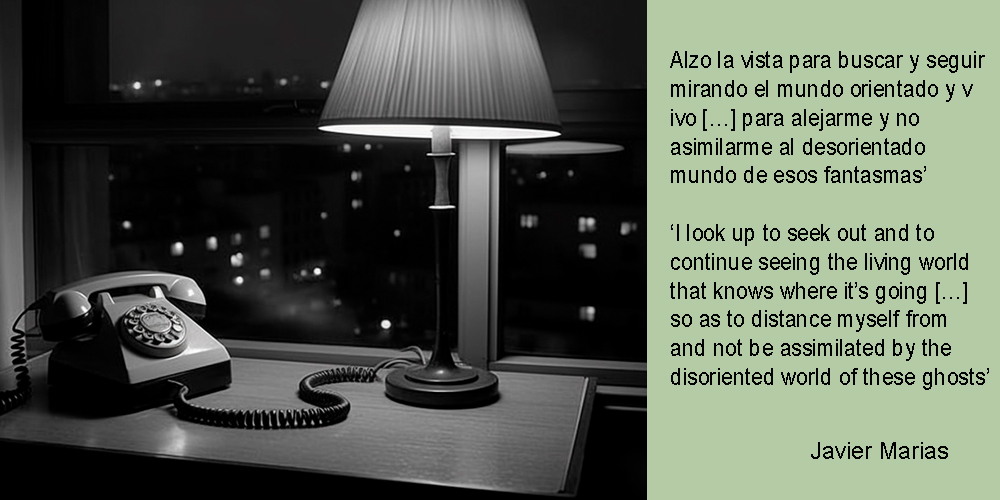
De Certeau, of course, wants us to focus on the hubris of such an all-seeing, all-knowing representation. And, yes, maps do come with complex baggage. Lest we forget, as critical cartography reminds us, “maps redescribe the world … in terms of relations of power and cultural practices, preferences and
priorities”9. They are far from neutral, factual transmitters of information on the world. To create and to read a map means enquiring into its omissions, the inevitable biases that have – historically and
today – shaped its representation of the world10.
In addition, with printed maps folding and moving online, should we not also entertain a healthy degree of technoscepticism? To a great extent, online geospatial mapping has disconnected us from actual spatial awareness, not least by stymying our capacity to navigate the city unaided, or, perhaps even more importantly, drastically reducing our chances of losing our way. It has essentially transformed the once inevitably immersive experience and negotiation of the chaos-cum-order of the city.
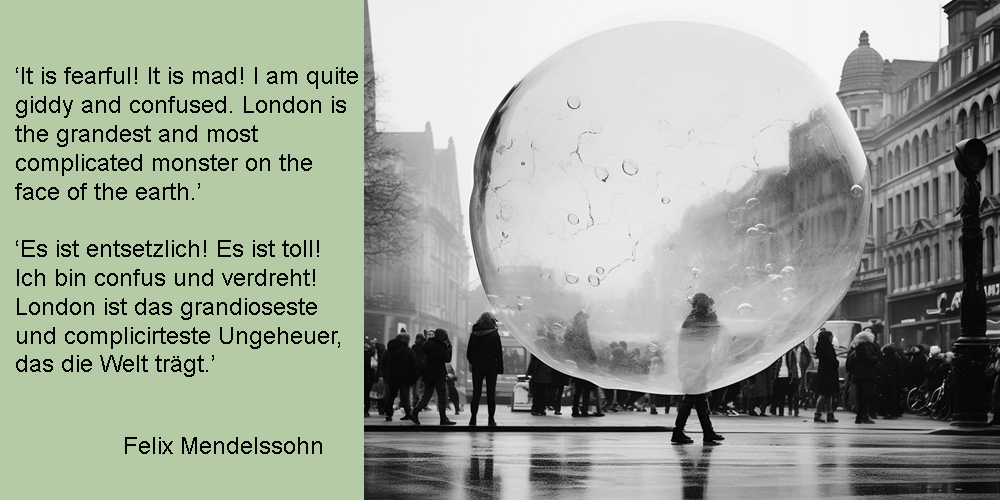
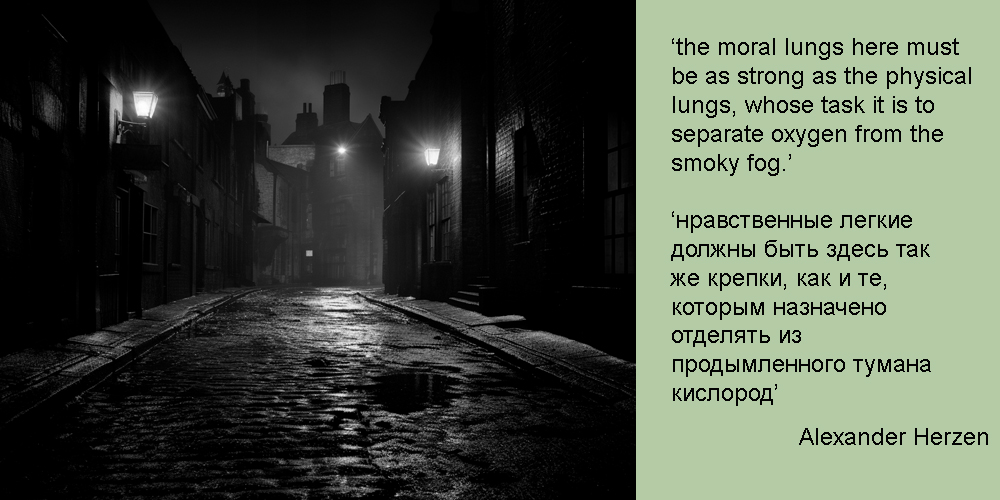
While Mendelssohn’s London-as-monster echoes plenty of British writers engaging with their capital – Daniel Defoe too called it “monstrous”11 – he emanates less anxiety than excitement. Mendelssohn’s description of the Ungeheuer (monster) borders on the ungeheuerlich (outrageous). How do you freeze the giddy, dazzling, polyphonic into a rationalised whole, taming the beast? (You’re beautiful! Stop!) Or should you even? How do you map the monstrous without losing sight of the Ungeheuerlichkeit of the endeavour?
Plasticity
Maps, a possible retort goes, may work to consolidate a certain view – but they can also make us pause and question what we see. Maps can become an entryway to seeing things otherwise12. And is this not the same with the city itself and its effect on the city-dweller? The modern city may indeed be part phantasmagorical spectacle (luring us to overlook its historical conditions), and part blunting mechanism (dulling our senses with its constant sensory onslaught), as Walter Benjamin and Georg Simmel respectively posited. But it also has the quite extraordinary capacity to irritate and demystify: to provoke recognition, reflection, and recollection.

In fact, it was Benjamin’s urban enquiry-as-method in the Parisian Arcades Project that saw promise in unusual constellations of objects13. In unsuspected places, in fragments or remnants, we might find ourselves face to face with the past, which might reveal to us both material reality and ideological representations over time. Or we might experience quasi-Proustian moments of mémoire involontaire – the spontaneous, inadvertent surge of recollection.
Can we put the zoom function of geospatial digital cartography, which hurls us from the map’s gnostic solar eye to the criss-crossing texts down below, in the service of such a revelatory reading of London?
There is certainly much critical charm in locating – or stumbling across – literary stories within the physical environments they describe, and which we might, or indeed might not, recognise. The effect of the coincidental that comes with such discoveries, and their fortuitous connections across a map, can be illuminating. Whether scrolling the virtual space of online mapping or dipping in and out of the physical space of an exhibition, the joy of such maps is that browsers or passers-by can read London – and respond to London – haphazardly, crosswise.
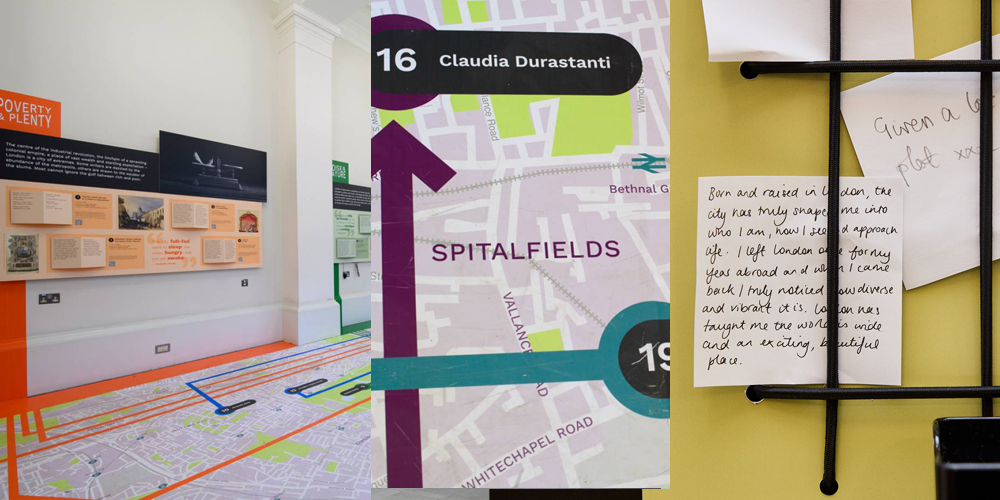
Trespassing vinyl floor maps, losing themselves in textual excerpts, jotting down their own response, the readers/viewers create their own cognitive pathways, following or questioning the six cross-cutting themes, each made up of conceptual pairs, that playfully disrupt any chronological or cardinal point-led grid formation. (“Are you really making a map if you’re not going anywhere?”14)
London has had a pervasive, even if internally no doubt contradictory influence on the work and the life of so many of the writers who have come here from across Europe over the years. And London wouldn’t quite be the same had it not hosted these writers, and been the object of their many testimonies and misreadings, portrayals and caricatures, disapprovals and praises. The encounter between writer-city-reader, between literature in the city and the city in literature, might well be mutually transformative.
“Cities … are plastic by nature. We mould them in our images: they, in their turn, shape us by the resistance they offer when we try and impose a personal form on them”15.
Mapping these intersecting, literal and figurative geographies, offers us the pleasure of strolling, flaneur-like, among them. You never know just what you may find.
[Stop? Stop!]
The European Literary Map of London was co-created with Lucy Shackleton (European Institute), Tim Beasley-Murray (Arts and Sciences), Duncan Hay (Centre for Applied Spatial Analysis), and Olivia Scher (European Institute). This text could not have been written without their creative, conceptual and technological work over several years. All blunders, gaps and non-sequiturs, by contrast, are exclusively mine.
UTA STAIGER is Associate Professor of European Studies and Director of the European Institute, UCL.
***
Edited by ZOLTÁN KÉKESI & MARTHE LISSON
Proofreading by ALICE-ANNE PSALTIS
Black and white images throughout the text: Miguel Navarro (www.miguelnavarro.net)
Lead image by Nick Page via Unsplash.
Categories
2 thoughts on “Of Media, Multiplicities and Monsters” Leave a comment ›