Buried in Plain Sight
OTHER CITIES: LONDON MEMORYSCAPE
Buried in Plain Sight: Pandemic, Poverty, and Slavery
at St Giles-in-the-Fields
by Margaret Comer
9 January 2025
What do we look at when we look at old monuments, like churches, and what do we see? As tourists, we tend to admire the architecture: delicate spires, monumental domes, pompous altars and colourful windows. We look at plaques and graves, naturally of the famous only – the Newtons and Turners of this world. But what if we tried to look beyond what is visible, opened ourselves to the unknown? We might see that the uneventful-looking churchyard with a playground on its edge was, centuries ago, home to a gallows. The unknown name on a plaque in a London church might turn out to be the ‘first proprietor’ of your home state in the US. Margaret Comer visited St Giles-in-the-Fields and scratched on the surface of the visible to discover so much that is buried in plain sight.
London’s Soho neighbourhood is inextricably linked with arts, entertainment, and death. A popular podcast, Murder Mile, offers 275 episodes, each covering at least one murder that took place in or around Soho. But the district’s violent history stretches centuries beyond its nineteenth-century reputation for poverty, violence, and drunkenness and includes legacies of massive state-sanctioned killing, disease, and social exclusion. Much of this history is buried beneath office blocks, chain coffee shops, and souvenir shops, but one particular place encapsulates this long saga of death.
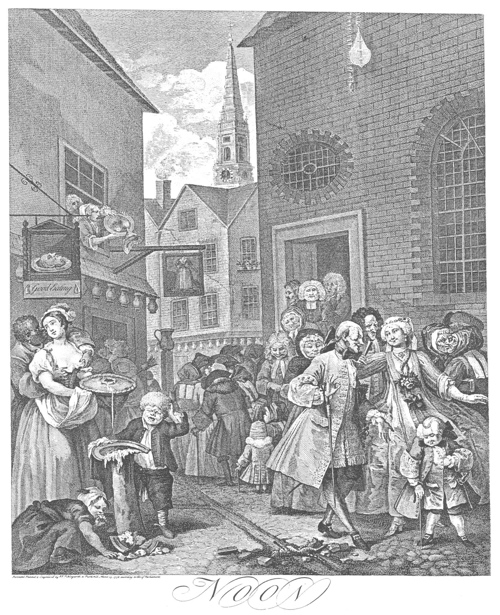
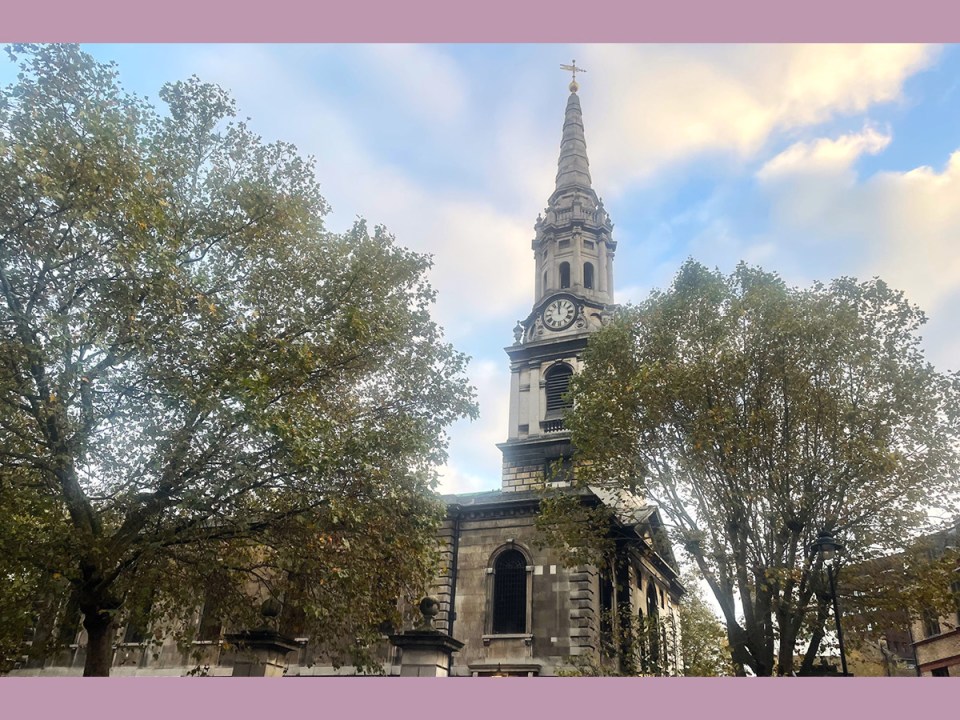
St Giles-in-the-Fields, located just south of the Tottenham Court Road Tube station, has hosted a place of worship for over 900 years. The leper hospital founded by Queen Matilda in 1101, was not only associated with disease from the very beginning, but also with the British monarchy’s foundations. Her husband, Henry I, was only the third King of England, and she herself ruled in his stead during his long absences.
Approaching from Tottenham Court Road, I walked through a series of relatively new, glass-and-metal constructions, passing grain bowl eateries, boutiques, and several chain cafés, to suddenly find the small stone church in front of me. It, too, had a small kiosk selling pastries and hot drinks out front, like many historic churches now do, in an effort to make ends meet.
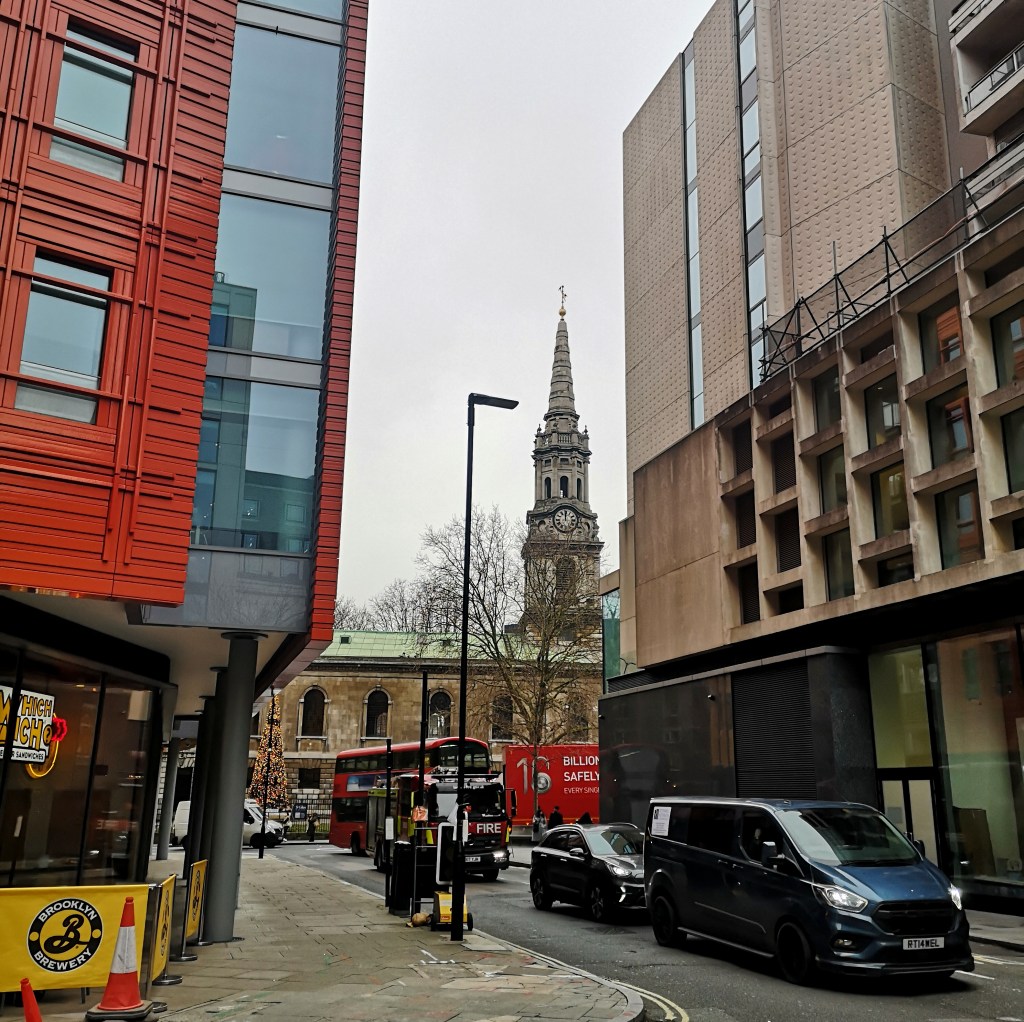
Standing in front of the gate on St Giles High Street and looking east, one gazes down Denmark Street, a short road with a storied reputation in the music industry. Several famous guitar shops still exist there, and acts including the Kinks, Elton John, and the Sex Pistols recorded music in Denmark Street studios. Tragically, in 1980, a man who had been ejected from an unlicensed nightclub at 18 Denmark Place returned and deliberately set fire to the building, murdering 37 people.
I visited on Halloween, and the day was obligingly grey, overcast, and chilly. The churchyard was lively, with people sitting on benches chatting, eating, and, in one case, tossing food to an enormous flock of pigeons. Inside, blue text panels briefly explain the church and surrounding area’s long history. For centuries, St Giles formed its own parish and recognised neighbourhood, though its independent identity is now mostly forgotten. The text panels explain and emphasise the parish’s central role in the English Civil War, the area’s Victorian era deprivation, and the subsequent rise of the entertainment industry.
Inside the church, as the text panels and the recently published parish history1 allude, the individual memorials tend to commemorate, not only the wealthy, but several key figures in colonial expansion and exploitation. A prominent memorial plaque on the eastern wall commemorates Cecilius Calvert, the second Lord Baltimore and ‘first proprietor’ of the colony (later US state) of Maryland. Cecilius never set foot in Maryland himself, leaving that to his brother, Leonard, but the plaque, placed by then-Maryland governor Parris Glendening in 1996, commemorates “the arrival on the Potomac River of the vessels, the Ark and the Dove, with 200 colonists.”

I was born and raised in Maryland, and I was greatly surprised to see ‘Lord Baltimore’ memorialised here, not least in a way that so blithely elides the fate of the Native Americans who met the Ark and the Dove. What a strange coincidence. I knew, of course, that Maryland had been founded as a ‘haven for Catholics’ when the rest of the early colonies were decidedly, sometimes militantly, Protestant. Maryland’s early and continued religious tolerance is one of our most treasured canonical legacies. Learning that the St Giles parish was home to many Catholics during the difficult Restoration period, in which Anglicans and Catholics vied for power, often violently, suddenly made the pieces fall together in my head. I hadn’t realised that the Calvert family actually lost their ‘rights’ to the Maryland colony and only recouped them when Cecilius’s grandson converted to Anglicanism.
But, in 1663, when the Calverts were still Catholic and still in charge, the Maryland Assembly decided that enslavement was for life, and enslaved people’s children would also be enslaved. This wasn’t a foregone conclusion: in some parts of Maryland, local jurisdictions had decided that all children were born free. So, this decision began to cement slavery as a permanent, core institution of systemic violence undergirding Maryland’s economy, politics, and society. Back at St Giles, this inequity was tangibly enacted in the churchyard. Where the 2nd Lord Baltimore, just discussed, was buried lavishly in 1675, there is no marker for Thomas. Thomas, an enslaved child whom Charles Calvert, the 3rd Lord Baltimore, had brought from Maryland back to London, died in 1685 and was buried in St Giles churchyard.

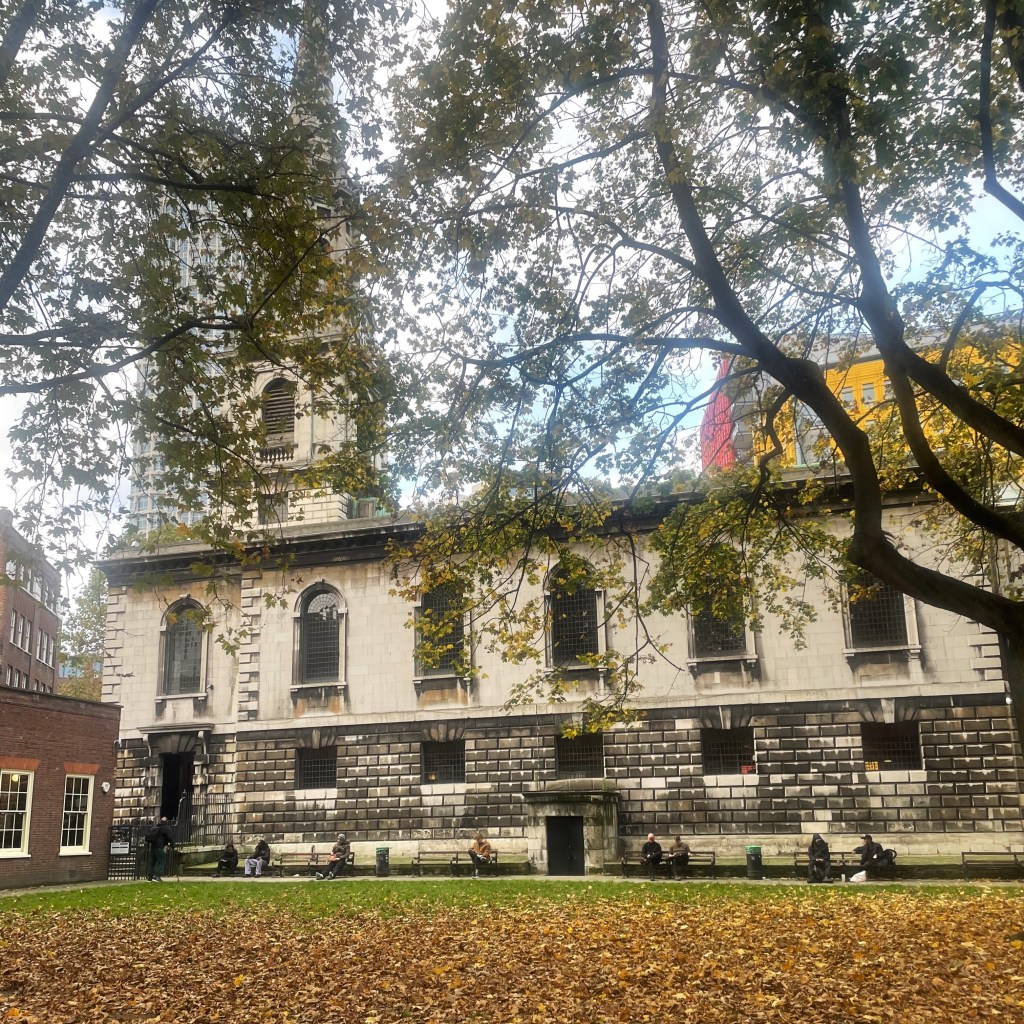
The churchyard today is a grassy area surrounded by a paved path. There is a children’s playground on the northeastern portion, and some historic gravestones line the western churchyard wall. In the northwest corner, a brick wall divides the churchyard from residential buildings behind it; the yard here has small trees and bushes. This is the historic location of the gallows.
London has a long list of infamous, historic prisons, where thousands of people could gather to watch public executions. St Giles’s churchyard itself had its gallows from the fourteenth century, and many people killed there had been convicted of religious offenses. For example, members of the Lollards, an early Christian reformist group founded by John Wycliffe, were executed there after arrest in 1414. Other Catholic rebels, including Anthony Babington, were also killed at St Giles as late as 1586. After this, many people executed at Tyburn were buried on site since the church was conveniently located nearby.
Since its beginning as a leper hospital, St Giles-in-the-Fields has been associated with disease. (Interestingly, the London School of Hygiene and Tropical Medicine still stands within St Giles’s parish boundaries.) Over the centuries, plague outbreaks in the parish killed thousands; according to the church’s text boards, 3,216 victims were buried in the churchyard during the 1665 pandemic alone.
The 1854 Soho cholera outbreak has become famous because John Snow apocryphally broke the handle off the nearby Broad Street water pump and proved the germ theory of disease; of course, as with every legend, the ‘truth’ is more complicated. But that outbreak killed at least 600 people. Over on Broad Street, a replica pump (sans pump handle) stands as a memorial to Dr Snow.
There is no plaque or memorial on the former site of the gallows, nor any visible memorialisation of the thousands of victims of infectious disease, exacerbated, especially in the nineteenth century, by poverty and exploitation at the hands of industrialism and colonialism alike. This is not, strictly speaking, unusual: in the United Kingdom, many historic graveyards lie, unmarked, under common areas.
Is this a problem, an erasure of history that cries out to be fixed? Or is it a reflection of how years pass and formerly red-hot conflicts die down to embers, then ashes? Theological contentions between Anglicanism and Catholicism persist, but it is hard to imagine open violence in Soho’s streets between its respective adherents. In a multifaith country, there is a long list of controversies that sectors of the public want the Crown to answer for before we get to questions of ‘defending the faith’.
This is not true of systemic racism. Black lives are still treated as more disposable, less ‘grievable’ (in Judith Butler’s phrasing)2 than white ones in the UK, and so the existence of the great and grand memorial to Cecilius Calvert – while, in the same place, nothing commemorates Thomas’s short life- isn’t just a matter of historic inequality and a tragic story that is firmly behind us. It reflects and encapsulates the ongoing, unresolved legacies of chattel slavery and colonialism. As some memorials to well-known but controversial figures involved in colonialism and slavery continue to be removed and recontextualised in the United Kingdom, the United States, and other places, the corollary is also key: who, then, is worthy of remembrance? Where and why should they be commemorated? In a recent Think Pieces essay, Sophie Chauhan writes about the liberatory possibilities in not only ‘felling’ statues of colonisers like James Cook, but in constructing art installations like Brook Andrew’s Jumping War Memorial, constituted of a sort of bouncy castle filled with replica skulls and symbols of Wiradjuri culture: “At the artist’s site for remembering the horrors of invasion, the settler body is toppled over and thrown off balance, forced to feel its way from the ground up”.
It is too simplistic to pronounce that removing memorials to ‘bad’ men and instead erecting ones to ‘deserving’ people will lead to an inclusive, equitable, peaceful society. There is a long list of high-flying memorial projects that have had little, or conflicted, impact on social division and inequality, despite best intentions. In Savannah, Georgia, a city whose history is inextricably entwined with the transatlantic slave trade, a group of local activists succeeded, in 2002, in placing the African-American Monument on the riverfront promenade, where many slave ships had previously docked. The statue of a loving African American family bears a graphic Maya Angelou quotation about the horrors of slave ships on its base, but, under pressure from city council members, who worried about this rhetoric’s impact in a major tourist area, Angelou added lines to the end with a more reconciliatory tone. The resulting monument, however, was criticised for downplaying slavery’s violence.
Clearly, a new plaque or statue can’t fix centuries of systemic violence on its own. Yet a memorial that is perceived to rectify a specific injustice, centring on who is remembered and mourned and who isn’t deemed ‘grievable’ enough, can be a meaningful form of symbolic reparation and repair. The next time you walk through Soho, you can wonder which of its hidden histories of violence aren’t completely consigned to the past and which of these might be meaningfully brought into the light.
MARGARET COMER is a Research Fellow at the UCL Centre for Collective Violence, Holocaust, and Genocide Studies. Her research focuses on the heritage of mass repression, memorialisation and heritagisation of the Holocaust and Soviet repression, grievability and memory, and contested memory, especially portrayals of suffering, perpetration, bystanding and victimhood.
***
Edited by ZOLTÁN KÉKESI and MARTHE LISSON
Proofreading by RASA KAMARAUSKAITE
All photographs by Margaret Comer
Categories
One thought on “Buried in Plain Sight” Leave a comment ›