Felling for Freedom
ESSAY
Felling for Freedom:
War, Abolition and the Settler Colonial Statue
by Sophie Chauhan
15 November 2024
In May 2024, Rahul Rao gave the Gender and Feminism Research Network and qUCL joint annual lecture and spoke about the ‘libidinal lives of statues’. Sophie Chauhan responded and has since developed her response into the following essay, in which she shares her reflections on the place-making of colonial statues and, equally, their felling. How their sheer presence usurps the legitimacy of the conquest and sends out the message that colonisation is ongoing. It only makes sense then – does it not? – to tear down those statues to make place for the future. Where there is no statue high on its pedestal, the sky is the limit to imagine a future when the colony will have fallen.
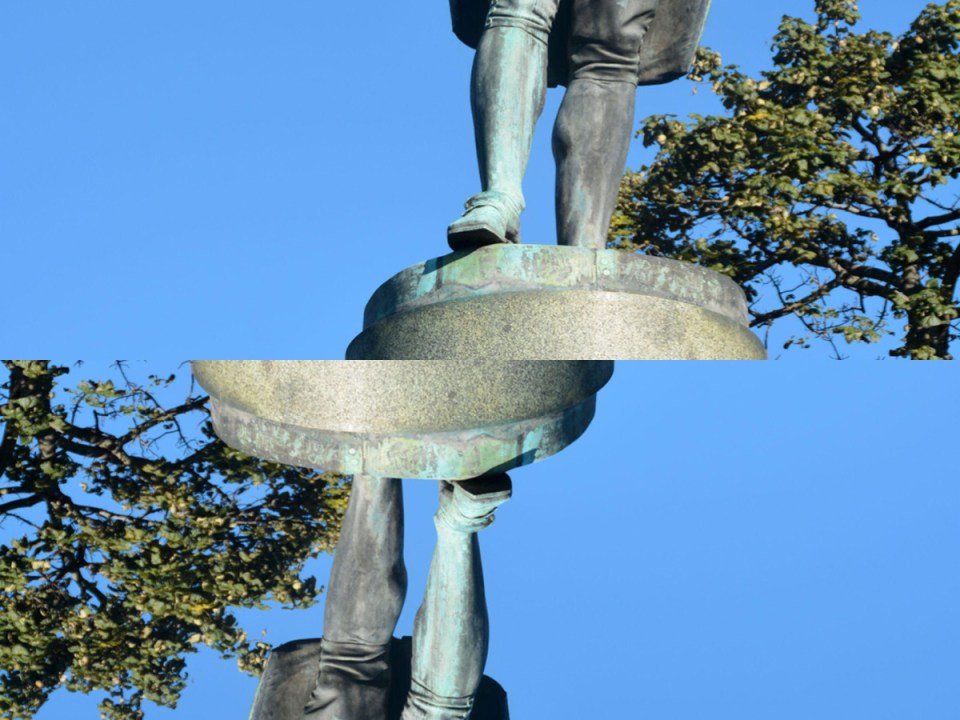
On the eve of 26 January 2024, a bronze statue of Australia’s mythic founder, Captain Cook1, is sawn off at the ankles in the seaside suburb of St Kilda in Naarm/Melbourne. Pictures of the scene become instantly iconic. At dawn the next day – the 235th anniversary of British colonisation – Cook’s stiff corpse is found face-down in the grass. Above his body looms a vacant plinth with a new didactic text scrawled in red paint. It reads: THE COLONY WILL FALL.
The Captain Cook statue at St Kilda has been sawn off overnight. @3AW693 pic.twitter.com/Y56MdZkd49
— Madelaine Burke (@Madelaine_Burke) January 24, 2024
26 January has been mourned by First Nations people and their supporters since 1935, when the anniversary of the 1788 colonisation was first celebrated as ‘Australia Day’. Every year, growing ‘Invasion Day’ protests offer spaces for grief, rage, disruption and political education across the continent. Rallies convened by radical First Nations activists in Naarm/Melbourne attract up to a hundred thousand attendees. In turn, attacks on colonial statues and memorials have grown more common in recent years, especially in the aftermath of the Rhodes Must Fall and Black Lives Matter movements. We see statues beheaded, smashed, toppled, splattered with ‘blood’ and ‘lynched’ at increasing rates. It makes sense, across those reaches of the world we might tentatively call postcolonial, that the erection, retention, destruction and reinscription of tributes to monarchs and conquistadors are understood through the lens of ‘history wars’. Statues make colonial figures into the protagonists of public memory, after all. Decolonial activists subsequently seek to erase, pluralise or rearrange the “systems of ethno-knowledge” that overwrite the lived realities of the colonised.2
Yet something feels different about the felling of Cook on Invasion Day. In Australia, historical narratives of settler entitlement, belonging, innocence and aspiration cast them as the rightful occupants of stolen land, past, present and future. Memorial sites facilitate the social reproduction of such settler colonial relations. Statues in particular train us to embody the points of view that ‘settle’ colonisers in place. Each conquistador-cum-statesman, elevated and eagle-eyed, stands tall to survey his surrounds. Through his lens, land is an object to be known, possessed, exchanged and used; it is the nature that his culture must overpower, the body that his mind must transcend. Suspended between the earth and the heavens above, he stakes his claim to sovereignty without getting his hands (or feet) dirty. When settlers identify with his gaze, we impose grammars of dominion over cosmologies of Country, obscuring them from view.3 Our terra nullius logic renders Aboriginal land vacant property for the taking.4 We rely on this detached and elevated point of view as a strategy of un-seeing. It is fundamental to what Tuck and Yang term ‘settler moves to innocence’5—the manoeuvres that allow us, collectively and as individuals, to disavow the violence of conquest and, in doing so, enable its continuation.
Statues that cast colonisers as ‘victors’ testify that conquest is incomplete and thus ongoing. These grandiose reminders of settler authority are only necessary because the persistent remainders of First Nations sovereignty – insurgent subjects, sites and signs – continually demonstrate that occupation is neither absolute nor natural. Most Australians imagine war as far away and long ago, not an ongoing process that continues to stain local soil. Despite all efforts to make war distant, settler colonial nations like Australia and the United States deploy tools of domestic warfare and counter-insurgency against their own populations to this day. Under current neoliberal conditions, the lines between the protective and punitive edges of state power have never been more blurred. We see prisons industrialised, police militarised, borders weaponised, wealth hoarded, welfare marketised, and war made profitable to unprecedented degrees, wreaking havoc along blatantly racialised lines. The repression of pro-Palestine protest in the West puts these developments on full show. For instance, when American police officers, many of whom have received training in the NYPD’s office in Occupied Palestine or from visiting Israeli military delegates,6 assault exiled Palestinians who have gathered to commemorate the 1948 Nakba,7 the circular ties that bind settler colonialism, the afterlives of slavery, racial capitalism and overseas imperialism are impossible to deny. Moments like this exhibit the logical end of campaigns such as the ‘War on Terror’: to submit insurgent domestic populations to the kinds of violence that states supposedly reserve for outside threats.8 Back in Australia, as Boe Spearim points out, it only takes a glance at statistics on Indigenous deaths in custody (over 560 since the 1991 Royal Commission)9 or rates of out-of-home care (10.5 times higher than non-Indigenous children)10 to recognise that genocidal Frontier War tactics are built into modern Australian governance. It makes sense that these practices are so advanced in settler colonies, where Indigenous existence poses existential threat to settler state sovereignty – from the inside.
The insider status of Indigenous insurgency means that some of its most powerful interventions are creative rather than destructive. Wiradjuri and Ngunnawal artist Brook Andrew’s Frontier War memorials, for instance, creatively unsettle settler ways of being and knowing. In Jumping Castle War Memorial (2010), Andrew invites participants to play in a seven-metre inflatable installation decorated with black and white Wiradjuri designs and floating model skulls. By blending macabre and joyful registers, the work makes a spectacle of ‘settler moves to innocence’ by exhibiting how a space of childhood play might also be site of violence and mourning for First Nations people. Compared with traditional memorial statues, encounters with Andrews’ work place unconventional demands on the viewer. Instead of relating through sight to an immobile, hardened figure, raised beyond reach on a pedestal, audiences who enter the structure are enveloped completely. To find their feet on its unsteady floor, participants must attune themselves to the reciprocal movement of their body and the ground below. In a similar vein, the figurative elements in the installation – floating skulls and an oversized inflatable ‘jumper’ – approach but do not assume proper embodiment. As fragments and shadows, ghostly apparitions, they too move with the structure while participants bounce. Andrews’ installation returns the participant to a state of fleshy, porous, relational being, and so enforces a real sense of mutuality between jumper and castle, body and environment, self and other. At the artist’s site for remembering the horrors of invasion, the settler body is toppled over and thrown off balance, forced to feel its way from the ground up.
Andrew’s installation art and the activist felling of Cook’s statue may appear to have little in common, yet I would argue that they cleave open the same fault lines in the bedrock of settler subjectivity. I would also argue that when it comes to decolonisation, creative and destructive interventions are more closely related than they may otherwise seem. Jumping Castle War Memorial primes participants to challenge dominant narratives by first ‘unsettling’ their point of view. This opening provides a point of entry for counter-narratives that challenge the settler colonial politics of remembering and forgetting. In a similar vein, the felling of Cook’s statue was accompanied by the writing of a new inscription on the plinth, one that speaks into the gap cleaved open. The slogan THE COLONY WILL FALL speaks not only of inevitable colonial collapse, but of the creative possibility that follows in its wake. In this respect, it is an abolitionist call. Whether they centre chattel slavery, police and prisons, borders, or any other oppressive institutions, abolitionist politics sustain a dual commitment to destruction – the act of felling, of creation, of reinscribing the ruins – without prescribing what might emerge in the aftermath. Above Cook’s dismembered ankles is an open space, a question mark. Below them on the plinth is a rewriting not of history, but of the future. The abolitionist grammar of willing in THE COLONY WILL FALL is also at play in the movement for Palestinian liberation—another case of resistance to settler colonial occupation. When we publicly declare that FROM THE RIVER TO THE SEA, PALESTINE WILL BE FREE, we are citing willful claims to the future tense. At rallies across Australia, these liberatory grammars converge in a chant that blends the above axiom with a famous affirmation of First Nations sovereignty – ALWAYS WAS, ALWAYS WILL BE, ABORIGINAL LAND. The hybrid product – FROM THE RIVER TO THE SEA, ALWAYS WAS, ALWAYS WILL BE – manages to articulate the complexities of colonial entanglement in strikingly simple terms.
In other areas of Palestine solidarity activism, subtle differences of grammar betray profound disparities in political imagination. I was surprised to hear the formulation ‘We will free Palestine, within our lifetime’ echoing across the boroughs of New York City this summer. Unlike that which appears in THE COLONY WILL FALL or PALESTINE WILL BE FREE, the willing force behind WE WILL FREE PALESTINE is attached to an active subject. We – here, US Americans – become the agent of decolonisation, or perhaps even its protagonist. Of course, grappling with the very real stake that the imperial core holds in Palestinian liberation is necessary; we too only stand to gain by divesting from the moral and material economies that make genocide possible. But Western activists are not the primary subjects of this struggle, and Palestine is not an object to be freed. Consider how the inverse formulation – PALESTINE WILL FREE US – otherwise expresses the stake that oppressed people everywhere hold in the defeat of Zionist occupation. Somewhere in the gap between these two declarations is an intransitive grammar of willing. Such a grammar expresses decolonisation as both subjectless and objectless. We can use it to write ourselves into new kinds of relation and remake one another in the process. It stretches the horizons of the possible, the thinkable. This is an abolitionist grammar.
Abolition demands that we refuse the narrow terms of engagement offered by liberal critique (what will replace this system of oppression?) and ask instead: how do we otherwise understand the problems that systems of oppression claim to answer? In the case of settler colonies, decolonisation is an abolitionist movement insofar as the return of Indigenous land and life11 calls for the abolition of settler colonialism as a structure12 – along with the settler subject built to inhabit it. Anything short of this – reform, recognition, reconciliation – is inhibiting insofar as it at once perpetuates and disavows the ongoing violence of occupation. For example, one news report absurdly suggests that the reason protesting college students wrapped a statue of George Washington in a keffiyeh was to “connect the plight of Gaza to fundamental American values,” as though US settler colonialism, imperialism and exceptionalism are not themselves driving forces in the genocide of Palestinians. Liberal commentaries like this attempt to artificially detach transnational solidarity struggles from the domestic stolen land on which they are waged. By contrast, Ruth Wilson Gilmore’s concept of abolition geography spells out the centrality of land to collective liberation, near and far:
“Abolition geography starts from the homely premise that freedom is a place. Place-making is normal human activity: we figure out how to combine people, and land, and other resources with our social capacity to organize ourselves in a variety of ways, whether to stay put or to go wandering. Each of these factors – people, land, other resources, social capacity – comes in a number of types, all of which determine but do not define what can or should be done.”13
Settler colonial statues are a place-making technology, but so is the decolonial, abolitionist practice of tearing them down. If the aim of immortalising founding fathers in bronze is to reproduce settler life on stolen land, to attack the undead coloniser is to wage war on colonial futures. What the felling of Cook tells us is that first, even in its metal manifestation, settler futures are not secure, and that second, places for freedom can be forged even in the smallest lapses of occupation. The liberated world may not rise from the ashes of a disappeared colony, but it will find strong foundations in the ruins left behind by fellings yet to come. For now, THE COLONY WILL FALL rings all the more powerful when scrawled over a tribute to settler conquest; and the seaside sky seems broader having shed the weight of bronze.
SOPHIE CHAUHAN is a third-year PhD candidate in Race, Ethnicity and Postcolonial Studies at University College London. Her research investigates diasporic ‘Asianness’, the shifting parameters of whiteness and anti-racist coalition movements in Australia and the United States. Outside of academia, she organises in queer, anti-racist and anti-capitalist solidarity spaces, and is author of Curious Affinities, a collection of essays and poems on the politics of intimacy.
To learn more about RAHUL RAO’s work on statues, listen to his conversation with heritage specialist SEAN CURRAN about the Gandhi statue in London’s Tavistock Square, recorded for the Think Pieces Podcast.
***
Edited by MARTHE LISSON and ALEX HYDE
Lead image: Dell Upton via Jstor, SAHARA Public Collection.
Categories
One thought on “Felling for Freedom” Leave a comment ›