Radical Landscapes at the William Morris Gallery

EXHIBITION
Radical Landscapes. Art inspired by the land
at the William Morris Gallery
Review by:
MAJA FOWKES
4 DECEMBER 2023
More than bucolic meadows and gently rolling hills, British landscapes have historically been sites of radical social action, arenas for societal transformation. A stimulating new exhibition at the William Morris Gallery tackles the interplay between landscape, art, and politics.
The exhibition Radical Landscapes brings together diverse works that span two centuries of the British history of landscape art, problematising personal and collective relationship to land through the lens of class, gender, race, national identity, and politics. Presenting snapshots of artistic engagements with the countryside, the show’s radical predilections converge around the right to trespass, historical moments of rural dissent and non-conformist attitudes to nature and belonging. First held in Tate Liverpool, the new iteration found fruitful ground in the William Morris Gallery in Walthamstow, where it got embedded in a local context marked by the micro-geography of Epping Forest and the River Lea wetlands and situated in its particular art historical realm championed by the environmental thought and practice of William Morris.

The starting chords of the show are struck by the bards of nineteenth century British landscape art, smoothly transitioning from Gainsborough, Constable and Turner to Ruskin, while omission of the local hero is remedied by using signature William Morris wallpaper as a backdrop for the display of these iconic painters’ works. This intervention opens up questions about other possible amendments to mainstream accounts and the re-evaluation of the dominance of masculine optics in landscape art, a cue for which could be found in the inclusion of a work by Martha Mutrie in the new collection display of Tate Britain. The diversification of the national approach to landscape art is more readily visible in the subsequent period, with the incorporation of artists such as Aubrey Williams , whose experience of work on sugar plantations on Guyana’s east coast and time spent with Indigenous Warao people in the rainforest profoundly marked his artistic practice upon moving to Britain. Hurvin Anderson’s large scale painting Double Grille (2008) depicts a lush green landscape behind white floral security grilles, a familiar feature of Jamaica where his parents were born. The work stands out for its evocation of the politics of exclusion through the fencing off of land, while also conjuring the sense of unsettled belonging for those with histories of dislocation. Less visible but no less impenetrable, social barriers t o the right to belong in the British landscape come to the fore in works by Chris Killip, Veronica Ryan and Jeremy Deller, investigating the hybrid and complex identities of immigrants and marginal communities.

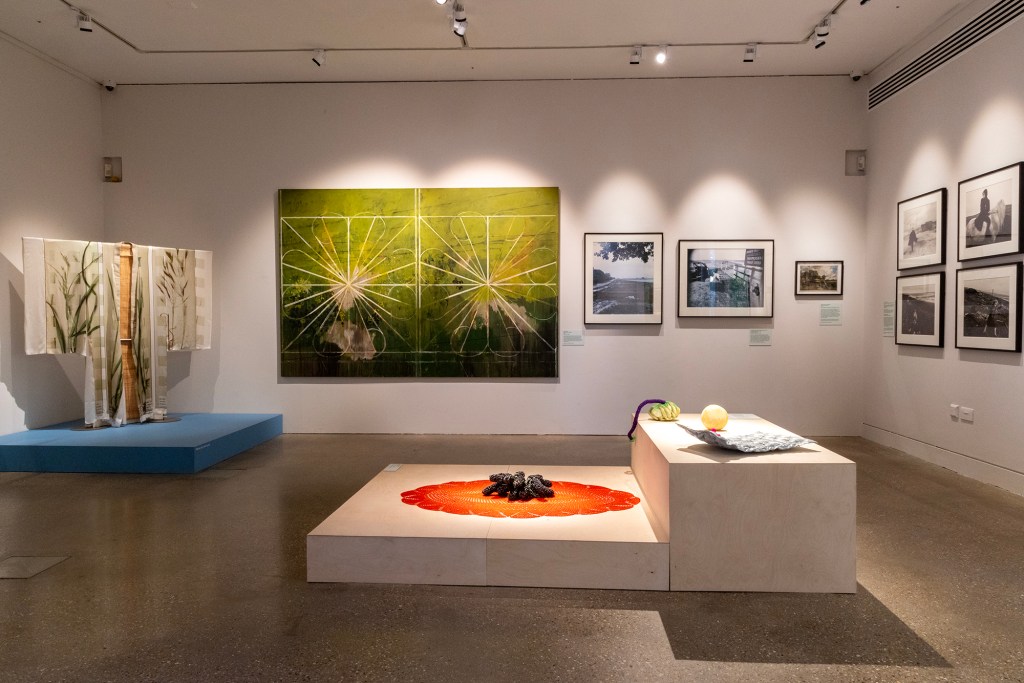
Landscape as a site for body politics and gender performativity is at stake in a number of works, including a series of photographs by Jo Spence, which through the insertion of the non-idealised naked female body into rural scenery, critiques the conventions of landscape art . Installed in a secluded room, Claude Cahun’s black and white prints could be seen as exemplary early representations of queer ecologies in art. Wilma Johnston’s film Private View from 1981 features the Neo Naturists, a collective of women who painted their bodies in vivid colours and engaged in ceremonial performances as modern reinterpretations of ancient fertility rituals. Another form of reconnecting with the land is celebrated in Sara Sender’s film In the Area 1990-93, which presents Spiral Tribe, a free party sound system that was behind legendary rave parties in the countryside. Recalling that this was a period in which “music, politics and optimism converged”, the perplexing caption elucidates that “for a brief moment there seemed to be a real possibility of our generation doing things differently and better.”
The exhibition then takes a more political turn with the representation of the entwined agendas of environmental campaigns, land reclamation actions and civil protests, which were directed against development, privatisation and the militarisation of common land. Milestones of rural disobedience are documented in photographs of The Kinder Scout Mass Trespass of 1932, the 1996 anti-road protests against the A 34 Newbury Bypass, as well as the 1980s Greenham Common Women’s Peace Camp, the display of which also includes a textile banner by Thalia Campbell, depicting tents, a campfire, bolt-cutters and white doves as symbols of peace against the nuclearisation of the countryside.
In addition to commissioning new works, such as an immersive piece by Abel Holsborough on the local Windrush Generation allotment holders, and devising an extensive public programme, including a closing rave party in the forest, the curators went one step further. Under the title “News from Nowhere,” borrowed from William Morris’s utopian novel, they staged an appendix to the exhibition in an adjacent room, where the artists’ works are juxtaposed with local museological finds. Amongst these are paintings of local landscapes, positioned around a taxidermized red squirrel, which appears to be practically the only non-human protagonist in the exhibition. A display case in the centre of the room contains an array of local artefacts from prehistoric flint tools to a plastic bag memorialising the M11 protests of the 1990s. The wall text comments on the rapid urbanisation of Walthamstow during Morris’s lifetime, quoting his views about “the grip of the land-grabber” over common land, which is “jerry-built upon by speculators in order to swell their ill-gotten revenues.” These words ring true in view of the current wave of gentrification of Walthamstow and the vertical expansion of the cityscape in a frenzy of new development. Although not venturing into the challenges of the present directly, the exhibition sets out radical precedents, which, if reactivated, could allow collective voices of dissent towards social and climate injustices to be heard again.
Radical Landscapes. Art inspired by the land is on view at the William Morris Gallery until 18 February 2024. The exhibition spans two centuries and features more than 60 works by artists including JMW Turner, Claude Cahun, Hurvin Anderson, Derek Jarman, Jeremy Deller and Veronica Ryan.
MAJA FOWKES is Co-Director of the Postsocialist Art Centre at the UCL Institute of Advanced Studies and Principal Investigator of the ERC/UKRI Consolidator Grant, Socialist Anthropocene in the Visual Arts. Her publications include Art and Climate Change (2022), Central and Eastern European Art Since 1945 (2020) and The Green Bloc: Neo-avant-garde Art and Ecology under Socialism (2015)
***
Proofread by ALANI HICKS-BARTLETT
Standfirst by NICHOLAS LACKENBY
Lead image: AHP_B_RT – Derek Jarman The Garden, Courtesy & © Basilisk Communications.
Categories