The Amazon: Beyond the ‘Insider/Outsider’ Distinction

AMAZON
Beyond the ‘Insider/Outsider’ Distinction:
Claude Lévi-Strauss Writing with the Amazon.
by Emily Baker
27 November 2023
The notion of ‘Indigenous Ecologies’ in the context of the Amazon could be understood to relate to the perspective of members of Indigenous tribes (descended from pre-colonial peoples of the Americas) towards their ecological reality. However, in this piece I take a more posthuman perspective, gesturing towards the role that nonhuman entities play in fashioning narratives about the Amazon, whether produced by Indigenous people or ‘newcomers,’ in this case produced by the Anthropologist Claude Lévi-Strauss. Even if one is an ethnographer in the field, the access to Indigenous knowledges is, more often than not, distanced, several times over, by worldview, processes of translation, biases, and the general constraints of the vehicle of language. However, if we consider texts about the Amazon to be co-written by the forest, animals and its Indigenous human inhabitants, then we can worry less about ‘insider-outsider’ dynamics, and still build up a rich, complex and accurately messy, portrait of the region.
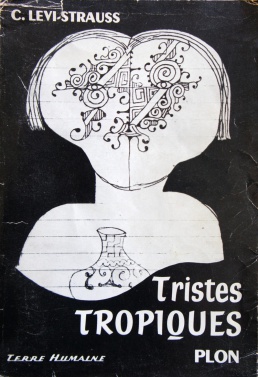
In this piece, therefore, I read Lévi-Strauss’s text Tristes Tropiques (1955) as an Amazonian text. The work, in many ways, defies textual genre with commentators noting the plurality of it including, as it seems to, multiple discourses. These are summarised by Grażyna Kubica as follows: “this is a travel book (comparable to works by Burton, T. S. Lawrence, Gide, Loti, Malraux), but at the same time it is ethnographic (the mystique of fieldwork and a neat presentation of structuralism), philosophical (references to Rousseau), a reformist treatise (radical critique of colonialism), while not ceasing to be a symbolic literary text (in the tradition of Baudelaire, Mallarmé and Rimbaud)”. No scholars, as yet, have considered it as pertaining to the genre of ‘Amazonian literature’, as I seek to do here. Amazonian literature is defined broadly by Jorge Marcone as: “indigenous or nonindigenous narratives, written by scientific travellers or state officials; or focusing on subsistence farmers or poor immigrants in search of fortune”. This catchall approach contributes, as he says, to suspending “the distinction between literature written by ‘insiders’ and ‘outsiders'”. Reinforcing the importance of this inclusive approach, Candace Slater highlights the frequent, damaging representations of the Amazon as an exoticised site of pristine nature containing native healers and scantily-clad tribes that it is someone’s “mission” or “right” to protect. This view fails to account for the “messiness” in terms of both “the less-glamorous swamps and bushlands, the big and little cities” that are a significant part of the Amazon and home to a total of 23 million people. These people include “descendants of black slaves, the Sephardic Jews, the Japanese agricultural workers, the Arab merchants and the mix-blood rubber tappers who have helped create the rich, distinctive cultures of an immense and varied region”.
The performance of the Amazon and its Indigenous inhabitants, by one particular travel writer, as pure and untouched is something Lévi-Strauss critiques in Tristes Tropiques, saying, “the means of approach to the tribe are carefully glossed over, so as not to reveal the presence of the mission station which has been consistently in touch with the natives for the past twenty years, or of the local motor-boat service reaching into the territory. But the existence of the latter can be deduced by a practiced eye from the small details in the illustrations, since the photographer has not always been able to avoid including the rusty petrol cans in which this virgin people does its cooking”. Framed as a critique of non-professional anthropologist travellers exoticising their experiences for profit, Lévi-Strauss later, nevertheless, reveals his own deep-seated desire to come into contact with “pure Indians,” when he says, “to my great disappointment, the Tibagy Indians were neither completely ‘true Indians,’ nor, what was more important, ‘savages’,” yet he acknowledges that the study of them “was to prove no less instructive than that of the pure Indians whom I was subsequently to encounter”.
In their “Queer Ecology: Guest Column,” Timothy Morton likewise extolls the importance of acknowledging the messiness and pollution that is part of the whole web of life/nature that humans cannot abstract themselves from, but which we are embedded within. He reminds us that, “the inside-outside manifold is fundamental for thinking the environment as a metaphysical, closed system—Nature. This is impossible to construe without violence”. In considering Lévi-Strauss as an Amazonian author, therefore, I echo Jorge Marcone, Candace Slater and Timothy Morton, in seeking the rhetorical deconstruction of the ‘insider-outsider’ and ‘nature-culture’ binaries, with reference to the Amazon. This is not to say that Lévi-Strauss does not frequently uphold the ‘inside-outside’ manifold by rhetorically constituting categories such as ‘Western civilization,’ ‘European observer,’ ‘savages,’ and so forth; but he often simultaneously disavows any hierarchies that might be derived from the dichotomies associated with them. Jacques Derrida in Writing and Difference discusses at length Lévi-Strauss’s acknowledgement of the limits of language and anthropological discourse, but his ambivalent use of these rhetorical “tools,” in the absence of better means of communication. In support of the deconstruction of the ‘insider-outsider’ and ‘nature-culture’ binaries, then, would be to acknowledge that nonhuman actors are active participants and co-creators with Lévi-Strauss of this Amazonian narrative. This type of reading contributes to a growing body of work that builds upon Ewa Domanska’s notion of “multi-species co-authorship” including Diogo de Carvalho Cabral’s work on human-ant negotiations in nineteenth century Brazil. His work asserts the value of acknowledging “nonhuman agency by allowing the exploration of animals’ [and plants] truly creative, rather than merely resistive behavior”.
In what follows, I analyse two brief sections from Lévi-Strauss’s Tristes Tropiques, to explore the account of resistive and cooperative human/nonhuman interactions; and to underscore Marcone’s point that “enunciations in any media can be thought of as entities originated in the interaction of human and nonhuman actors”.
In his essay, Marcone discusses the “‘subjectification of the nonhuman” in the novela de la selva or regional Latin American forest novel as evident when, “the white characters react verbally and psychologically to the overwhelming physical-biological-social environment that defeats their attempt to control it”. This is also evident throughout Lévi-Strauss’s memoir Tristes Tropiques but especially humorously framed when he mounts an expedition to Nambikwara territory. He says, “The expedition was being led neither by me nor by Fulgencio, but by the oxen. These ponderous beasts were like duchesses, whose vapours whims and fits of weariness had to be carefully studied”. He follows, “they often deliberately run away and hide, and may remain undiscovered for days on end. I was once stuck for a whole week, because one of our mules, or so I was assured, had set off into the campo, first walking sideways, then backwards, to make sure that its rastos (tracks) could not be followed by its pursuers”. As much as Lévi-Strauss emphasises the resistant nature of such forms of animal agency, we can borrow from Andria Pooley-Ebert’s work on horses when she points out that “compliance and cooperation was usually a more pervasive behavioural trait than defiance”. In other words, the oxen and mules cooperate to the point that they are tired, and then they assert that they need to rest.
In the following quatrain also published in Tristes Tropiques, Lévi-Strauss alludes to the forest’s frustration of human will, whilst also explicitly acknowledging its ability to communicate, anticipating the premise of Eduardo Kohn’s How Forests Think: Toward an Anthropology beyond the Human by almost fifty years:
Amazon, dear Amazon,
you who have no right breast,
you tell us some tall stories,
but your paths are too narrow.
Lévi-Strauss explains that he made up such poems to distract himself from the profound fatigue of trekking through the forest with a little monkey called Lucinda attached to his left boot. He tells that Lucinda flatly refused to hold him in any other place on his person, yet whenever he stepped into some scratchy bracken she would let out a piercing scream. This vignette about the stubborn monkey and the challenging undergrowth demonstrates how nonhumans (here, animals and plants) contribute, in their own way, to the production of texts about the Amazon. When Lévi-Strauss says in the third line of the poem: “you tell us some tall stories” he alludes to this narrative agency of the forest.
For Morton, “all life-forms, along with the environments they compose and inhabit, defy boundaries between inside and outside at every level”. This lack of ontological distinction between ‘insiders’ and ‘outsiders’ is echoed again by another of Lévi-Strauss’s comments on Lucinda the monkey: “She was a native of that forest, and yet a month or two in the company of human beings has made her as great a stranger to it as if she had grown up among the refinements of civilization”. In just one lifetime the skills needed to survive in such an environment can be compromised for a creature such as Lucinda, and gained by a non-indigenous anthropologist like Lévi-Strauss.
Returning to the quatrain, the second line, “you who have no right breast” refers to the myth of the tribe of fierce female Amazonian warriors, who supposedly cut off one of their breasts to better fire their bows and arrows. The naming, by sixteenth-century Europeans, of the Amazon river and basin after these warriors from Greek mythology, speaks to the simultaneously alluring, yet dangerously threatening, environment that they perceived. This more militaristic vision of the forest reflected the idea that it was ultimately something that ought to be tamed, conquered, and used to ‘human’ advantage. As such Lévi-Strauss’s short poem is emblematic of the ambiguous situation whereby stories about the Amazon are shaped by both a long cultural history that ideologically reinforces the colonial endeavour, as well as these forces of the nonhuman that can be considered political actors in their own right.
REFERENCES
Diogo De Carvalho Cabral, “Meaningful Clearings: Human-Ant Negotiated Landscapes in Nineteenth-Century Brazil,” Environmental History 26, 1 (2021): 55-78.
Jacques Derrida, Writing and Difference, translated by Alan Bass (London: Routledge, 2001).
Ewa Domańska, “Animal History,” History and Theory 56, 2 (2017): 267-287.
Eduardo Kohn, How Forests Think: Toward an Anthropology beyond the Human (Berkeley: University of California Press, 2013).
Grażyna Kubica, “Lévi-Strauss as a Protagonist in His Ethnographic Prose: a Cosmopolitan View of Tristes Tropiques and Its Contemporary Interpretations,” Etnográfica 18, 3 (2014): 599–624.
Claude Lévi-Strauss, Tristes Tropiques, translated by John Weightman and Doreen Weightman (New York: Penguin Classics, 2011)
Jorge Marcone, “Towards an Amazonian Environmental Humanities,” in Hispanic Ecocriticism, ed. José Manuel in Marrero Henríquez (Oxford: Peter Lang, 2019)
Timothy Morton, “Guest Column: Queer Ecology,” PMLA: Publications of the Modern Language Association of America 125, 2 (2010): 273–82
Andria Pooley-Ebert, “Species Agency: A Comparative Study of Horse-Human Relationships in Chicago and Rural Illinois,” in The Historical Animal, ed. Susan Nance (Syracuse: Syracuse University Press, 2015)
Candance Slater, Entangled Edens: Visions of the Amazon (Berkeley: University of California Press, 2001)
EMILY BAKER is Associate Professor in Comparative Literature and Latin American Studies at UCL.
***
Proofreading by LEE GRIEVESON
Lead image by Alexa Schmitz via Pixabay.com.
Categories