Dwelling
THINK PIECES REVIEW
& KONESH JOURNAL
Dwelling
by Peter Browning, Marthe Lisson, Flora Sagers & Saba Zavarei
29 June 2026
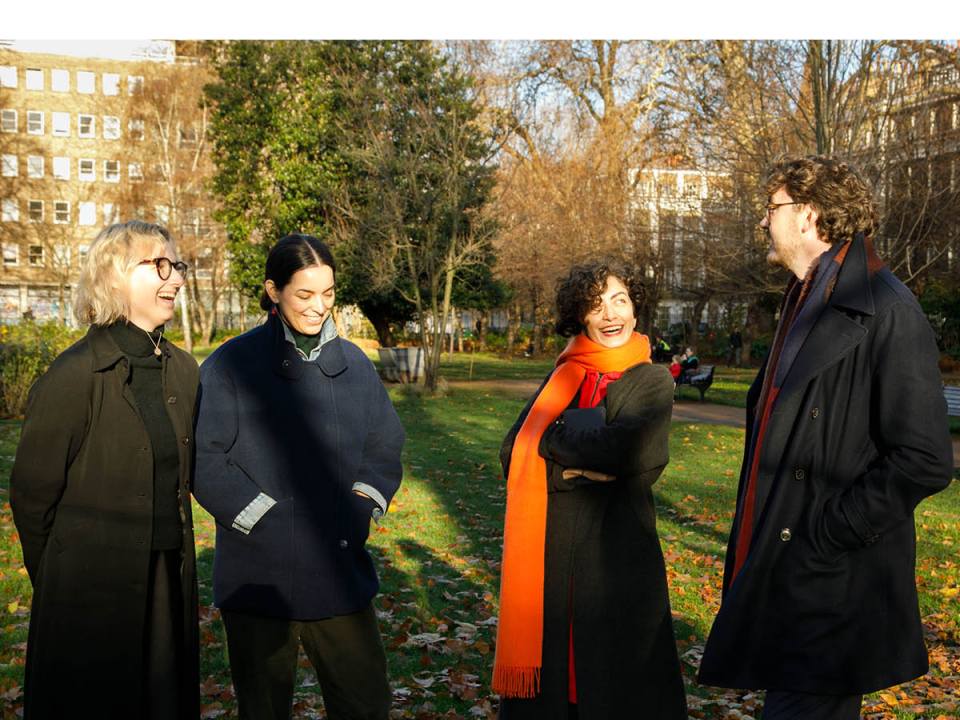
In 2025, Think Pieces and Konesh Journal embarked on a collaboration on the theme of dwelling. In the first instance, the editorial team organised two workshops that took place in September and October 2025 and that explored dwelling in Gordon Square, Bloomsbury. In this conversation, the editors sit down to discuss what they learned in these workshops and how these insights will inform the special issue they are working on.
Marthe Lisson: It is 9:27am, we’re here in Gordon Square. It’s lovely weather. We can still sit outside, despite it being 11 December. A squirrel is joining us too. But who are we? Let’s start with a quick round of introductions.
Flora Sagers: Hi, I’m Dr Flora Sagers. I’m an interdisciplinary researcher and writer.
Marthe: I’m Marthe Lisson, I’m the Editor of Think Pieces at the Institute of Advanced Studies.
Saba Zavarei: Hello, Dr Saba Zavarei here, an artist, researcher and urbanist. I’m also the co-founder and editor of Konesh.
Peter Browning: And I’m Peter Browning. I am a sociolinguist and Lecturer in Applied Linguistics at UCL’s Institute of Education.
Marthe: Thank you very much. Now, where do we start dwelling on dwelling? What do we want this conversation to result in?
Flora: We could talk about what we wanted to get out of the workshops, and then about the workshops themselves and our reflections on them as a process. The workshops were quite different from one another, and therefore we reflected and moved on in our thinking between them.
Saba: The first workshop was organised as part of the Open House Festival which required us to choose a specific site. We chose Gordon Square. But rather than opening the doors to an otherwise inaccessible place or offering a historical tour, we opened the square through a series of exercises we designed – inviting participants to uncover layers of meaning, to dwell in the space in new ways, and to reflect on their own forms of dwelling within it. In doing so, memories and sensory experiences became part of the encounter.
Flora: And [we chose Gordon Square] partly because it gave us that ability to have that sense of a natural space within an urban setting. This helped us to consider the variety of beings that dwell because often conversations about dwelling can be quite human-centric. We were able to explore the environment more holistically and completely.
Peter: I think because we anchored it with Open House and with this place [Gordon Square] in mind, the reflections we’ve generated are quite spatialised reflections about dwelling, which they wouldn’t necessarily always be.
Flora: Yeah, because thinking and considering dwelling, we could have been thinking about notions of nationhood or identity instead.
Saba: Or we might think of place not as a confined location but more as a spatial condition – something that could just as easily be a street or a passing moment. In this sense, place isn’t necessarily pinned to a fixed geographical boundary but emerges through the ways we move through it, experience it, and dwell within it.
Peter: It brings locale to the surface a bit more.
Flora: Choosing the word ‘dwelling’ felt important, because it allowed us to consider space, but also thought, and how we might inhabit spaces even when we aren’t physically in them.
Saba: I think in that sense the workshop was very successful. The outcome wasn’t just about the space itself – many memories, thoughts, projections, and imaginations emerged through the exercises.
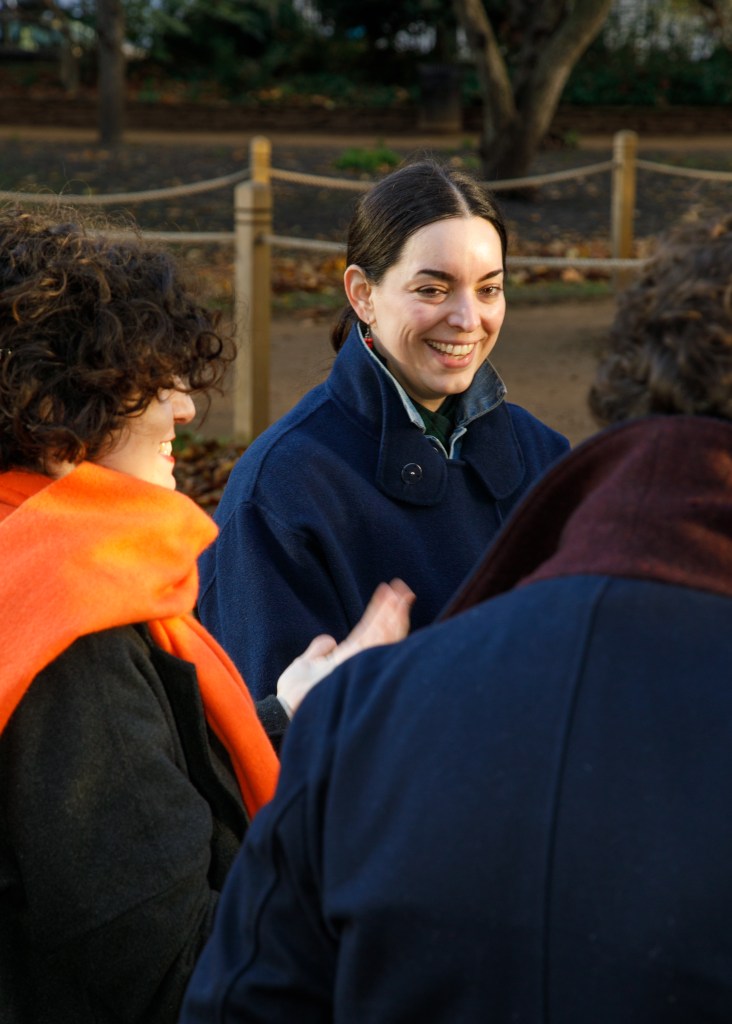
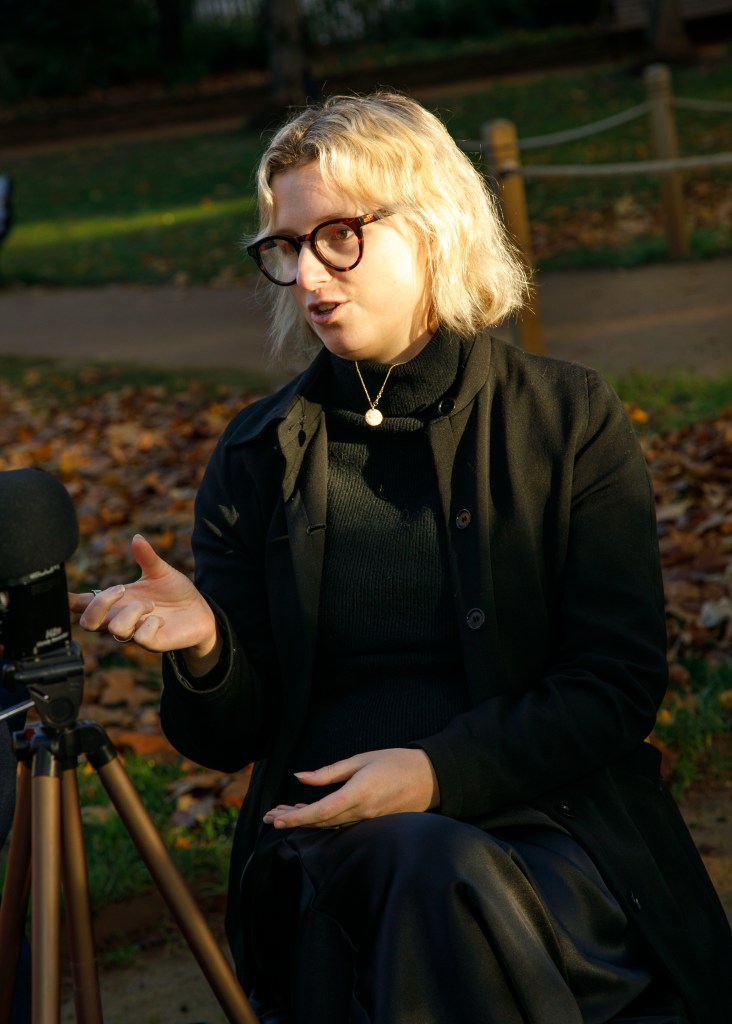
Marthe: Let’s talk about the workshops one at a time. Flora, you already said that they were quite different from one another. What did we think of the first workshop?
Peter: What surprised me about the first workshop was the people that came. Because it was with Open House, it was quite a heterogeneous group. What they then brought with them was very interesting in terms of experiences, in terms of expectations, and in terms of how they engaged. I think a lot about the participant who was very hesitant in the beginning, but then really let themselves go, and how the experience of the workshop itself was doing this. We generated some meta-reflection on dwelling, but we also created a practice of dwelling for people through what we did.
Saba: It was also about expectations. Some participants arrived asking about the history of the place – they expected to be informed rather than asked to do something themselves. That created a challenge at first. But once they realised that they had to actively engage, they became activated in their own ways, even if some remained hesitant about the approach.
Peter: I think there are generic expectations, in the sense of what ‘genre’ this event is. We call it a ‘workshop’ because we don’t want to call it a ‘tour’, but obviously participants want to understand this space as fixed and us as being there to give them information about this space, rather than inviting them to construct an experience and dwell in this space.
Saba: Which was almost the opposite of what we wanted to do. Our aim was to complicate the meaning of Gordon Square, to open it up to multiple interpretations.
Flora: There’s also something about the fact that we were quite intent on mapping in that first workshop which lends itself to trying to categorise or reduce a place. And so it became both about mapping and dwelling, rather than dwelling in and of itself. And that was something that we reflected on and decided to change for the second workshop. I think that first workshop, for us too, was confusing.
Saba: Even when we were thinking about the methodology, we hadn’t really questioned it beforehand. We only realised afterwards that mapping had not been the right approach. It imposed a structure. We invited people to open things up, to explore freely, yet we were still expecting a very particular form of outcome. That reflection – questioning mapping as a method – became an important insight for us.
Flora: We were trying to do two things and realised it wasn’t quite right.
Marthe: We then cut out the mapping in the second workshop and focussed entirely on the experience of dwelling. And I think the outcome was quite different. We also had a very different audience, all of them were students.
Peter: Yeah, and the Open House frame [was gone] as well. That definitely helped open up people’s expectations and allowed participants to engage in a different way.
Flora: It’s also interesting that all of those things – mapping, ‘touring’ spaces/places through Open House – are linked to notions of tourism, rather than notions of dwelling, of temporarily being in a space and therefore experiencing it in a superficial, often transient manner rather than dwelling where you’re really inhabiting one space and exploring it from lots of different viewpoints.
Peter: Yeah. Something that emerged with the participants in the second workshop, that really struck me, is that there was so much gratitude in the conversation we had at the end. This idea of, “we’re so thankful to have had this experience of spending time in the space in a non-transactional way”.
Flora: I think we emphasised the value of (dwelling) from a wellbeing perspective more in the second workshop.
Peter: I did wonder whether we sanctified it too much, the way that we talked about dwelling as this really positive thing. We started with the meditation and, in a way, ritualised the experience. It almost became this ‘sacred practice of dwelling’. It’s not to say that this was negative or positive. It’s just to think about what that framing did for participants, and how they made sense of the workshops and of dwelling. And I wonder if that kind of framing then allowed participants to think more metaphysically about things.
Marthe: I’m wondering whether age has something to do with it because the majority of participants in the second workshop were still fairly young. So they have that experience of, as they said themselves, walking around life or the city with their headphones on, being a lot on their phones, in their phones. And I felt that for them it was an experience of actually paying attention to what’s happening around them, unfiltered.
Flora: There’s so much we could say about the idea of mediating space through headphones, and there actually is some really interesting work on that by musicologist/music psychologist and phenomenologist Dr Jacob Downs. He has written a book about headphones and how we mediate the world through them. There is something very isolating about the headphone, because obviously, you’re sort of in your own internal space. You’ve isolated yourself from either, or both, the environment and from other people. And there was definitely something quite interesting about the fact that this was quite a communal experience for people in the workshop.
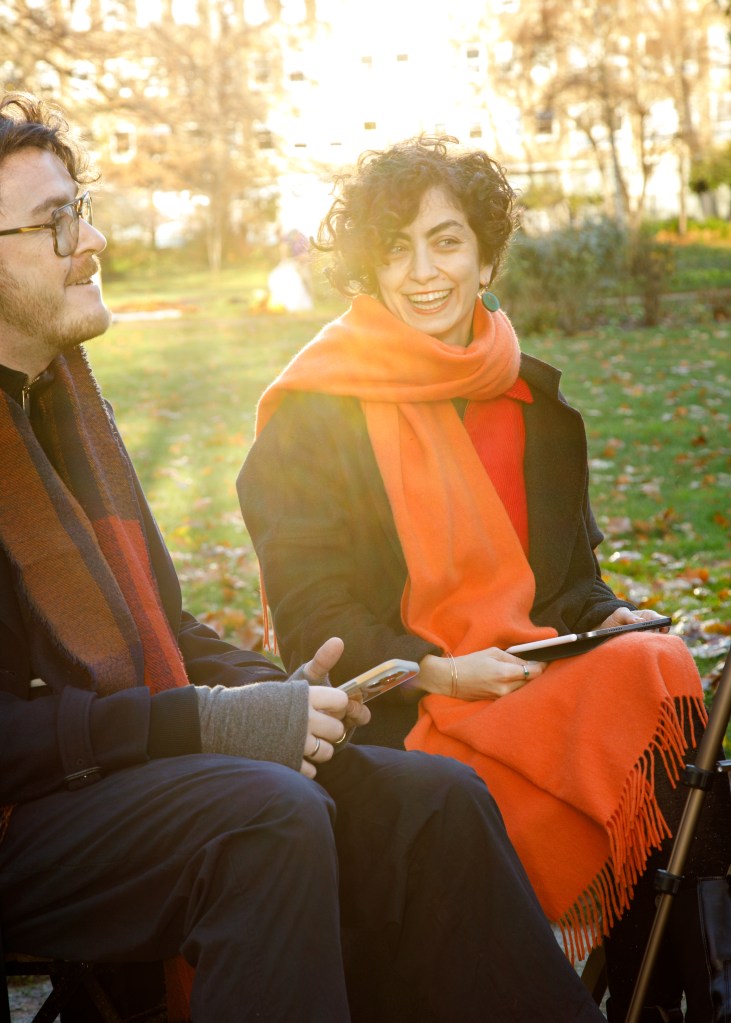

Saba: Also, the phones came up. Several participants said they were happy to not use them. I remember one girl in the second workshop saying she found it liberating to have her phone in her pocket and not touch it at all.
Peter: And the slowness emerged. I think in my notes I wrote something like “could dwelling be an anti-capitalist practice?” because it’s forcing us away from this speed, and away from an individualised way of existing in the world, where our engagement with the world around us is superficial, we just transit through space.
Saba: Yes, speed was definitely an important element. Slowing down allowed participants to notice details, reflect, and engage more deeply with the space and the exercises.
Peter: I think we created ‘conditions of otherwise’ to foster a different kind of experience.
Flora: Yes absolutely, we engaged in a good deal of ‘othering’ practices: ‘othering’ ourselves from other people in the park, as well as othering the space and our temporal understandings of a space through that ‘radical slowness’, and how that could be a political act. We could talk about that endlessly, the ways in which we sought to help people to pay attention to the natural environment and how that exists in contrast to the everyday lives of late stage neoliberalism – we are rejecting or taking issue with technology and the rapid temporality that is associated with it, and we are dwelling in an outdoor space and focusing on aspects of the earth, and are thereby in tune with seasonal and natural rhythms. We talked a lot about seasons in that workshop, partly because it was, the beginning of autumn and the leaves were turning.
Peter: That’s interesting in terms of temporalities – seasonal temporalities and Earth temporalities.
Saba: What struck me in both workshops was how dwelling wasn’t just about what was physically present or how we perceived it. It was also about the imaginative and bodily projections we bring with us. For example, the woman in the first workshop who started dancing said she usually dances in her own park but didn’t realise she could do it here. Her body was carrying that movement even if Gordon Square hadn’t yet invited it. Another participant saw a branch and remembered sitting on branches as a child; the branch became an invitation, and she acted on it. Similarly, someone else noticed a log that they had always wanted to sit on. These moments showed how dwelling connects past and future: we carry memories, habits, and bodily knowledge, constantly projecting possibilities into the spaces we encounter. Dwelling, then, is as much about potential and imagination as it is about the material space itself.
Flora: Yes. I kept on thinking about the ‘thick present’, the idea that, if you’re really involved in thinking about the present moment, temporally speaking, then our understanding of the present moment is ‘thick’ and multi-layered. We are constantly interacting with the different layers of the past as well as the different possibilities of the future. Whether this is through nostalgia, or resurgences in fashion, art, or culture or the historical cycles and traumas of the past, or apocalyptic projections or prophecies of our future in an era of the climate crisis and increasing war-mongering.
Saba: Another interesting aspect is how inviting people to be fully present in the moment opened up their awareness of the past and future. By focusing intensely on the ‘here and now,’ participants were able to imagine possibilities, recall memories, and connect those experiences to the space. That interplay between presence, memory, and projection made the workshops feel very rich and dynamic.
Flora: Dwelling within your body, your mind, within your memories.
Saba: I remember in the second workshop, a young woman from Pakistan mentioned that she couldn’t dwell in public spaces there, which made this experience feel quite alien for her. Yet by the end of the workshop, she seemed grateful for the opportunity. It raises an interesting question: is dwelling across geographies even possible?
During the bodily exercise, she chose to walk very slowly, as a contrast to the constant rushing she’s used to when avoiding public spaces. I found that beautiful – she was consciously exploring ways of being in a space that she normally couldn’t. Once given the opportunity, she could experiment: “What happens if I walk very slowly?” It’s a powerful reminder that dwelling is not just about the space itself, but about the ways we inhabit it, physically and imaginatively, and the possibilities we open up for ourselves.
Peter: That’s where the participatory nature of the workshop is very helpful, thinking about how we have been socialised into being in certain spaces, in certain geographies. That’s why the retreat into childhood, I think, is interesting. It is in those moments where the body becomes disciplined and socialised into certain ways of being in the world. Going back to that time can then be a moment to reflect on the paths that we’ve taken, or the possible paths in different contexts. I do think that that being present and the reflection that we invited them to do helped to bring that to the surface.
Flora: It felt very appropriate to do the workshops here, so near to Virginia Woolf’s sort of last dwelling place. The person of modernism, really, so thinking about how we can talk about spaces in London, but actually reflect on ourselves and our whole experiences and those of society, all within one single space. But obviously we’ve made a couple of different spaces for that. Within the workshop, just recording, and then in the venture writing, written piece.
– Squirrel enters the scene –
Marthe: I wonder what he is saying. “You are dwelling in my place!”
***
The Institute of Advanced Studies is closing and with it, Think Pieces. This conversation is the last publication to appear on Think Pieces. But rather than it marking a definite end, it means the beginning of something new. Think Pieces is handing over the baton to Konesh Journal where we can continue to dwell. Please follow the journal online for updates on the special issue which is due to be published at the end of 2026: konesh.space.
Edited by MARTHE LISSON
All images by Mariam Gomez
Categories