Reclaiming Chersonese
THINK PIECE
Reclaiming Chersonese:
Making a Case for an Alternative Archive
by Nelli Shkarupina and Renate Lurdesa Baumane
A biologist has mapped the species,
A surveyor has taken precise measurements,
A historian has documented past events,
An archaeologist has excavated relics,
A passerby has formed an impression.
Narratives provide context in which the observed reality is interpreted, understood, and acted upon. These pieces of knowledge end up being the truths or the ideas accepted as truths that underpin the perceptions shaping our reality. For these narratives to be considered (hi-)/storically plausible, a series of evidential artefacts is typically archived.
Traditional archival frameworks are constrained by the limits of physical space and the materials deemed worthy of preservation. What the archive preserves, perhaps unintentionally, is not the past itself, but a contemporary view of it. Our current impressions of the places and artefacts mentioned in it are, thus, curated by the materials on display in the room of an archive. As a consequence, the spaces that allegedly contain traces of historical events or cultural memory become an extension of the archive beyond its walls.
While archives have existed in various forms across different societies, the modern institutional archive is closely linked to the rise of the nation-state, particularly in Western Europe from the seventeenth century onwards. As such, historical landscapes have been recurrently transformed by the competing demands of national mythologies. Anthony Smith wrote that “to become national, shared memories must attach themselves to specific places and definite territories.”1 He used the term territorialisation of memory, described as the attachment of shared memories (ethnic landscapes) to particular places.2
This think piece therefore makes the case for the spatial archive as an alternative mode of understanding heavily contested cultural heritage sites – a framework that expands prevailing notions of what constitutes an archive. The argument takes shape through a close study of the archaeological site of Tauric Chersonesus in Crimea, Ukraine, which was forcibly seized by Russia during the 2014 annexation of the peninsula.
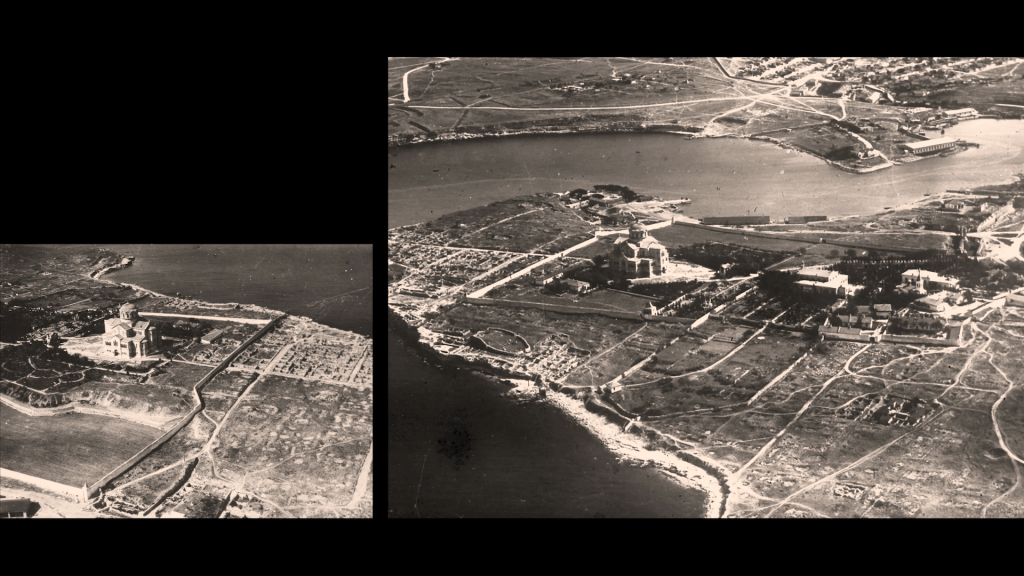
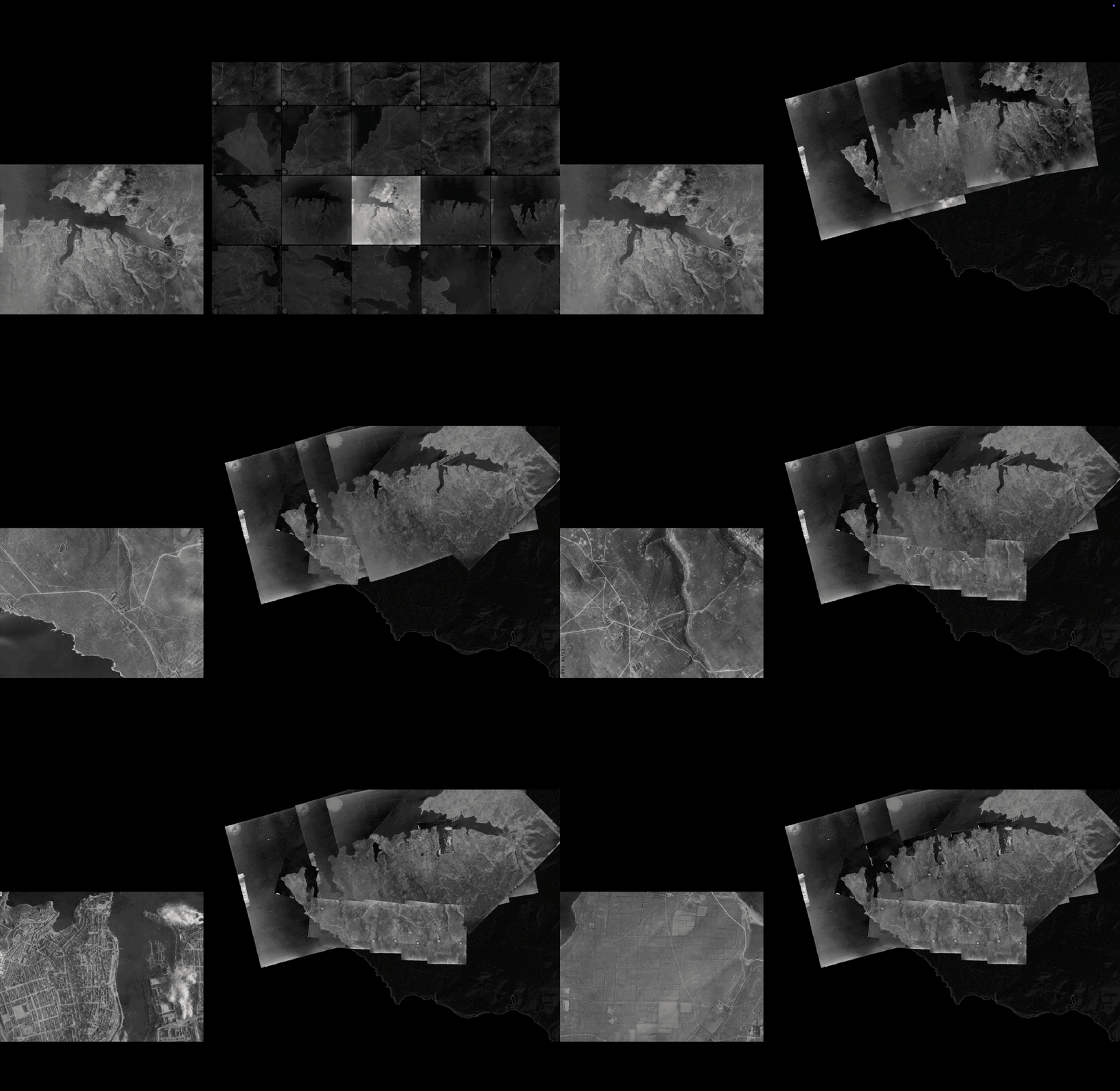
This archaeological site is the first and, for now, the only UNESCO World Heritage site in Crimea. It is located at the edge of the modern city of Sevastopol and comprises remains of an ancient Dorian Greek colony dating from the fifth century BC. UNESCO described it as “an outstanding example of democratic land organisation linked to an ancient polis, reflecting the city’s social organisation.”3 The listing includes the main protected zone and a larger buffer zone, which contains the chora, the agricultural district divided into hundreds of rectangular plots.
Throughout the ongoing war Russia wages against Ukraine, Russian authorities continue to develop and deploy calculated (hi-)/storical narratives, using a very tailored rhetoric to legitimise their actions. In 2014, when Russia forcibly annexed Crimea, ideologically, the Russian regime connected this to the alleged importance of Chersonesus as a centre for Orthodox Christianity, presented to be one of the key ‘unifying values’ for Russian and Ukrainian people. Following the illegitimate referendum on Crimea’s accession to Russia, Vladimir Putin’s now-infamous speech from 18 March 2014 started almost immediately from the site of Chersonesus:
“Everything in Crimea speaks of our shared history and pride. This is the location of ancient Chersonesus, where Prince Vladimir was baptised. His spiritual feat of adopting Orthodoxy predetermined the overall basis of the culture, civilisation and human values that unite the peoples of Russia, Ukraine and Belarus.”4
Here, he refers to the myth about Prince Volodymyr5, ruler of the medieval Slavic state of Kyivan Rus, being baptised in Chersonesus. There are two main reasons why his figure is being repeatedly exploited in modern Russia: ideological reduction of independent Ukraine and Belarus under the premise of shared religion and creation of a symbolic link between ‘Prince Vladimir’ and the current Russian president carrying the same name.
A close friend of Putin, Russian Orthodox Church metropolitan Tikhon Shevkunov, initiated a series of exhibitions, Orthodox Rus. My History, held in several cities including Moscow and Saint Petersburg in 2014 and 2015, and eventually in Sevastopol in 2016. There were almost no physical objects present as part of the installations, only large-scale epic imagery of the rulers of Kyivan Rus and the later Muscovite Tsardom, overlaid with animated skies and mystical purple/green lighting. The official church-led media described it as “a display of the history of Russian civilisation as a single, continuous process,”6 an approach that disregards Ukrainians and Belarusians as nations in their own right.
Following the opening of these exhibitions, Rossiyskaya Gazeta, a government-owned Russian newspaper, published an article in conversation with Sergey Alekseev, the so-called ‘Doctor of Historical Sciences.’ According to him, “there is a positive myth based on reality known to science and established by it,” which inspires people and brings positive results, as opposed to falsifications and harmful interpretations of history, which “had nothing to do with either ideology or academic science.”7 Events of the past, as well as the present, are viewed not as possible consequences of their context, but as something ‘predetermined,’ which was always meant to happen. Therefore, the multiplicity of interpretations is perceived as dangerous, delusional, and intoxicating.
Arguing against their position, one could refer to the historian David Lowenthal: “No absolute historical truth lies waiting to be found; however assiduous and fair-minded the historian, he can no more relate the past ‘as it really was’ than can our memories.”8 Historical science within the Russian media becomes a structure that treats memory as scientific evidence – it pretends to be the single bearer, defender of the true history.
Robert Bevan, who quoted Lowenthal in The Destruction of Memory (2016), argues that, while at war, strikes on civilian buildings are carried out not only with an intent to cause infrastructural damage, but also to erase the very “ethnic landscape” of the enemy. Bevan describes modern memory as archival, entirely relying on the materiality of trace. “In such a climate,” he argues, “memory becomes especially vulnerable to attacks that aim to repress or obliterate its outward representations.”9
Following the exhibition project, in 2023, Tikhon Shevkunov became one of the leading figures behind New Chersonese – an expansive architectural and cultural endeavour spearheaded by the Russian authorities. Framed as a “majestic and unprecedented museum-temple complex,”10 the project has been constructed within the UNESCO buffer zone of the ancient site of Tauric Chersonesus. In clear violation of international heritage protocols, the complex now spans 24 hectares and includes around 30 structures, including themed museums, an Orthodox temple, and manicured parks, all unapproved under international heritage guidelines.
What visitors encounter is not the ancient city, but rather a simulated stage set for a revivalist Russian imperial myth, complete with replicated Byzantine quarters, religious monuments, and highly curated museum exhibitions.
Crucially, the actual archaeological remnants of the ancient city are pushed to the background of this spectacle. The visitor map at the complex’s entrance, as a clear example of this, purposefully excludes the ancient remains entirely, highlighting only the recently constructed buildings, with the historical site reduced to a directional arrow pointing vaguely towards the cathedral.
The renovated St Volodymyr’s Cathedral,11 built at the time of the Russian Empire, is shown only to be linked via the newly constructed road to the Museum of Christianity.12 Again, this design choice reinstates the project’s political aim – to overwrite the site’s complexity with a singular narrative of Russian religious and imperial continuity. A place of multilayered historical, cultural and urbanistic value has been flattened into a tool for state-sponsored self-glorification. As the chief architect, Dmitry Smirnov, openly stated, their goal is to “create modern Russian monumental architecture”13 on the very ground where the Russian state was allegedly born a thousand years ago.
Tellingly, in interviews surrounding the project, the chief architect frequently speaks of Chersonese and Sevastopol as a symbolic pair. In Russian literary and political discourse, Sevastopol has long been mythologised as the ‘City of Russian Glory’ – its very name synonymous with martial pride and national endurance (perceived as one of the highest national virtues). Soviet and post-Soviet propaganda have persistently reinforced this identity, embedding both Chersonesus and Sevastopol into the Russian ethnic and cultural landscape.14
As a consequence of centuries of celebrated imperialism, Russian identity still heavily depends on the national memory attached to places beyond the borders of Russia itself, especially to the ones in Ukraine.15 Many of these historically significant sites were never really part of Russia (and still are not), yet Russia’s cultivated sense of entitlement over them has become central to its national identity.
New Chersonese is neither simply an architectural nor a heritage project. It is an act of spatial storytelling, one that claims the site for a specific version of history, at the expense of all others. As the chief architect puts it, this is “architecture that will last for many, many centuries,”16 which is a clear attempt to materialise a long-term political claim for the site.
Besides its illegality, the construction of the New Chersonese entertainment complex is both materially destructive and symbolically violent. Building works began in 2021, with Russian authorities claiming to have conducted extensive and careful archaeological excavations beforehand. Yet, the excavation site was flooded, submerging parts of it under water and, simultaneously, exposing just one example of the many failures that render any statement of responsible preservation hollow.
Instead of acknowledging this as an act of irreparable damage, authorities have branded it as natural restoration, now referring to the flood as the “revival of an ancient river.”17 This act of rhetorical inversion, destruction reframed as renewal, shows a broader pattern at work. The erasure of the original archaeological context is not a side-effect of the development; it is demonstrated as progress, even as care. This language of ‘revival’ masks the violence of appropriation.
What passes for archaeology within the complex is limited to a small landscaped area behind one of the administrative buildings, near the visitors’ parking lot – an Archaeological Park that has more in common with theme park design than with archaeological stewardship. During construction, stones and remnants from excavations were removed from their original context to be reassembled decoratively to blend with the stylised architecture of the New Chersonese.18 Stones are not preserved in situ, to speak on their own terms; they are rearranged to say what the state wants them to say. These fragments, once part of a complex stratigraphy of time, have been made into set pieces, stripped of temporal depth and reoriented to support a (hi-)/storical fantasy.
These actions are not incidental. They are part of a deliberate strategy of spatial narration, in which the site itself becomes a curated archive: one not of history, but of memory that is controlled and manufactured. What is being archived is not the past as it was, but a selective vision of what the past ought to have been, according to the ideological needs of the present.

The chosen language is a fundamental element of this archival rewriting. In official statements, the complex is repeatedly described through statistics: surface area, number of buildings, visitor capacity.19 This language of measurement is cold, militaristic, and territorial. It is one of possession, not of preservation; one suggesting conquest rather than care, projecting an image of order imposed upon disorder – an image of civilisation brought to bear on a fictive cultural void.
The naming of the created museums reinforces this logic. The Museum of Christianity, the Museum of Crimea and Novorossiya, and the Museum of Antiquity and Byzantium construct a tightly controlled narrative arc – from early Christianity through the imperial Russian past, culminating in a modern Russian civilisational mythos. Novorossiya, for instance, is a historical term tied to Russian imperial conquest, later revived in contemporary expansive rhetoric, to support territorial claims. By embedding this lexicon into the built environment, the project inscribes an ideological geography onto the land itself.
Transformation of the physical is only the beginning of the cultural reconstruction, as it initiates the emergence of new narratives attached to a site or a change in the hierarchy of the existing ones. Despite numerous publications of Ukrainian and international media exposing the New Chersonese as a project of appropriation and destruction, the site is still openly accessible only to the teams approved by the governing state. Russian government and affiliated authorities invest heavily not only in the construction project itself, but also in cultivating a body of literature designed to reinforce their (hi-)/story of Chersonesus.
For instance, in 2022, a team of the Vernadsky Crimean Federal University received a ‘Megagrant’, a research grant of 90mn rubles (approximately £800,000), awarded by the Russian government, in support of academic research on the topic of ‘ethnocultural transformations’ in Crimea during the Byzantine rule.20 This grant funded multiple books and articles related to the Tauric Chersonesus archaeological site, alongside other culturally and historically significant locations across Crimea, both in Russian and in English, with all the names inevitably transliterated from the Russian language.
Within this (hi-)/storical revision, New Chersonese functions as a spatial archive. Physical matter, landscape, and language are all mobilised in the service of a political imaginary that seeks to define what may be remembered and how.
The project does not preserve Chersonesus as a historical palimpsest but reduces it to a curated stage for Russian imperial identity. This overwriting is symptomatic of the inherent instability of frameworks that govern interpretations of heritage, where the narratives inscribed onto material culture are contingent, mutable, and always reflective of the agendas of their custodians and shifting with political currents.
Due to these forced attempts at narratological control, there is an urgent need to develop alternative approaches to understanding these contested sites. Their aims would not be so much about having authentic clarity and definitive truth, but rather about creating a space where no voice has significantly more power to distort or dominate the preserved narrative.
Landscape here functions as a palimpsest not merely of physical strata but of memory and meaning. The site’s significance arises through the combination of material remains and the narratives inscribed upon them, each layer neither purely history nor fiction, but a composite that reshapes a passerby’s perception and spatial understanding. The perceived space becomes a medium through which memory operates – a physical setting that allows past narratives to be remembered, reshaped, or erased. Memory, thus, is not a passive recall of events, but an ongoing act of construction, a selective process that accommodates the present moment. As such, any intervention in a site of historical and cultural significance, like Chersonesus, is never merely spatial, but also narratological.
Each reconfiguration of the site generates a new version of Chersonesus, layered over and through earlier ones. These versions are not discrete; they coexist and bleed into one another, with no single layer being able to fully constitute history, fiction, or myth; they hover in between, blending fact with imaginative projection.
As narratives are projected back onto the physical landscape, they act like a kind of intangible geology: a sedimentary layer of meaning that overlays and interacts with the terrain itself. In this sense, memory and narrative become spatial forces that contribute to a parallel present in which multiple temporalities overlap and inform one another.

The approach allows for an alternative mode of thinking about spatial archiving – not as the act of fixing a singular, authoritative history in place, but as engaging with the coexistence of conflicting narratives within the same landscape. Rather than seeking to stabilise the past, it recognises built heritage as an ongoing negotiation, a relationship between material traces, remembered experiences, and imagined futures.
From this perspective, preservation becomes less about containment and more about cultivation: a way of attending to the changing relations between landscape and meaning over time. This can be understood through a three-part methodology:
In the first stage21, a site is continuously documented – not only in physical terms, but through the active gathering of (hi-)/stories, memories, interpretations, and competing claims.
In the second stage, these associations are re-situated within the site itself. They are mapped back onto the landscape through visual, digital, or narrative means, transforming it into a layered environment where official (hi-)/stories, personal memories and imagined futures coexist and contend with one another.
In the third stage, these accumulated perspectives begin to solidify – not as a final truth, but as a provisional stratum that forms part of the site’s evolving identity. As these layers accumulate, they produce new material, as well as narratological configurations: reinterpretations, reconstructions and interventions that re-enter the physical (and, by extension, reshape how the site is perceived, understood, and narrated).
Crucially, this approach does not enforce a singular reading. It generates a plurality of narrative possibilities from which meaning can be actively navigated. In this open-ended field, language itself becomes a site of contention, where framing, translation and interpretation are inseparable from the structures of power that produce them.
Language is inherently relational. It implicates both the speaker and the listener, the narrator and the observer. It inevitably binds the one who voices and the one who receives in a relation, where questions of perception are never merely about acoustics or optics, but are always matters of power and control.
Listening, traditionally framed as the passive counterpart to speech, has to be reimagined as an active mode of archival engagement. In contexts such as Tauric Chersonesus, there is a pressing need to create conditions in which the observer is not positioned as a passive consumer of an imposed narrative, but as someone with the space to interpret, question, and also refuse what is presented to them. An approach to archiving that values multiplicity makes room for this interpretive agency.
To preserve is not only to protect what is physically there, but to maintain the conditions through which multiple readings have the opportunity to emerge. If the archive is understood not as a sealed system of facts, but as a spatial practice shaped by accumulation, tension and change, then preservation becomes a question of how we engage with complexity rather than eliminate it. This requires an approach that does not resolve contradictions but holds them in view, allowing conflicting narratives to coexist. Only then can we resist the reductive logic of imposed memory and attend to what continues to shift, persist, or surface within (hi-)/storically contested landscapes.
Acknowledgements:
We would like to thank the Center for Spatial Technologies (CST), Edward Bottoms, Nicholas Simcik Arese, and Michał Murawski for their guidance and support. We would also like to give a special nod to the CST work titled Church, Chora, Chersonese, which inspired and informed much of our thinking for this Think Piece.
NELLI SHKARUPINA and RENATE LURDESA BAUMANE’s collaborative artistic practice draws from spatial and cultural research to rethink what archives can be. Expanding on their work developed at the Architectural Association, they investigate speculative models of archiving that question dominant frameworks of memory and preservation.
***
Edited by FLORA SAGERS
Proofreading by JOSH WEEKS
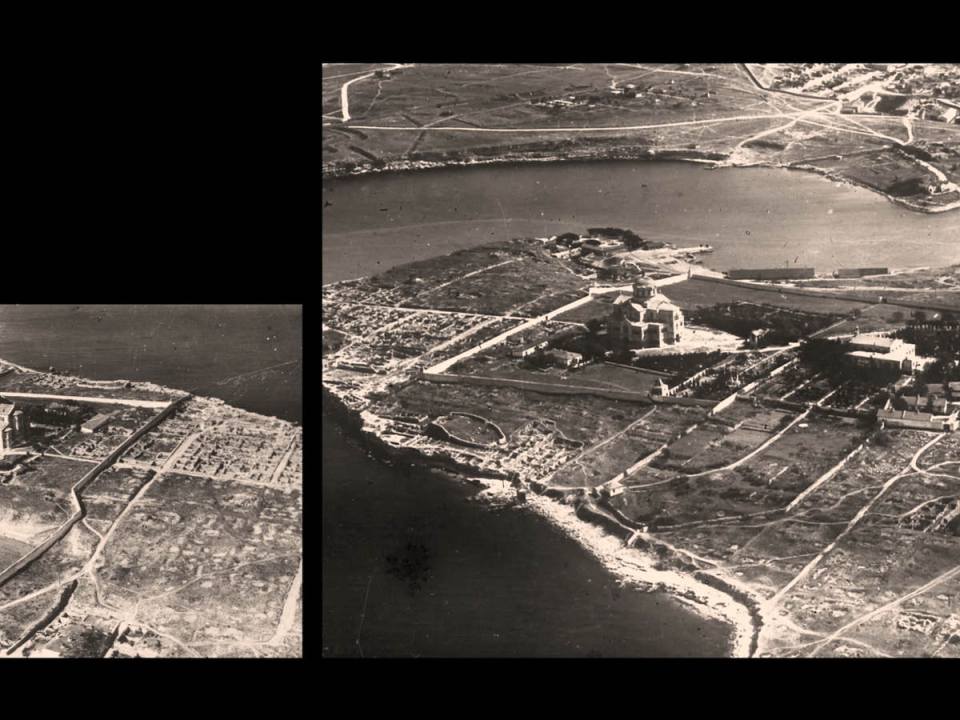
Lead image: Aerial view of the northern fragment of excavations on the archaeological site of Tauric Chersonesus with the St. Volodymyr’s Cathedral among the remnants of the polis. Church, Chora, Chersonese, 2025. Video, 18′29″. By Center for Spatial Technologies (CST).
Categories