Architecture as a Manifesto

ESSAY
Architecture as a Manifesto:
At the Threshold of Narrative and the Reality of Space
by Nelli Shkarupina
[…] even if there are architectures without architects, there can be no architecture without an idea or concept. Architecture invents concepts and materialises them. […] Before forms,
architecture is about ideas.1
Since the early twentieth century, the genre of manifestoes has been repeatedly employed by architects. Being central to the theoretical discourse for decades, it frequently resurfaces in critiques within the field even nowadays. Since the 1910s, as the understanding of ‘architecture’ became ever more ambiguous and ever less unified, the definition of a manifesto has also developed varied interpretations. My interest in following this transformation began after reading After the Manifesto – a selection of essays on architectural manifestos, edited by Craig Buckley and published relatively recently in 2014.
The book emerged from two conferences that engaged with the question: What happened to the Architectural Manifesto?2 Upon first look, and still now, I am not capable of fully treating this question seriously. The customary conveyance of a manifesto presumes its content to be a single right answer to what its subject is, and the desired change is phrased as if it has already happened, or at least is happening inevitably. This definitive, authoritarian quality of a manifesto could be viewed as assertiveness. Yet, for the reader, such as myself, at times when one is surrounded with an overwhelming volume of information, but nothing is unquestionably self-evident, it rather comes across as naivety or even ignorance.
However, if a manifesto is to be considered a performative act, then it does not necessarily believe in its own words. As Buckley suggested, if its overt confidence is perceived as theatrical, this approach would reveal the concealed vulnerability of the presented idea.3 Charles Jencks, co-editor of Theories and Manifestoes in Contemporary Architecture (1997), compared the manifesto to the haiku, as an analogous art form.4 The form that similarly demands an exact character of expression. An architectural manifesto is conveyed not only through the primary meaning of the text; its idea is also communicated through the implications of the selected wording, font, colour, and format. As Mark Wigley puts it, in a manifesto, “the statement is always an aesthetic statement, even when the very theme is an attack on aesthetics.”5
The manifesto is associated with the black, the red, and the CAPITAL sans serif; the expected writing would be in numbered short theses explained concisely, presenting only the calls for action. The curious consequence of this style is that, despite the superficial clarity, the shortest expressions of a manifesto could easily remain abstract and, therefore, paradoxically ambiguous. A bold, broad, ‘aesthetic’ statement (if not elaborated) is open to interpretation. Thus, it is important to consider a manifesto not only as a self-contained piece that it appears to be, but in its larger context.
Buckley’s After the Manifesto included essays by, among others, Anthony Vidler and Mark Wigley, as well as one by Bernard Tschumi, which was added as the final essay of the book. Bernard Tschumi, an architect and theoretician, initially drew my attention with his noticeable presence at the Architectural Association. There, I encountered his work in history lectures, stories passed at the school terrace, as well as physical spaces – on the walls of the print centre, where one lets the eyes wander off to his posters, and at the library, which cares for multiple AA Publications listing him as an author. Alongside my interest in the content of his theories, I find it fascinating to unravel what literary and visual tools he used for their representation. In this think piece, I question what the role of the manifesto specifically was in his projects, and, conversely, what meaning these projects held for the development of the manifesto itself.
Bernard Tschumi established his own studio in 1983, winning an architectural competition and realising the project of Parc de la Villette in Paris. However, the main references for this writing predate any of his built work. He described the period after arriving in New York in 1975 through his objective to “redefine the nature of architecture.”6 In the following years, he published several experimental works, combining them under the title Architectural Manifestoes – “in the plural, so as to remove the pretence of a unifying theory.”7
Since a manifesto is a literary tool to change the existing condition, it is quite a declarative gesture, as well as an anticipatory one, to frame one’s own ideas as manifestos, not as mere explorations or drawings. Yet, through the plurality in the title and further alterations to what is usually identified as a manifesto, Tschumi remained critical of the genre, incorporating an analytical element into his work. I find this self-reflective quality particularly interesting in his publications; it suggests a far greater range of applications for manifestos in times when there is neither a universally accepted view on architecture, nor a widely embraced striving for it. It seems that writing about architectural manifestos as a phenomenon has been no less compelling than writing an actual manifesto; Bernard Tschumi did both.

‘Manifestoes’ resemble contracts that the undersigned make with themselves and with society. As with all contracts, manifestoes imply certain rules, laws and restrictions. But they soon become independent from their authors. At this point, a masochistic relationship begins between the author and the text itself, for the manifesto-contract has been drafted by the very person who will suffer from the restrictions of its clauses. No doubt such carefully devised laws will be violated. This self-transgression of self-made laws adds a particularly perverse dimension to manifestoes. In addition, like love letters, they provide an erotic distance between fantasy and actual realisation. In many respects, this aspect of manifestoes has much in common with the nature of architectural work. It plays on the tension between ideas and real spaces, between abstract concepts and the sensuality of an implied spatial experience.8
Tschumi’s Architectural Manifestoes now exist in the form of an extended exhibition catalogue, published by the Architectural Association in London circa 1979; the quoted writing was included as an introduction, and each of the projects within was considered to be a manifesto of sorts. Although some of the included works also appeared separately, with the exhibition long gone, only the formatted imagery and complementary catalogue descriptions remain to be viewed today.
These ‘manifestoes’ were, and still are, a provocation. From the language of the writing to the juxtaposition of photography with conventional and unconventional architectural drawing, this body of work remains teasingly playful and, at the same time, serious in its intent to shift the dialogue at a large scale. For instance, the exhibition was accompanied by a series of statements such as “Form follows fiction.”9 It displayed an ironic attitude to modernism as a historicised and, by then, irrelevant approach; at the same time, it functioned as a way for Tschumi to position himself alongside the most well-known ‘revolutionaries’ of architecture.
The modernist works which he refers to could be recognised as the most ‘conventional’ architectural manifestos for their sense of immediacy, collective acceptance, and self-importance – these are such publications as Towards New Architecture: Building Principles (1920) by Le Corbusier, La Sarraz Declaration (1928) by CIAM, and others. The later manifestos, such as the ones by Tschumi, were more diverse in their iterations and often merged with other declarative forms of literary and visual expression. I believe this to be the reason for the theoretical books to blend manifestos with ‘programmes’ and ‘theories,’ refusing to draw a clear boundary between them.
In Tschumi’s work, one of the features that is different from the earlier examples is how he describes what will happen in architecture instead of what already is. For instance, in “The Park”, he writes: “Architecture will not simply be the expression of accepted functional or moral standards. Rather actions, whether forbidden or not, will become an integral part of architecture [italics added].”10 Furthermore, when it was published as part of The Manhattan Transcripts (1981), the projects were introduced as “a tool-in-the-making, a work-in-progress,” and by no means “a definitive statement.”11
Alongside the rest of the transcripts, The Park suggested treating an architectural drawing as a ‘script’ for the represented space, a ‘scenario’ that the architect creates to interpret space in a particular way. Rather than dictating rules for the physical form itself, Tschumi aimed to create a new way of reading a spatial idea, communicated through multiple narrative-based series of its two-dimensional imaging.

Coming back to the catalogue, one could follow other challenges to the premise of a manifesto. Grounding the definition in the etymology and history of the manifesto, Anthony Vidler described it as “a call to action (military or otherwise) and a revelation (religious or otherwise).”12 In the world of art and design, a manifesto was also used as a means for individual self-proclamation.
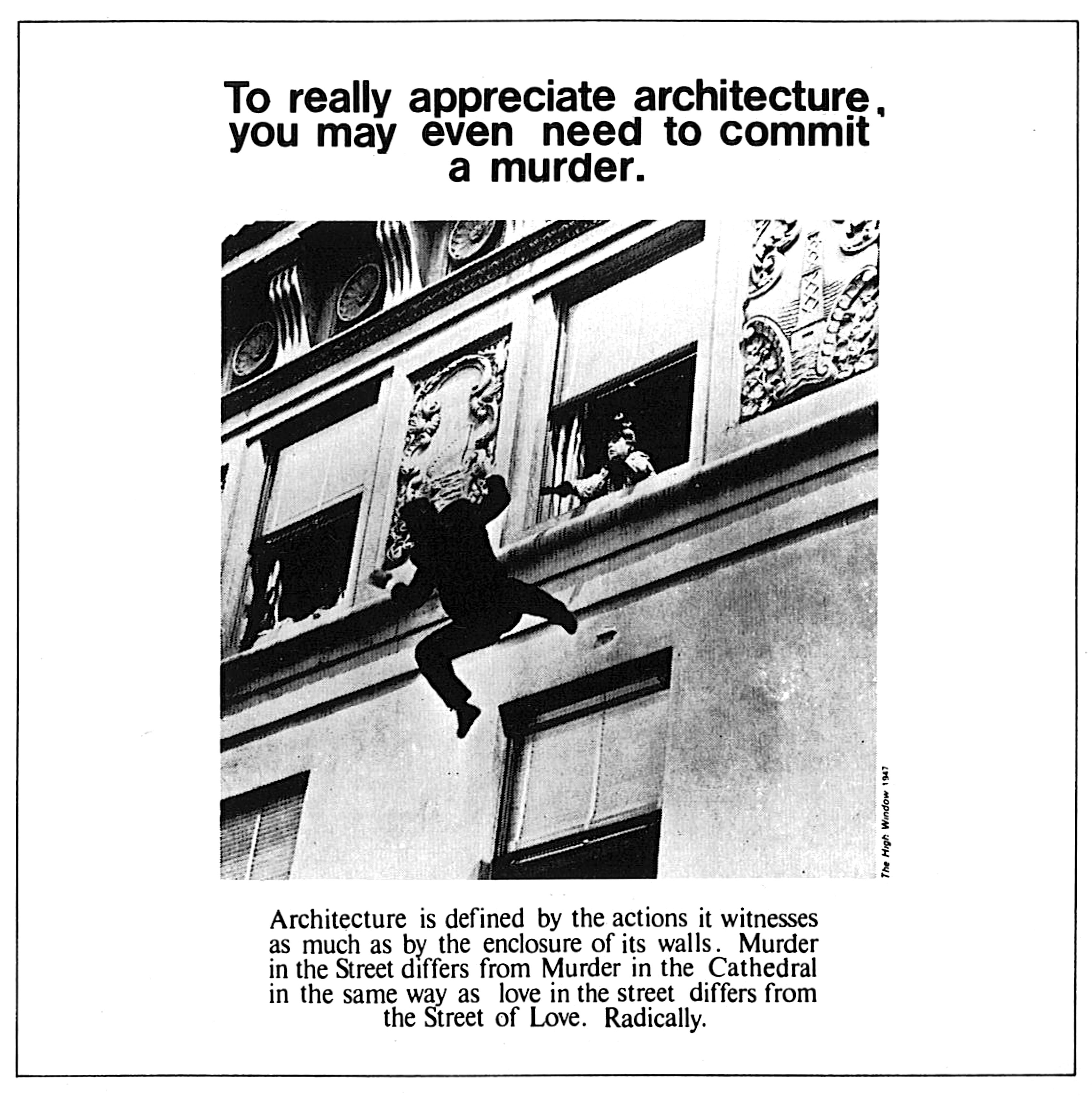
This aim of a manifesto, to share an architect’s methodology with a wide audience, is synonymous with the idea of Advertisements for Architecture (1976) by Bernard Tschumi, a series of postcard-sized publications intended to be distributed as advertisements. Curiously, created with “the sole purpose of triggering desire for architecture,” these were not advertisements for the ‘product’ of architecture, but for its ‘production.’13
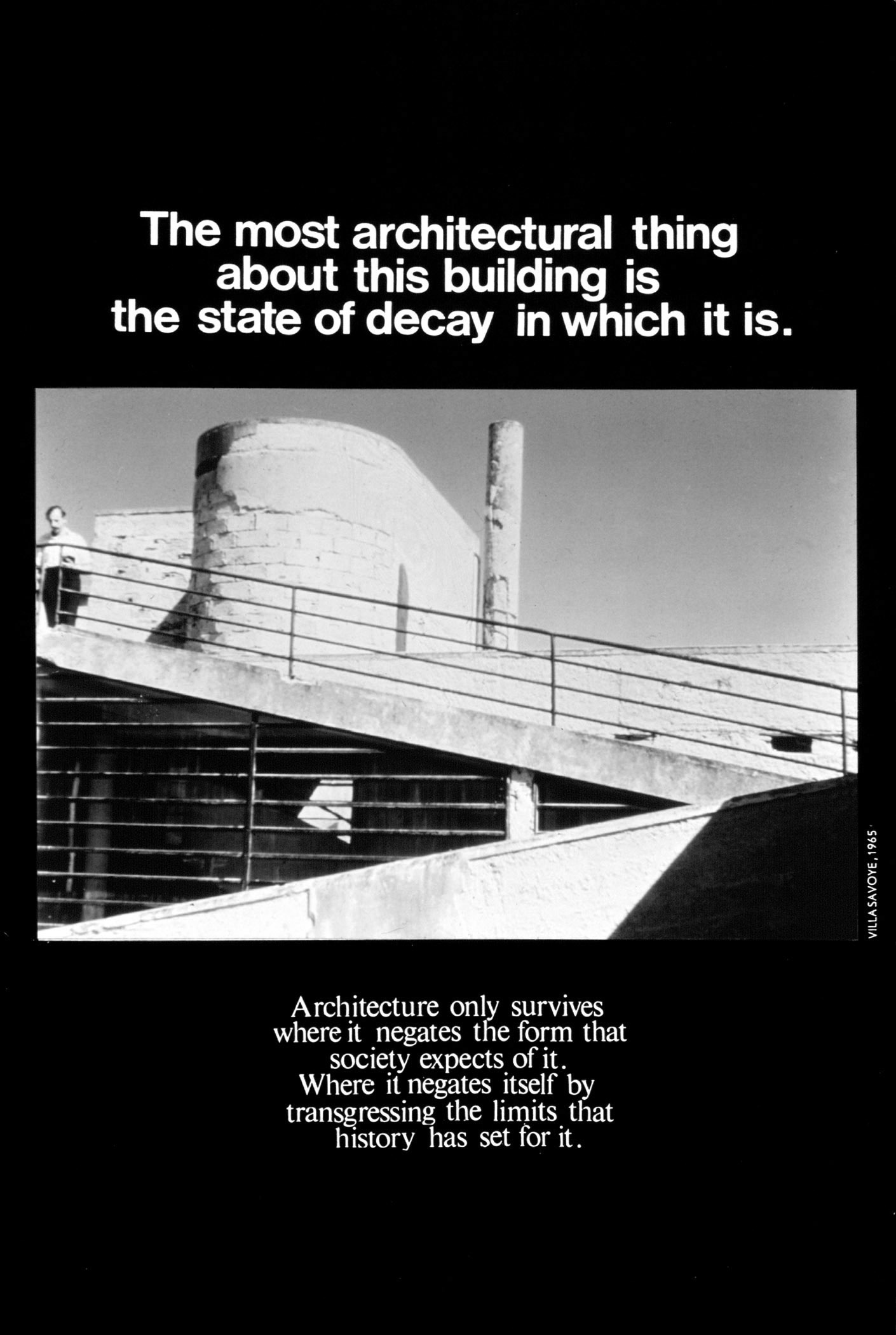

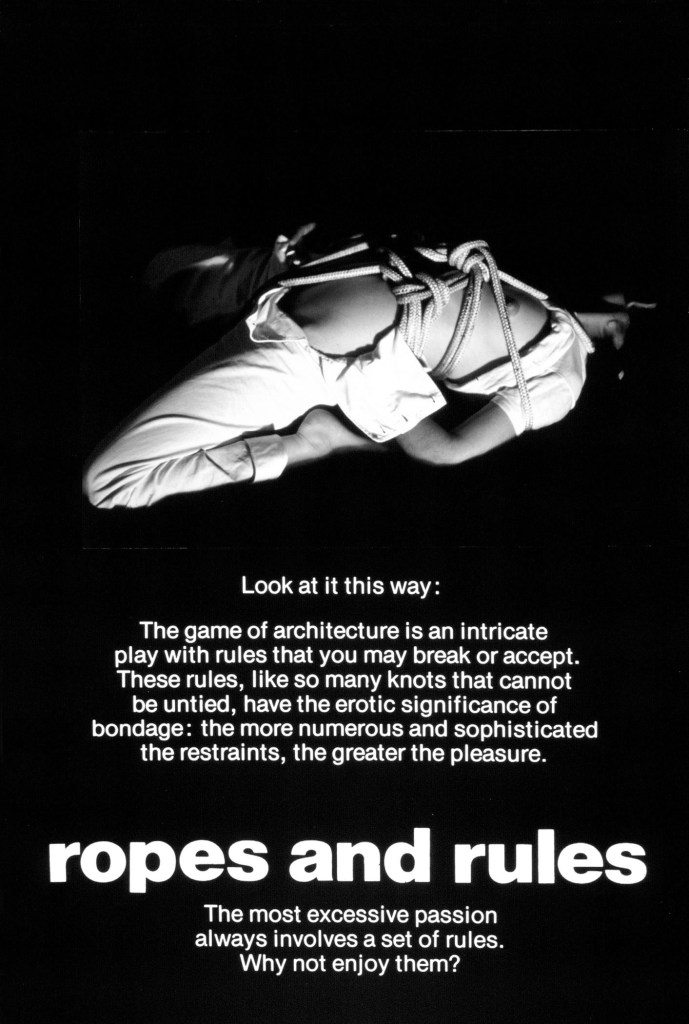
Bernard Tschumi, Advertisements for Architecture, 1976–1977. In Architectural Manifestoes.
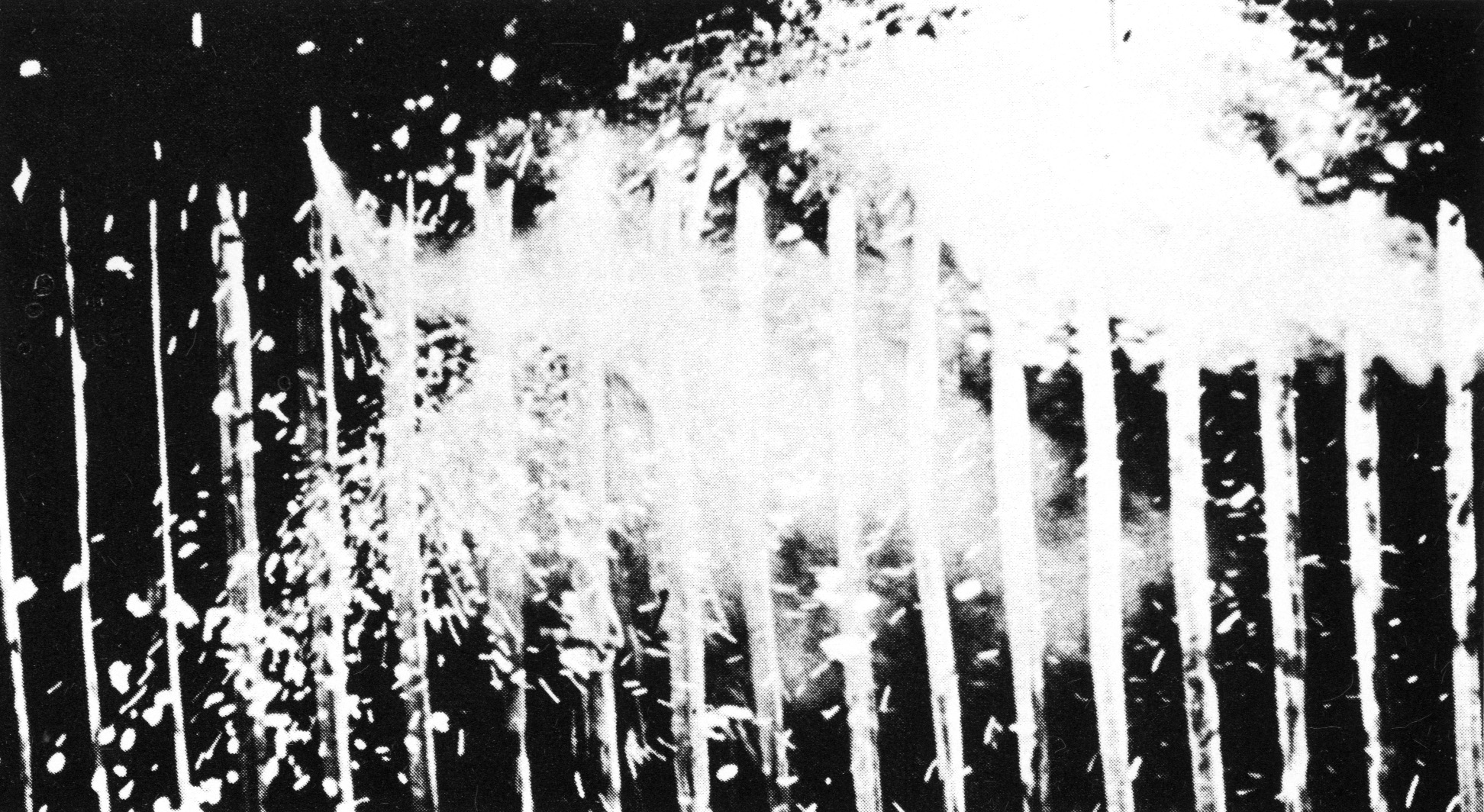
In the first project of the catalogue, Tschumi described the fireworks as “the greatest
architecture of all.”14 Showing “the gratuitous consumption of pleasure,” for Tschumi, they were a manifestation of architecture created not for a pragmatic meaning, but for the delight of its making.15 Once again challenging the connotations of the term ‘architecture’, this approach elevated the discussion from the conflict between functionality and form-for-the-sake-of-form into the conversation about the design process being an independent practice, separate from the built spaces; “[…] good architecture must be conceived, erected and burned in vain.”16
One of the most interesting features of architecture as a field is its intersection with multiple disciplines; space can be understood as physical, as well as intangible, and, in both versions, it is subject to individual perception. The boundary between architecture as a theoretical conversation or an artistic expression and architecture as a constructed, occupied space is not fully clear, which is what Tschumi explored as a theme of study in itself. He devoted significant writing to the relationship between the ‘idealistic’ and the ‘physical’. The installation ‘Rooms’ (1978) is opposed to the preceding pieces.
‘Rooms’ are not manifestos in the proper sense. Real spaces or real objects, rather than representations, they are the exact reversal of the previous six pieces. While the others are plots or fantasies that desire a space to exist, here are spaces that desire a plot. The reality of the space somehow implies the subjective reality of sensual experience, as the materiality of your body coincides in the materiality of that space.17
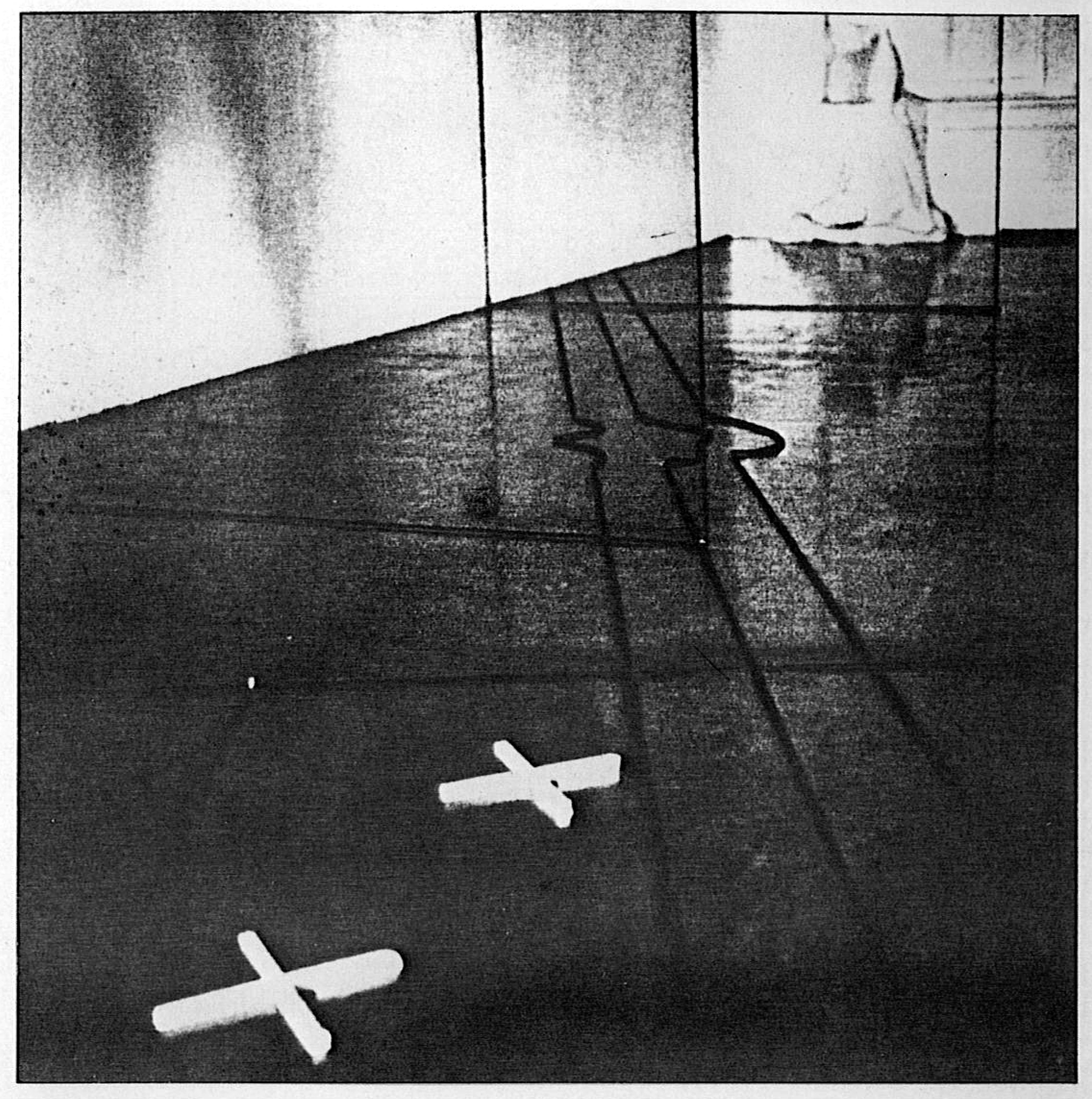
The description concludes with his statement: “A real table cannot be printed on a page.”18 It prominently echoes René Magritte’s infamous piece, The Treachery of Images (1929); just as the painting displays a depiction of a pipe, neither a photograph nor a drawing could host a real space; only a version of it directed by its draughtsman.
In the experiments conducted by Bernard Tschumi, as well as my exploration of his work, the certainty of a manifesto is distorted in confrontation with the discrepancies between narratives and reality. While one is able to vocalise their theory in a single definitive manner, the physical manifestation of architecture evokes multiple unique perceptions and, therefore, cannot be flattened into its single projection or scripted by a single scenario. However, acknowledging this divergence would allow one to write a manifesto that recognises the limit of its influence over its fulfilment.
Leaving his statements in the speculative realm, Tschumi also created more freedom for himself to adjust or redevelop the notion of architecture in every piece. He recontextualised architectural ideas within their emergence from the two-dimensional imagery; the realised spaces within their projections returned to the paper realm; then, the places within the events that happen there (not as a consequence of their design, but in correspondence with their formal and social constitution).
Looking back, I started studying manifestos because of my scepticism about how categorical a manifesto ought to be. I was rejecting the arrogance of the form in which the idea was given; yet, by voicing my disagreement, I simultaneously submitted to its provocation, responding to the desire for attention that manifestos project. Although the loudness of a manifesto is offensive, it seduces the reader to respond, a valuable quality to utilise in theoretical dialogue.
According to Tschumi, any form of communicated idea that challenges the existing, verbal or visual, could be a manifesto. Ironically, after writing this piece, I feel as if I have less certainty of what a manifesto is than before; however, I suggest embracing this uncertainty. Rather than an exception, I see the self-reflective aspect of Tschumi’s manifestos as an important part of the genre’s evolution. Such an approach allows the manifesto to acknowledge its position as a form of subjective expression, enabling it to find new relevance in the conversation today.
Some might wonder if I would write my manifesto after this study, but I stubbornly refuse to make a manifesto of my own; furthermore, I disagree with the idea, promoted by some practitioners, that ‘architecture,’ by any of its definitions, will die without manifestos. Alternatively, I suggest a way of looking at such declarative forms with consideration of their constraints, as well as their aesthetic objectives. Perhaps, relating the manifesto even further to varied media of image-making, while carrying its sense of urgency, would not dilute but enhance the exciting tension between an idea and its embodiment that makes manifestos so precious.
NELLI SHKARUPINA is a multidisciplinary artist and designer with a background in art and architecture. Her current focus lies in the relationship between physical space and its intangible manifestations in culture and memory. Together with Renate Baumane, she is investigating this theme from various perspectives and questioning the definitions of architecture.
***
Edited by FLORA SAGERS
Proofreading by JOSH WEEKS
Lead image by Jingda Chen via Unsplash.
Categories