


THE FIRST PAGE
Recognition Politics in Settler Colonial States: Normalizing Dispossession and Elimination in Palestine
by Emile Badarin
20 October 2025
The First Page presents the first page of books that are launched as part of the IAS Book Launch series. On 20 October 2025, Emile Badarin will present his book Recognition Politics in Settler Colonial States, in which he is using Palestine as a case study to show how recognition politics operate to legitimise long-standing colonial power structures. He shows that in colonial contexts, settlers use recognition to legitimise and normalise the dispossession and elimination of Indigenous people and that settler-colonial states themselves actively pursue recognition to further the elimination of the indigenous societies they seek to replace. Central to Badarin’s analysis is how anti-Zionism has been strategically equated with anti-Semitism, and effectively used as a tool for the advancement of both settler-colonialism in Palestine and Israel’s recognition on the international stage.
Introduction
Recognition as a medium for conquest and elimination
Liberal thought has canonized recognition as a channel for emancipation, mutual respect and peaceful co-existence. This conviction in the emancipatory force of recognition stems from the well-known master–slave dialectic portrayed in G. W. F. Hegel’s seminal work, The Phenomenology of Spirit, published in 1807. In this hypothetical dialectic, the master is the starting point of recognition, which unfolds as a medium for achieving freedom and universal equality. In contrast, Frederick Douglass, a Black American who was enslaved by a European white settler-master, an abolitionist and later a statesman, offers a real-life and revolutionary account of recognition, which responds to the victims’ yearning for freedom. A brief biographical overview of Douglass helps explain recognition from the perspective of enslaved and subdued individuals.
Douglass was born in 1817, a decade after the publication of Hegel’s book, into slavery on a plantation farm in Maryland in the United States to an enslaved African mother named Harriet Bailey. He was separated from her as an infant. She worked from dawn to dusk on a plantation farm and walked several miles each night to see her son until she died a few months later. As Douglass recalls in his memoir, he had no memory of ‘ever seeing’ his mother in daylight. In Douglass’s world, the only social recognition that was available to him and his fellow slaves was the market value of their labour and disposable bodies. Neither the European settler-cum-master nor the slave coveted each other’s recognition. On the contrary, Douglass’s sense of self-worth stemmed from the love of another plantation slave: his mother. Despite the societal disregard for him save for his potential for labour, she undertook the arduous journey to reunite with her child until she died. A genuinely radical and revolutionary transformation occurred when Douglass discovered the value of recognition from people whom the European settler society in America considered a subhuman and insignificant race. It was at this point that the struggle for recognition began. However, this was not a struggle for obtaining recognition…
Recognition Politics in Settler Colonial States: Normalizing Dispossession and Elimination in Palestine was published by Bloomsbury in June 2025.
EMILE BADARIN holds a PhD in Middle East politics from the University of Exeter. His research cuts across the disciplinary boundaries of international relations, Middle East politics, colonialism and coloniality and the Question of Palestine. He has published widely on these topics in impactful international journals. His first book was published in 2016, Palestinian Political Discourse: Between Exile and Occupation.
On 20 October 2025 Emile Badarin will launch his book Recognition Politics in Settler Colonial States at the Institute of Advanced Studies. More information.
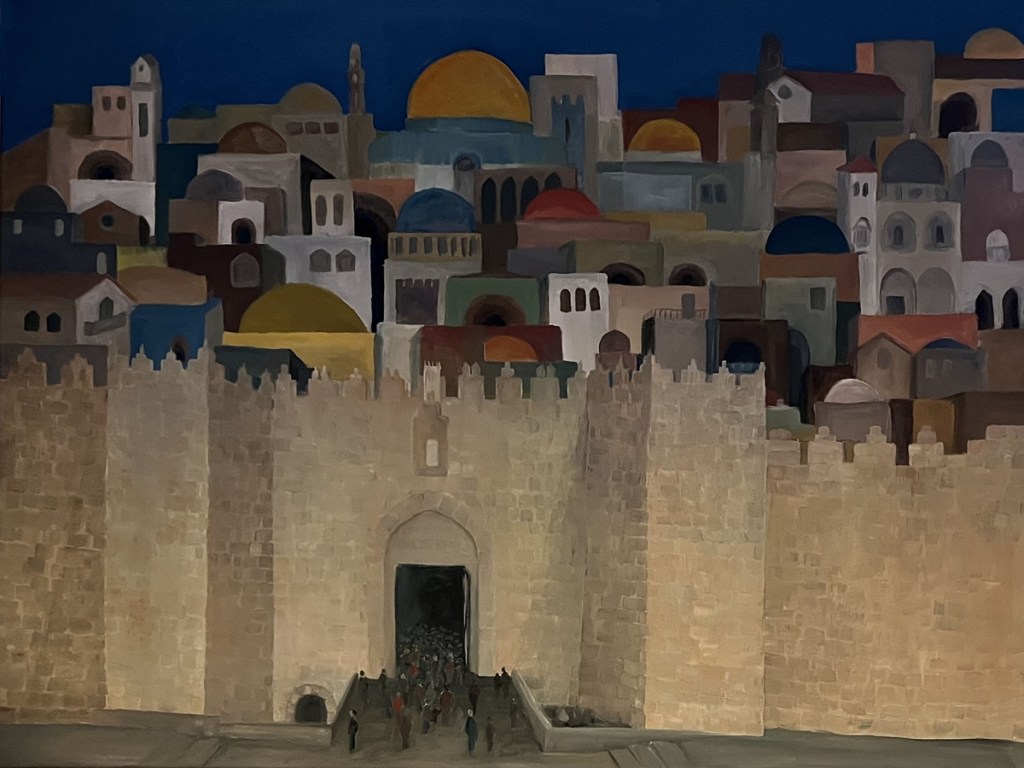
The lead image is a detail of a painting created by Emile Badarin.
Categories