Shocking the System

CONVERSATION
The Consequences of Shocking the System:
Comparing Evolution and Disasters
with Rozana Himaz and John Martin
30 May 2025
In this conversation, Rozana Himaz (UCL Department of Risk and Disaster Reduction) and John Martin (UCL Medical Sciences) draw from their research in economics and medical science to explore how a shock can affect people across their lifetime, across future generations and even across millions of years. Their conversation develops from an event they led at the IAS, ‘The Consequences of Shocking the System: Comparing Evolution and Disasters’ on 3 March 2025.
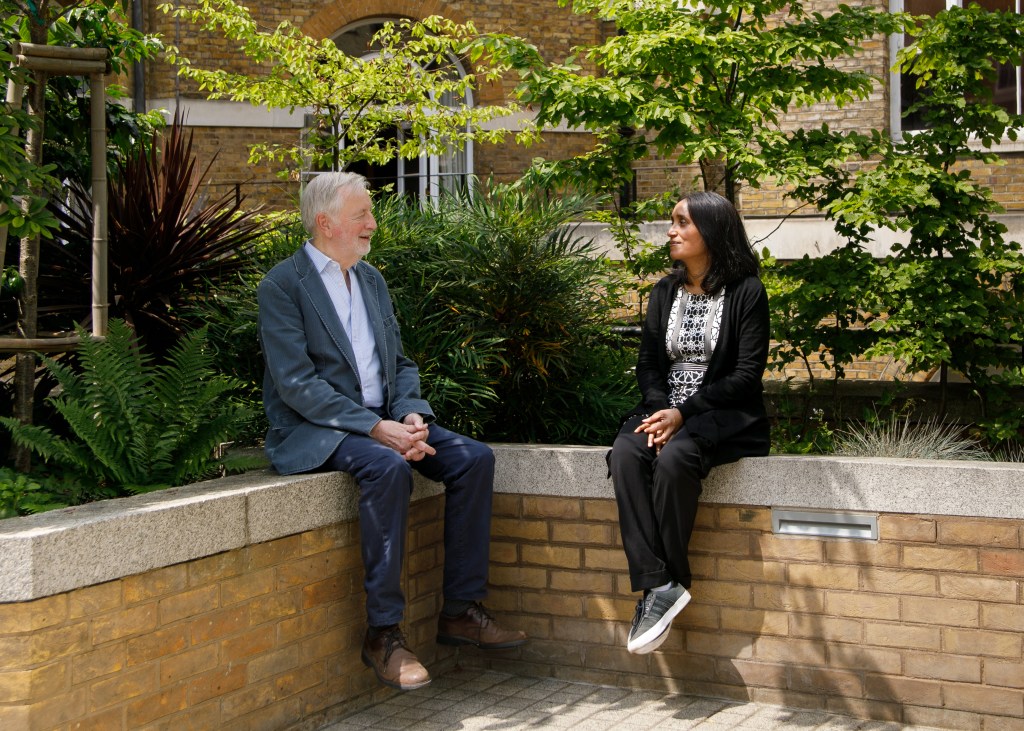
Rozana Himaz: In my work as an applied microeconomist, I use large longitudinal household surveys that follow the same individuals across many years and statistical methods to understand how a ‘shock’ that is external to the system such as parental death, a tsunami or an earthquake, can have significant consequences in the short and longer terms. How about your research?
John Martin: My study of platelets – the small cells in the blood needed to stop bleeding – led me to a new theory of the evolution of mammals and, therefore, humans. This theory is a companion to Darwin’s theory. The new theory proposes that 220 million years ago, there was an explosive change within one animal, in the cells that stop bleeding. That change was inherited by offspring, giving future generations an advantage through natural selection. Better blood clotting allowed the evolution of the placenta and, therefore mammals and therefore humans. One shock event in one egglaying animal was necessary for us to exist.
RH: Central to our discussion is this idea of a ‘shock’. In our talk at the IAS, we defined shocks as natural events that were exogenous and unpredictable. These could be idiosyncratic, affecting a single unit, such as parental death or change in an animal cell, or covariate, affecting a group, such as tsunamis or landslides. Do you have any further thoughts on this concept of ‘shock’?
JM: I think the Big Bang, which started the universe, is analogous to my idea of shocks. The cell mutation that led to mammals was a second Big Bang. From a biological point of view, without certain shocks, we wouldn’t even be here. The mutation that created placentas, for instance, allowed mammals to evolve. Without it, we’d still be egg-laying creatures with small brains – no humans, no societies.


RH: That’s fascinating. So what’s the cause of the shocks that you investigate?
JM: Stephen Hawking says the Big Bang came out of nothing; there was nothing there. I find that impossible to accept. Cause and effect are inherent in our knowledge of what the world is, and in our disciplines, economics and medical science. So, I cannot accept that the Big Bang came out of nothing. There had to be a cause before that – and in religion, most people would say it was God . I have gone away from believing in the God of my childhood to a more sophisticated God, which I think is a combination of all those constants which were necessary for the Big Bang to occur, which had to exist before the Big Bang. And perhaps they are God or part of God if we define God as a cause of the universe. That first change of a single cell, perhaps it was Gamma rays from outer spaceor the finger of God.
RH: To say that something started from nothing is more a reflection of us not understanding ‘nothing’. The type of shocks I study, such as the Indian Ocean Tsunami that killed around 200,000 people in 2004 or the death of a parent when one is still a child, may not seem like the Big Bang in the cosmic sense, but are big bangs for the individuals involved. These events are turning points that deeply affect people’s lives. Although the media might present these events only in terms of immediate loss, they can trigger long-term transformation and shifts in life trajectories. In some of my work, I show that the death of the father in Ethiopia during a child’s adolescent years between 12 and 19 can have positive impacts on a child’s sense of agency and peer relationships, if the wider developmental context is not disrupted. Despite the pain, some of the uses of adversity can be sweet. We can also show empirically that while the 2004 Indonesian tsunami had disastrous consequences, including some that were inter-generational, the unprecedented aid flow in the aftermath supported several positive longer-term outcomes.
JM: Right. Whether it’s evolution or social change, some shocks create space for entirely new realities. Not always for the better – but definitely different. Indeed, whether an outcome is ‘good’ or ‘bad’ depends on our moral and philosophical stance. What is the role of women in your work? I’ve discussed the blood clotting platelets, evolution and the importance of the placenta in mammalian evolution, and therefore the creation of human beings. So in my work, it is really women that were central to the whole of mammalian evolution. It was all about them.
RH: In my work, natural hazard shocks can affect men and women differently. It’s not the case that women are always worse off, or men are. In the case of the 2004 tsunami, orphaned adolescent boys dropped out of school more than girls in Indonesia to join the workforce. This may have affected their productivity and wages in the longer term. By the same token, there’s a lot of work that shows how disasters can be particularly detrimental to women. Sometimes the focus on women is driven by the project funder’s agenda – not because men are not affected or necessarily suffer less.
JM: It also makes you wonder about what could have been. What if the tsunami hadn’t happened? What if the cell mutation had never occurred? These counterfactuals challenge us to see just how much of our reality rests on moments of rupture. It also makes us think of ways in which interventions can be designed to mitigate impacts, if negative. If the mutation had never happened to that single cell I’m talking about, we would not exist wouldn’t have existed, and animals would have remained egg-laying. The big brains of humans wouldn’t have occurred because they needed nine months inside the mother. So letting things take its course brought about humans.
RH: That’s an interesting point. Do you think we try to control too much when we, as policymakers or professionals, design interventions to mitigate perceived impacts of shocks? Maybe we need to let things evolve more organically and reduce the prescriptions. Top-down policies often miss the mark. Yet if we leave everything to ‘evolve,’ the process of arresting negative consequences might be too slow or unequal. Perhaps the real task is co-creating change with the people who are actually affected – working with local systems instead of imposing external ones.

JM: That makes sense. Prescribing without understanding leads to shallow solutions. But how do you find that balance?
RH: It’s tricky. Often, small behavioural shifts – like how people use resources or respond to trauma – have more impact than any sweeping policy. But they’re rarely accounted for because they’re hard to measure. And sometimes ignored. Policymakers want numbers, not nuance. In contemporary development economics, journals are dominated by randomised control trials that seek to find the causal impact of an intervention. While they can be useful to answer specific, controlled questions, taken individually they miss the bigger picture – the wider, deeper reflection of causes, consequences and patterns. There was a talk recently about how childcare vouchers in an international development context can get mothers back to work as early as a couple of months after giving birth. The intervention was discussed as a success, without enquiry into what that outcome meant for the infant, how the child’s father fitted into the picture, and other related aspects.
JM: Yes. And there’s an inherent problem in the randomised control trials that we find in medical studies – I’m not sure if you account for this in economics. Any population within a randomised control trial is heterogeneous. If you take heart attack, for example, you can do a randomised controlled clinical trial on an intervention preventing heart attack. But there is a problem: I believe that heart attack is caused by four or five different diseases if you define disease as a specific cellular or molecular change. Therefore, if you’re trying to prevent it, there should be four or five different controlled trials performed, but at the moment, we just take all heart attacks. We give patients a therapy to see whether it works or not in the randomised control clinical trial. But the problem is that the results are applied to an individual human being who might not fit into any part of the heterogeneity of the randomised control clinical trial. The solution needs wider thinking.
RH: I agree that narrow designs produce narrow answers. We can extend this analysis to other domains. We currently have created systems – academic, institutional, and even funding structures – that reward small thinking. Deep, risky ideas don’t fit the format.
JM: There’s no space for speculative thought when everything’s driven by citations and metrics. And within the narrow parameters for success, driven by grant-giving bodies. We talk about impact, but often it’s just impact factors. Wider thinking is essential, as well as the time to develop intuitive novel ideas – ideas that are wide, deep and experimental.
RH: A bit like what we are doing now, having conversations across disciplines, trying to understand where we come from and where we can go. We’ve covered some interesting themes such as what exactly we mean by shocks in our separate works, and how its consequences can create new realities across a person’s lifetime, across future generations and even across millions of years. We both note in our works how there is adaptation to shocks and inherent resilience, and how the methods we use and questions we ask can benefit hugely from learning from each other’s disciplines.
JM: Yes. This is probably what Clive Cookson [Senior Science Writer at the Financial Times], who chaired our talk at the IAS meant when he noted that conversations such as ours are exactly what should be happening in universities.
ROZANA HIMAZ is Associate Professor in Humanitarian Economics and Chair of Research at the UCL Department of Risk and Disaster Reduction. Her work has been used as evidence in the UK House of Commons, Scottish Parliamentary debates and as evidence to support a $100 million investment by the World Bank in modernising general education in Sri Lanka.
JOHN MARTIN is Professor of Cardiovascular Medicine at the UCL Centre for Cardiovascular Biology and Medicine. He is a clinician-scientist working in University College Hospital and researching in the university. He believes that new thinking is necessary to solve the problems of human biology and disease.
***
Edited by MARTHE LISSON
Proofreading by EYLUL BOMBACI
All images © Mariam Gomez
Categories