Astonishing Things at the Royal Academy of Arts

EXHIBITION
Astonishing Things: The Drawings of Victor Hugo
at the Royal Academy of Arts
Review by:
PATRICK BRAY
17 APRIL 2025
The towering figure of intellectual and political life in much of nineteenth century France: Victor Hugo. Every moderately-sized French town owns a rue/avenue Victor Hugo. Who does not know his name? Surprisingly, however, his talent in drawing with ink on paper, rather than writing, is still not as widely known as his books and plays. Even though Victor Hugo produced some 4,000 drawings in his lifetime. Truly Romantic in sujet and atmosphere; dark, eerie, creepy at times. Political, imaginary, even abstract; decades before abstract art was conceived of. A comparatively small selection of 70 of Hugo’s drawings is on view at the Royal Academy.
Victor Hugo’s artwork truly is ‘astonishing’. For those who were not aware that Hugo was one of the most accomplished visual artists of the nineteenth century, stop reading this review and go immediately to the Royal Academy of Arts to get a sense of his awe-inspiring drawings. And yet Hugo’s name is familiar to all, whether because of his novels such as Les Misérables (so famous we don’t bother translating its title) and The Hunchback of Notre-Dame, his poetry (all French schoolchildren recite his ‘Demain, dès l’aube’), or his long political exile in Jersey and Guernsey. During his lifetime, he dominated French culture and politics to a degree almost unimaginable to us today. Hugo’s life (1802-1885) spanned nearly the entire century that he claimed as his own: in one notable verse, he wrote, “This century was two years old…When in Besançon…was born of Breton and Lorrain blood, A child without colour, without sight and without voice”. This child would add colour to his writing; he would give vision to a new political reality by calling for a United States of Europe; and he would lend voice to the poor and unheard throughout the world. At his funeral, two million Parisians of all political persuasions and social classes gathered to pay homage to the man who did so much to create the world we now inhabit.1
But what about his visual art? Hugo made his name in poetry at the age of 15, revolutionised theatre and prepared a political revolution with his play Hernani at the age of 28, yet it wasn’t until his 30s that he started to develop his drawing into more than just a casual hobby. By the time he went into exile in the 1850s, his drawings developed from sketches to complex experiments in forms and techniques. At the time of his death, he had created nearly 4,000 drawings, and yet hardly any had been exhibited to the public or reproduced in print.

His literary work and aesthetic thought constantly return to the fact that writing is always both aural (we hear the words we read in our head) and visual (visible letters on the page). The act of ‘seeing’ involves interpreting the signs hidden in plain sight all around us. The world is a text for us to read. As Stéphanie Boulard and Pierre Georgel demonstrate in their book Hugographies: Rêveries de Victor Hugo sur les lettres de l’alphabet (Paris: Hermann, 2022), Hugo’s drawings are obsessed with the letters of the alphabet, hiding them in the most unlikely places as signs that point to an interconnected world.
We can see these letters in nearly all of the drawings of the exhibition. The clearest instance is in the drawings and photographs of Hugo’s house in Guernsey, where the magnificent fireplace is in the form of an enormous H. or his Visiting Card for the New Year, 1856 (one of several cards he made every year for his closest friends), which features a stylised ‘H U G O’, with a ‘Victor’ inscribed in miniature on the ‘H’, and a church in the background (itself in the form of an H and an inverted V).
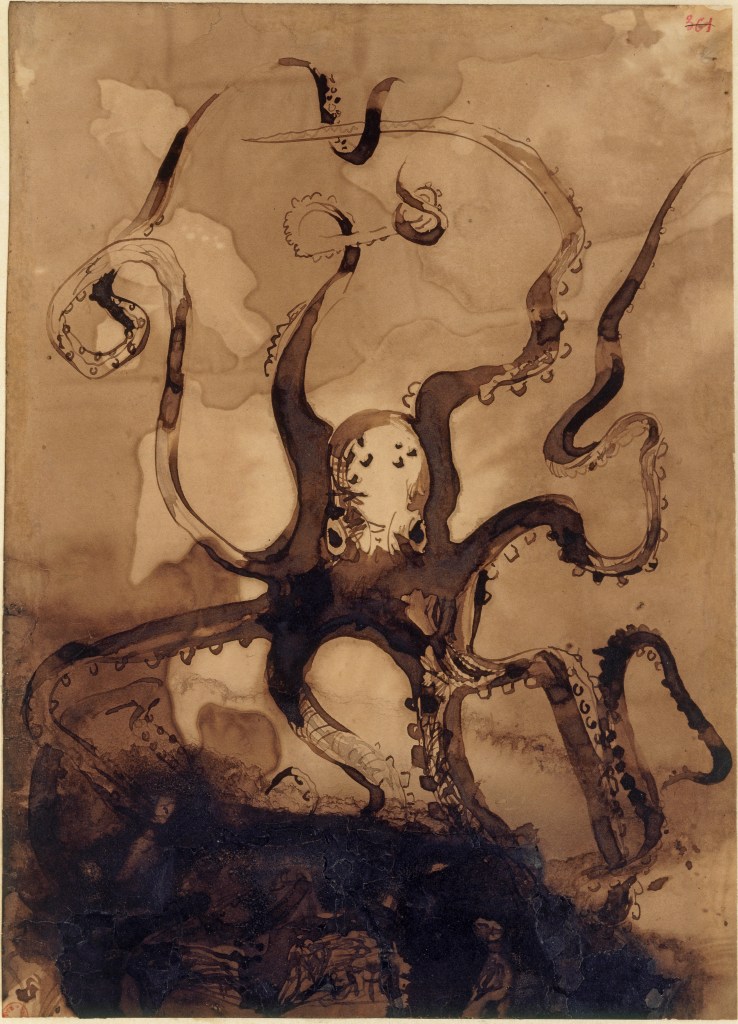
More surprising is the drawing of an octopus, which serves as the exhibition’s main attraction. Hugo’s novel The Toilers of the Sea had introduced into French the word pieuvre, a word used by the fishermen of Guernsey for octopus. In his drawing (1864-66, pen brown ink and wash on paper), we can make out letters such as ‘V’, ‘O’, and ‘U’ formed by the tentacles, and by following the indications from the novel The Toilers of the Sea, an ‘H’ created by the body centring on the giant forehead of the octopus, which recalls Hugo’s own famously large forehead.
The exhibition at the Royal Academy of Arts is organised thematically instead of chronologically, which allows us to perceive resonances in Hugo’s work such as the repetition of letters, but also the experimentation of new types of forms. The themes are Writing and Drawing, Observation and Imagination, Fantasy and Reality, and Ocean, though many themes overlap. The showstoppers, besides the octopus, include incredibly detailed miniatures, a giant multicoloured and oddly phallic mushroom, ‘Ecce Lex/John Brown’ (a pen, ink, and pencil drawing of a hanged man), and the enigmatic ‘Planet-Eye’, which combines an ink spot with added details to draw the connection between the cosmos and human vision.

Despite the many qualities of the exposition in bringing together so many extraordinary pieces of Hugo’s artwork, the museum-goer will perhaps be left puzzled by the layout, arrangement, and descriptions. The themes only loosely tie into the drawings displayed and the written descriptions and guide include several errors and basic French mistakes (homme ocean instead of homme océan, Les Miserables for Les Misérables). We learn that Hugo ‘began his career as a royalist, but from 1851 onwards… he came to represent the ideals of the French republic’ – however, his political turn had come much earlier, as evident in his plays Cromwell and Hernani, or in his poem Écrit en 1846 where he replies to a former political ally turned critic, “I grew up”.
The very title of the exhibit is misleading, as the curators themselves admit. It is taken from a letter from Vincent Van Gogh to his brother, where the painter admires Hugo’s visions as ‘Astonishing Things’, though it is very unlikely Van Gogh had ever seen any of Hugo’s artwork, but was rather referring to his writing.
Still, the point of this exhibition is the drawings themselves. ‘Astonishing Things’ will change the way you see, not just the writer Victor Hugo, but the world around us, from landscapes and trees to politics and fantasy, and even the planets above.
Astonishing Things: The Drawings of Victor Hugo is on view at the Royal Academy of Arts from 21 March – 29 June 2025. It is organised in collaboration with Paris Musées – Maison de Victor Hugo and the Bibliothèque nationale de France. More information
PATRICK BRAY is Director of the UCL Centre for French and Francophone Research, Institute of Advanced Studies.
Lead image: Victor Hugo, The Cheerful Castle, c. 1847. Pen, brown and black ink and wash, crayon on cardboard, 15.8 x 22.2 cm. Maisons de Victor Hugo, Paris / Guernsey. Photo: CCØ Paris Musées / Maisons de Victor Hugo
Categories