The Sun, the River and the Spirits

INTERVIEW
The Sun, the River and the Spirits:
Uzbek filmmaker Saodat Ismailova
by Maja & Reuben Fowkes
10 April 2025
Saodat Ismailova is an Uzbek filmmaker and artist. In her work, she interweaves myths, rituality, and dreams within the tapestry of everyday life, investigating the historically complex and layered culture of Central Asia which stand at the crossroads of diverse material histories and migratory legacies. Her research encompasses the region’s ancestral knowledge and traditional spiritual practices, as well as the modern history of Uzbekistan. In 2022, she showed her video Chillahona at the 59th Venice Biennale and presented her work Chilltan at documenta 15. From October 2024 to September 2025, she is Creative Fellow at the Institute of Advanced Studies, in the research project on the Socialist Anthropocene in the Visual Arts (SAVA).
Maja & Reuben Fowkes: How does your work shed light on the transformation of nature in Central Asia?
Saodat Ismailova: Environmental questions come to the fore in many of my works, including The Haunted, The Stains of Oxus or Fishing in an Invisible Sea, a film from 2004 that was my first on the subject. It took the form of a documentary dedicated to the people that are living through the transformation of the landscape around the Aral Sea.
Stains of Oxus is a film that follows the Amu Darya, which is the longest central Asian river at around two and a half thousand kilometres in length. It starts in the Himalayas, in the Pamir Mountains in Tajikistan, because water in Central Asia comes from the melting of glaciers. In fact, before making Stains of Oxus, I made documentaries on the music and dance of Central Asia, which allowed me to travel throughout the region. I think that crossing the landscape creates a different type of connection and understanding to what we read in books or hear from oral accounts. It’s a more physical realisation, a physical measure of Central Asia.
So, I went a couple of times to the Pamir Mountains before making the film, going up the Amu Darya river, which also changes its name along the way. As you go up, on the other side of the river, there is the longest border with Afghanistan in Central Asia. It was very interesting to see how the same population is divided between the side that was in the Soviet Union and the side that was not. Although the people are from the same ethnic group and speak the same language, there are differences in relation to, for example, electrification. There is no electricity on the Afghan side and there are no roads, but other things are the same, as they have a very particular architecture there. And so I cannot speak about Stains of Oxus without thinking of these travels.
At one point it became evident that the Amu Darya is like an artery of the region, and I wanted to make a work about it. Initially I thought – of course I realised it’s probably not possible – what if you travelled the entire length of the river by boat? But the river crosses many borders, it starts in Tajikistan, and then it crosses Uzbekistan, it enters Afghanistan, then it enters Turkmenistan, and then it re-enters Uzbekistan, then it goes to Karakalpakstan, and to the Aral Sea, where it disappears. Following the river, it was an interesting possibility to see how the river is born and then how it dies. But not in a natural way. As you follow the river, you see how the river was used for the irrigation system and for the delimitation of borders. For example, it creates an important statement about where the Soviet Union could, and where it couldn’t, exert influence.

M&RF: Your work abounds with references to spiritual dimensions, traditional beliefs, dream worlds, and spirits. Also in relation to the natural world in Uzbekistan and Central Asia. How do you bring these spirit worlds, these dream worlds, to life in your practice? And why should these perspectives be part of our discussions today?
SI: Beliefs about spirits are, I guess, related to how people were trying to visualise and understand nature by projecting themselves onto nature. The presence of what we call spirits – animating or bringing to life something that corresponds to our human physical representation – is a way for people to understand the environment, the wind, the land, the trees, the caves. Normally in Central Asia, formations that are particularly outstanding, such as rock formations, old trees, or springs in deserts, are inhabited by spirits or at the centre of a lot of stories, and that’s where a kind of spiritual space of human experience is projected. For example, when I think about the project that I was researching for a while, Qyrq Qyz (40 Girls), it started because of this fascination with toponymical titles, of the qyrq qyz or the 40 girls, that we have so many of in Central Asia. But when you look at it, it’s always something related to nature, it’s a waterfall, it’s a cave, it’s a stalactite formation, so the connection is very close. I guess the spirits were replacing a scientific way of understanding for people who were living next to, or being enveloped by, nature.
The Haunted is a work that came out of the Stains of Oxus. It’s when I understood the presence of the Turan tiger, which we knew about, but it was totally blurry for us. But by going along the banks of the Amu Darya river, where the Turan tiger had its habitat, people kept on speaking about it. Although the tiger had disappeared, its presence was reinforced and it became a very strong spiritual figure that can guide us. When you lose the presence of an animal or a mountain, there is something that gets destabilised in the perception of life. The Haunted allowed me to speak not only about the disappearance of a species, but through the extinction of a species, also about the transformation of a landscape, the disappearance of a sea.

M&RF: It’s very hard not to ask about the chilltans, those shapeshifting mythical beings from Central Asian cultures that you introduced to a global art audience at documenta 15 in 2022, and described as taking many forms, from humans to tigers and even natural phenomena like the wind or clouds. What is the relation between the 40 chilltans and the 40 girls?
SI: The qyrq qyz, 40 girls, is a small part of the chilltan. Chilltan is the bigger idea, because chilltan, there is no gender definition, it embraces a bigger understanding of a force that – in simple words – it’s a presence that stabilises nature when it gets destabilised. It has its wisdom, which is related to experience, because I think that these understandings are shaped through many hundreds or thousands of experiences of people trying to understand or trying to grasp what is happening. I think that it is important to look at this knowledge not as the only truth, but to look at it as a human experience and as a way of trying to understand the environment.
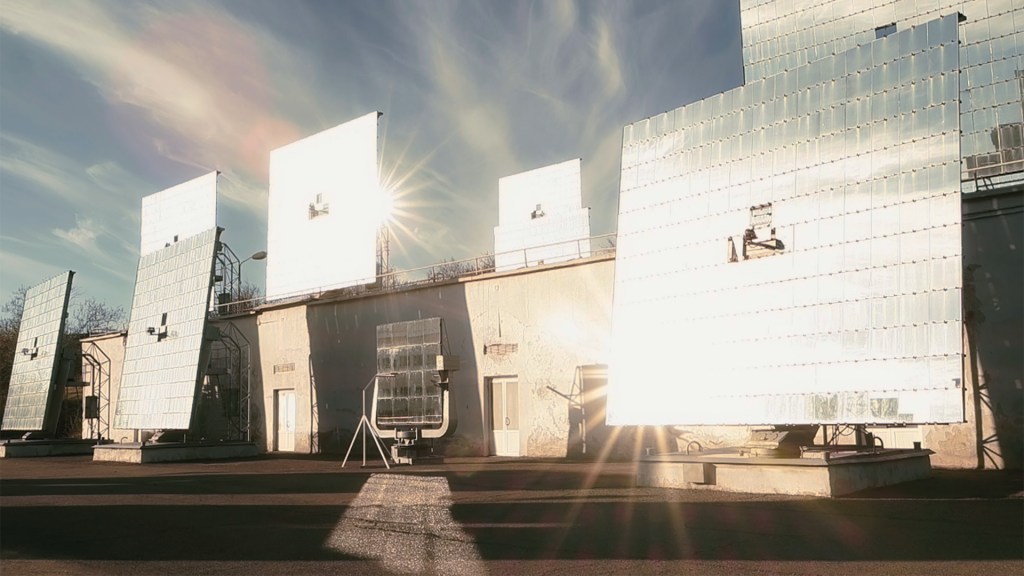
M&RF: Thinking about the Socialist Anthropocene, one of your most recent films, Melted into the Sun – which we screened last autumn during the SAVA Research Week 04 at the Institute of Advanced Studies – deals with the Sun Institute of Uzbekistan. It encodes a very particular socialist scientific history and we were wondering if you could tell us a little bit more about it.
SI: It’s actually a failed utopian project, because only two of this kind of sun furnaces have been built in the world, one in France and one in Uzbekistan. And then they stopped constructing them, because there is an easier and cheaper way of extracting solar energy. But what became clear to me is that this could only have happened during the Soviet period in Uzbekistan, because it’s a project that is not about profit, but about an idea and an experiment. When I think about socialism, it’s about not only measuring what you gain financially through an investment, but in terms of the value of an idea that expands our understanding through the imagination, experimentation or science. And, of course, the film is about sun worship from ancient, pre-Islamic times in the region, until the Sun Institute with its futuristic endless time, reflecting the transformation of sun worship through technology and science.

M&RF: What are you working on for your creative fellowship with the SAVA research project?
SI: I think that in the beginning I was keeping it very open, and I was also looking at the Steppe and to nuclear legacies, which I think are very interesting. The Sun Institute is part of the same project, because what they wanted to produce there were materials for the exterior of rockets that fly to space. I was also already researching Arslanbob, a forest in the south of Kyrgyzstan. It’s a walnut forest, a relic forest, it’s not known how long it has existed, and it covers an enormous area, around seven hundred thousand hectares. There are several reasons to think about the forest, firstly because in Central Asia we don’t have many forests, our imagination is more related to mountains and steppe, so it’s not something that we are familiar with. The forest also lies in a very complex borderland between Uzbekistan, Kyrgyzstan and Tajikistan, which directly relates to the Soviet legacy of the creation of nation states in Central Asia. Then, of course, there are the people that depend on the forest and how the forest is endangered today by over-extraction. I’m hoping to make a final work about the forest of Arslanbob this autumn within the framework of the SAVA Creative Fellowship.
M&RF: Finally, how is it for you to be a creative fellow in the SAVA project?
SI: I think it’s fascinating, and I see it as a gift to be surrounded by scholars and to get to appreciate different perspectives and methodologies for thinking about certain subjects. In creative work, along with artistic research, there is a sensorial dimension that drives us. There is also intuition, and I believe that in the scientific world it’s the same – intuition is leading all of us. It is enriching to work with SAVA research fellows, who have the same past related to socialism. Although there are very different ways to approach these histories, by working together, I believe that our mindsets expand.
MAJA & REUBEN FOWKES are the Directors of the Postsocialist Art Centre at the Institute of Advanced Studies as part of which they lead the Socialist Anthropocene in the Visual Arts (SAVA), a research project funded by UK Research and Innovation (UKRI) under the UK government’s Horizon Europe funding guarantee.
***
Edited by MAJA & REUBEN FOWKES and MARTHE LISSON
Proofreading by BECKA HUDSON
All images © Saodat Ismailova
Categories