Rethinking the ‘War Frontier’ Label
ESSAY
Rethinking the ‘War Frontier’ Label:
Narratives and Records on the Southeastern Charcas Frontier
in the Sixteenth Century
by Mario Graña Taborelli
16 January 2025
The term ‘war frontier’ brings to mind very specific associations; a place of conflict and violence, one group of people fighting another. A frontier implies a seperation between ‘here’ and ‘there,’ a well-defined distinction between the ‘right’ and the ‘wrong’ place (depending on perspective, of course). Mario Graña Taborelli, however, is challenging this notion. His analysis of documents and records on the Southeastern Charcas Frontier reveals a space that was not an impermeable border, but a place open to exchange and conversation. Taking this South American, sixteenth-century frontier as an example, do we have to rethink contemporary war frontiers, too?
The documentation of an inspection in 1596 by top royal official don Pedro Osores de Ulloa (1540-1624) to the Southeastern Charcas frontier, in present-day Bolivia illustrates the changing understanding of the idea of the ‘war frontier.’1 What was a ‘war frontier’ at the time? It was a space inhabited by Indigenous populations who had not been ‘conquered’ and incorporated into the Spanish Empire and were therefore classed as being at war, even when that was not always the case. It was a term the Chiriguanaes were familiar with – whether they had built friendly ties with the Spanish or not – and the Spanish themselves to justify the captivity and exchange of other Indigenous peoples, including rival Chiriguanaes, for goods deemed as sumptuous. It was a way for the Spanish living there to secure rewards based on their merits. It was also a label conveniently used by locals to remind outsiders that life was in such spaces different. It gave license to frontier peoples – Spanish and Indigenous alike – to relate to each other in ways perhaps uncommon in other spaces. It created a sense of ‘locality’ which provided meaning to those who inhabited geographies otherwise seen as unhospitable. In this definition, I am attempting to study frontiers as spaces constructed from below (from the perspective of the inhabitants), instead of from outside (from the perspective of those who did not live there). ‘War frontier’ was thus a communicational concept built and spread by frontier inhabitants.
The records of the 1596 inspection were submitted as part of a petition to gain rewards from the Spanish Crown. They tend to exaggerate the ‘war-like conditions’ of such frontier, describe a rural landscape, populated with scattered and tenuously connected farms, some under the protection of the odd fortification, and most without any fences or walls. In a previous article I explained that although the inspection was conducted by Osores de Ulloa, it was in fact Captain Melchor de Rodas (1526-1601) and the residents of the frontier who permitted the visit and toured Osores de Ulloa and his entourage, shaping the visit’s results.2 The inspection was an opportunity to reconfirm the authority of Rodas and his strong network of relatives and allies, including two groups of Guaraní-speaking Chiriguanaes, in that frontier, with the endorsement of Osores de Ulloa. It also offered the chance for a reconciliation between both men a few years after a legal dispute over their merits.3 It is possible that they may have wanted to show the authorities above them a ‘peaceful’ space. However, the measures taken by Osores de Ulloa gathering farms and placing them under the defence of the few fortresses in the area, commanding the construction of fences, suggest something different casting doubts over the ‘war frontier’ label. This is prompting us to think about other non-violent relations in such geography.
In her most recent work, historian Lauren Benton places “imperial small wars at the centre of a new history of global order” showing how “their histories help to illuminate the politics of difference and hierarchy, from racial exclusion to class and religious conflict”. In her words, the term small wars “reflects the insight that empires specialized in violence at the threshold of war and peace”.4 Some of the narratives associated to the frontier under study here fit perfectly well in that description. However, the use of this terminology comes with its own problems. By no means do I suggest that frontiers, like the southeast of Charcas in the second half of the sixteenth century, were peaceful spaces. Yet, there is also proof of other forms of relations among Indigenous peoples and their Spanish neighbours, including trade, cooperation, and regular visits, that are also present in the records. This is not evidence of “violence in a threshold of war and peace”. These exchanges speak of a ‘relational space’, in which the changing connections among different peoples – including Indigenous, Spanish and Africans, among others – shaped their interactions and those with their environment. The use of ‘violent’ as a term is an oversimplification of the relations between Indigenous peoples and Spanish in such spaces. Neither Spanish nor Indigenous peoples were just ‘violent’ with each other. They also cooperated, supported, challenged – even legally – and interacted with each other’s presence in many creative manners. Violence was one of them.5 The boundaries between Indigenous peoples and Europeans were not clear either. Individuals and groups carried and staged multiple and overlapping agencies and were able to navigate such complex landscapes thanks to their relations with one another. More importantly, frontiers were ‘middle grounds’ or ‘Indigenous grounds’ but never just ‘European grounds’ as they were spaces where either both groups coexisted, or Indigenous peoples held the upper hand.6 We could even say that frontiers were ‘local grounds’.
There is still the question as to where the image of frontiers as spaces of permanent violence comes from and in this piece I would like to elucidate the origin of this image based on the study of four types of records on the southeast of Charcas frontier in the second half of the sixteenth century: the reports of merits and services written by the Spanish with the expectation of receiving rewards and posts from the Crown that are also known as Probanzas; letters written by Spanish residents in that frontier to advance their own agendas; legal cases; and fragments dispersed among chronicles written by members of religious orders. The examination of some examples of those records could provide some insights into the origin of this “War Frontier” narrative which could be extrapolated and tested on other imperial borderlands.
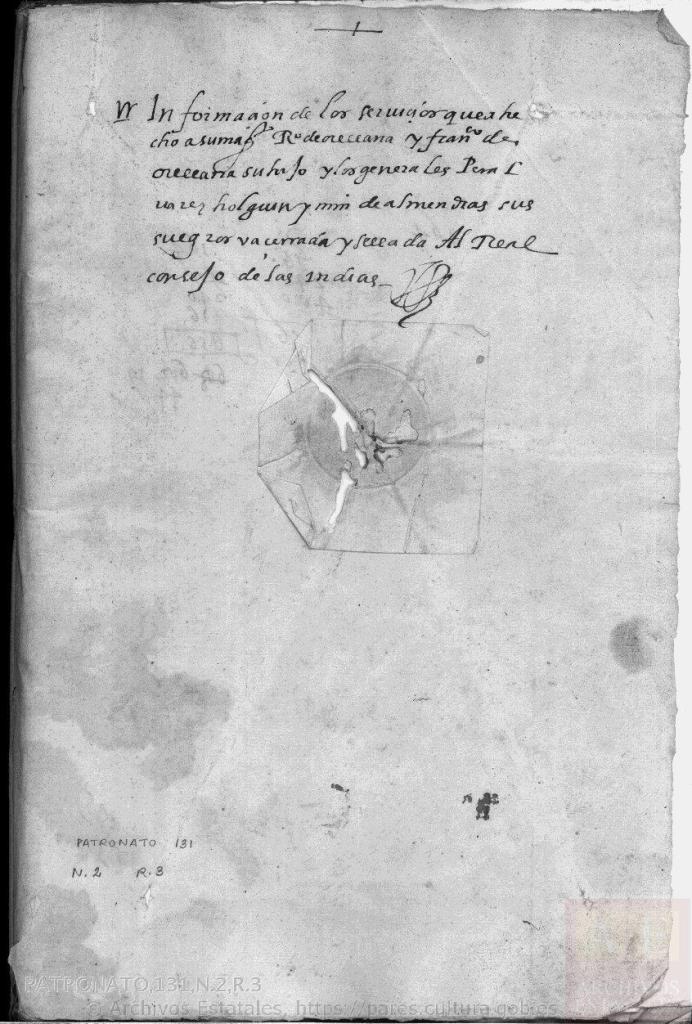
In 1588, Rodrigo de Orellana presented his Probanza to the body responsible for royal advice on policies in the Indies – Council of the Indies – referring to the services of his father, Francisco. He had accompanied the holder of an encomienda or grant of Indians, don Gabriel Paniagua de Loaysa to Santa Cruz de la Sierra in 1574 as part of the large expedition assembled by viceroy don Francisco de Toledo (1569-1581) to punish the Chiriguanaes. As was common, one of the witnesses stressed “I entered with the said don Gabriel and other people to the lands and settlements of the said Chiriguanaes Indians where we fought twice against them, in which fights many were dispersed with great work and risk to our lives, because such skirmishes took place in rough and dangerous land”.7 Similar statements can be found in hundreds of Probanzas received by the Council of the Indies. Orellana, like many others, were determined to demonstrate to the Crown the difficulties and challenges that they faced whilst trying to achieve their missions. They had to, if they were to succeed with their claims to glory and show that they were deserving of royal rewards. Violence played a significant role in such claims.
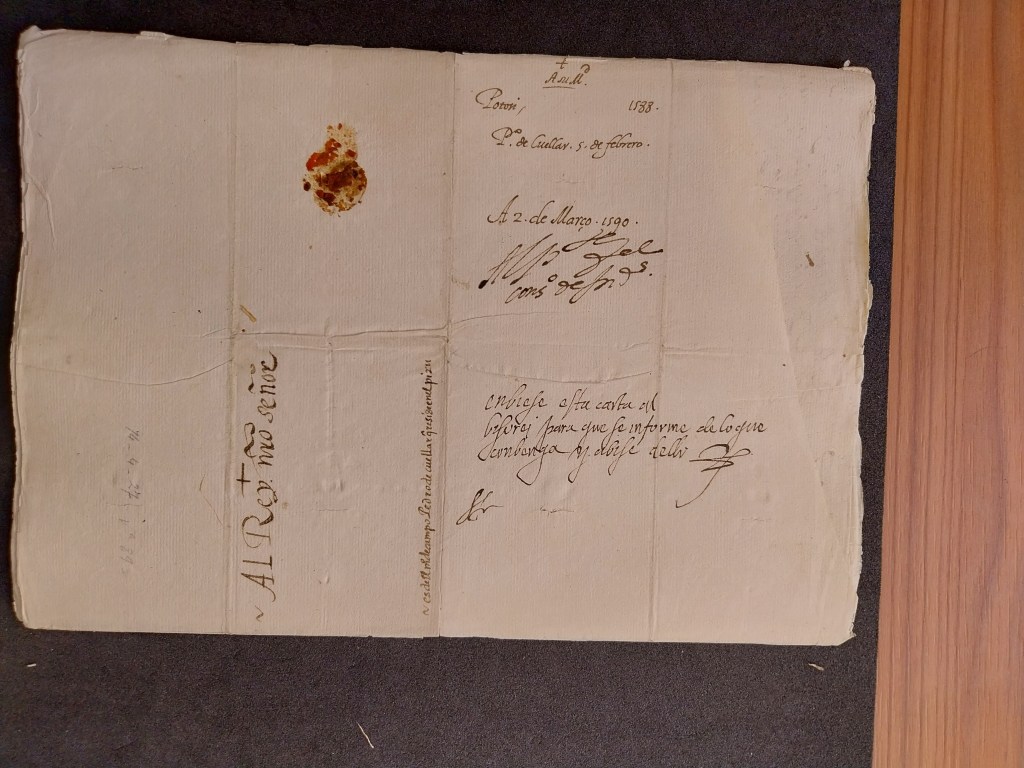
Something similar happens with letters. On 2 March 1590, Captain Pedro de Cuellar, remembered for his participation in a 1584 military campaign against the Chiriguanaes wrote that “in the year of 84 I was named Field Marshall with two hundred and fifty men who were recruited in this province to enter, conquer and punish the Chiriguanaes […] who after being conquered and christened years before and being in peace, rebelled […] and murdered over one hundred Spaniards, who were with them, committing a great slaughter afterwards by eating them […] and continued with their incursions into the frontiers of this province which are populated by the Spanish, committing notable robberies and cruelties”.8 Cuellar described the hellish conditions of living in a ‘war frontier’, where instability and violence ruled. His aim was to demonstrate to the Crown the importance of the presence of the Spanish in that corner of empire, and the services that they provided, which again, were supposed to render rewards in the future.
This same narrative of ‘War frontier’ is also present in legal cases. In 1582, Captain Pedro de Segura Zavala arrested a number of Chiriguanaes, who he accused of “looting the valleys of Sopopo, Siripona, Turco, and Aromasi, where many residents lost their lives […] where they looted and burned down farms in these valleys and where some people were burned alive”.9 Segura Zavala was trying to justify the arrest, which did not help to calm the situation but caused further unrest among the Chiriguanaes involved. His description sounds similar to the letter and report of merits mentioned above. The Southeast Charcas frontier was a site of regular skirmishes and permanent violence. This is confirmed by Carmelite priest and writer Antonio Vazquez de Espinosa (1570-1630), who travelled extensively across the frontier. In his chronicle, he stressed that “this land is all a frontier with the Chiriguanaes and it is not safe; because every day they commit thousands of robberies, murdering Spaniards, blacks and Indians in the farms and taking the women”.10 A place of captivity and murder, the frontier was unsafe, even for someone who was only travelling across the area in his pursuit to raise funds.

So far, I have shown evidence of the ‘war frontier’ label as it was used by the Spanish. However, the Chiriguanaes also participated in this narrative. They used it to their own advantage to secure sumptuous gifts from their Spanish neighbours in exchange for other Indigenous peoples they regularly seized through incursions beyond the frontier. During the 1574 expedition by viceroy Toledo, for example, Chiriguana groups that were fleeing their settlements left behind a cauldron with human remains reminding the Spanish that were chasing them of their cannibalism. They were also letting the same Spanish know that they were in a ‘war frontier,’ making use of that same label. The Chiriguanaes also used this narrative to regulate Spanish presence, deciding when and how they wanted to enter partnerships with Spanish captains in the frontier. They negotiated an alliance in that manner in the case of San Miguel de la Frontera, a town destroyed by Chiriguana raids, when such partnership was dissolved, in 1585. All this is not clear from what the Chiriguanaes said, because there is very little evidence of their voices in the records; but from what they did, which can be assessed via the testimonies of the Spanish. The Chiriguanaes’ actions show sophisticated and complex ties between themselves and the Spanish that certainly go beyond ‘violence’.
The arrest of a group of Chiriguanaes that visited Santiago de la Frontera de Tomina in 1582 was not a difficult task. The Indians were familiar with the Spanish in the town, they visited them regularly and received gifts such as scissors, knives, shells and hats. These visits were opportunities to settle disagreements, as ‘good’ neighbours would do, and were moments of various exchanges that, though encapsulated in a wider and more prevalent narrative of ‘violence’, still offer glimpses of something else. On the day of their arrest, the Chiriguanaes paid a visit to Captain Rodas. They were not going to stay overnight as sometimes they did “for two or even three days”.1 Instead, they wanted to go back to their settlements. It was their familiarity with the Spanish that became their undoing. These fragments of information have only survived because of the legal case of the Chiriguanaes’ arrest, a serious incident in the frontier that eventually triggered the destruction of a Spanish town, San Miguel de la Frontera, in the summer of 1584. There is plenty of other evidence showing similar circumstances.
Documents reveal that ‘war frontier’ was a narrative supported by various groups who were keen on classing such space as ‘violent’ for many reasons, as we have seen above. Only an approach to frontiers as relational spaces, where violence was present as one form of exchange among many, will enable a more complex analysis of such geographies; one that departs from opposing categories such as ‘victims vs victimisers’ or ‘Spanish vs Indians’ and one that permits to explore the agencies of the inhabitants of these spaces, without prejudices or teleologic/anachronistic views. Understanding the use of such narratives and approaching frontiers as relational spaces should help our comprehension of present-day frontiers -for example between Argentina, Bolivia and Paraguay, or Bolivia, Paraguay and Brazil, which similarly to those spaces in the Early Modern period, reflect the contradictions and complexities of the interactions among different groups, individuals, and their environment.
MARIO GRAÑA TABORELLI is a Visiting Research Fellow at the Institute of Advanced Studies. He is a historian of the Early Modern Iberian Worlds who works on political cultures, law and social history.
***
Edited by MARTHE LISSON
Proofreading by LEE GRIEVESON
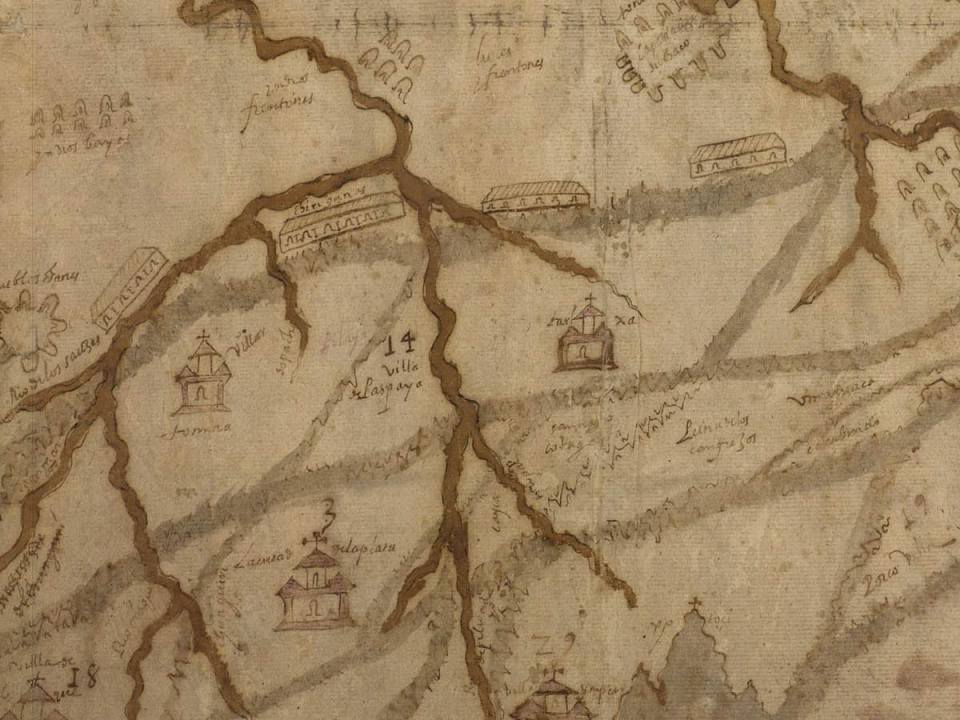
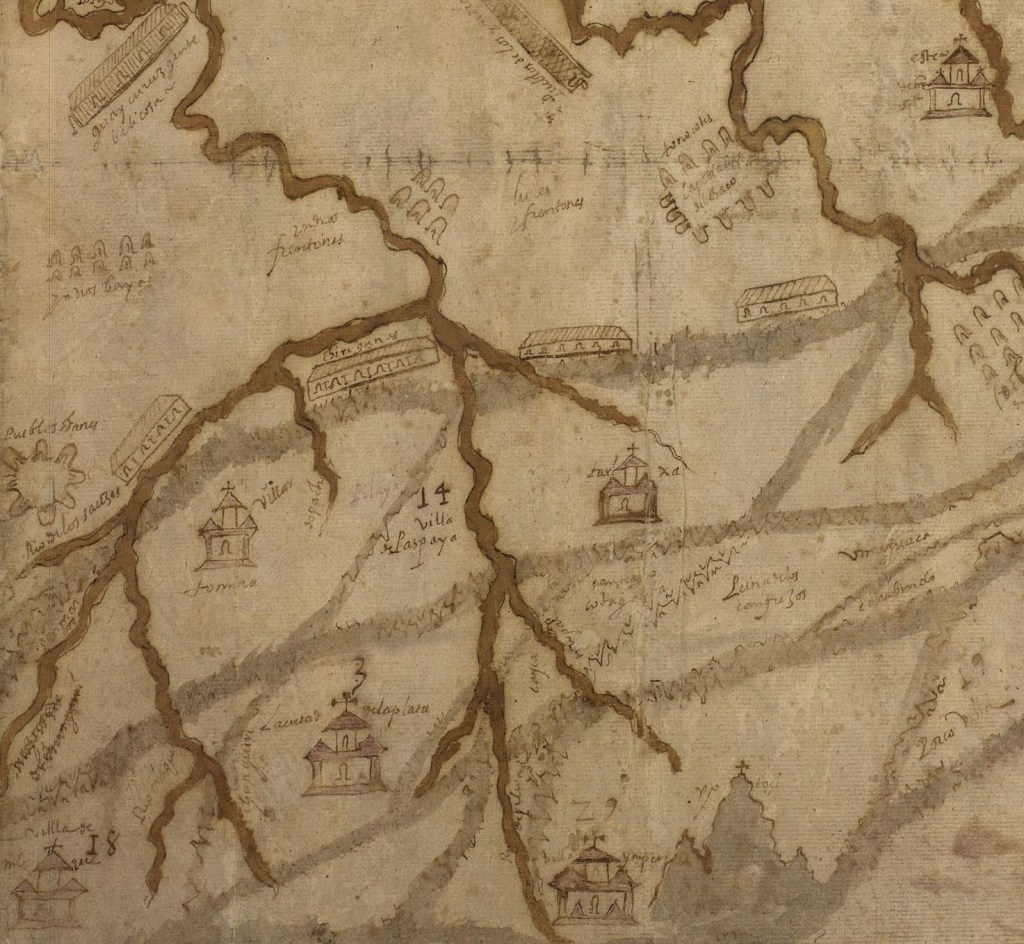
Lead image: Detail of a section of an early seventeenth-century map of Charcas showing the southeast frontier (AGI, MP, Buenos Aires, 4)
Categories
One thought on “Rethinking the ‘War Frontier’ Label” Leave a comment ›