The Black Atlantic at 30: Diaspora in Conversation
SERIES: THE BLACK ATLANTIC AT 30
Diaspora in Conversation:
Movements and Communication Across Borders
by keisha bruce and Guyanne Wilson
18 April 2024
On 5 May 2023, the UCL Department of English, the Institute of Advanced Studies (IAS) and the Sarah Parker Remond Centre (SPRC) held a day of conversation to celebrate the thirtieth anniversary of Paul Gilroy’s The Black Atlantic. This series offers some reflections on the book’s resonance now, and how it has travelled since its publication in 1993. Thinking back to their roundtable discussion at the symposium, keisha bruce and Guyanne Wilson discuss approaches to diasporic studies within their respective fields, their conceptualisations of diaspora, and some key questions concerning
diaspora in communication.
Guyanne: Let’s start by introducing ourselves.
keisha: I’m keisha bruce and my research explores questions around race, gender and sexuality as it relates to media and technology. I’m currently based at UCL as a Postdoctoral Research Fellow.
G: I’m Guyanne Wilson. I’m the Quirk lecturer in English linguistics at UCL. My research focuses on World Englishes, or what people also call New Englishes, varieties of English around the world or postcolonial Englishes. I’m interested in variation, particularly in Africa and the Caribbean, in online settings and diaspora.
k: Great. I’m excited to be in conversation with you as we arrive at questions of Black identity and transnational communication from different fields. Let’s go back to our panel talks at the Black Atlantic Symposium and share how we each feel our work responds, or doesn’t respond, to some of the arguments made in Gilroy’s seminal text.
G: For me what was interesting when thinking about what to contribute as a linguist is that if you think of the Black Atlantic and the movement of Black people across the Atlantic, World Englishes, to a large extent, is a discipline that is only possible because of this. Yet it struck me that World Englishes scholarship hasn’t really engaged with the Black Atlantic as we should. World Englishes as a discipline has tried to be neutral, to provide a neutral description of these varieties of English. But you can’t be neutral in something that involves people. People aren’t neutral, and people are doing really important things with their language. What about you?
k: Something that I was really interested in what stemmed from the panel was how we might think through questions of ‘diaspora’ without necessarily having to centre the role of physical geography and geographic placement, while still acknowledging its importance. My research has focused on the curation of diasporic intimacies on social media. Obviously when we think about the internet, there’s this perceived absence of geographic location. Instead, people move differently; the digital Black diaspora isn’t configured by a movement across seas. It’s the absence of geographic landscapes that interests me and pushes me to think about diaspora as a set of ideas, as a set of cultures, and as a set of resources. I think this naturally brings us to the question of how we conceptualise diaspora in our work. How would you respond to this?
G: When you think of diaspora in contemporary society, part of it still has to relate to national borders. You’re part of the diaspora because you’ve crossed these borders. I also work with social media. It’s interesting to think of social media as a sort of borderless space, where notions of national identity are still important. You see that in language terms, because people on social media make important national claims to their identity through their language. When I think of my own work right now, diaspora also becomes prevalent in migratory patterns of Black and Brown people today, where Black and Brown people have migrated to the United Kingdom or the United States or Canada. What happens then when different Englishes come into contact with one another? How does that work for you?
k: I appreciate how you focus on points of contact and what is created at those points of contact. I really like that. And maybe we can talk about that a little bit more later, in addition to this idea of borderlessness and national identity on social media. In terms of how I conceptualise diaspora, the research project that I’ve been working on really started with thinking through Paul Gilroy’s claim in the Black Atlantic that “playful diasporic intimacy … has been a marked feature of transnational black Atlantic creativity”. I was really interested in this playfulness and creativity, and how they take shape on social media, and how diaspora or diasporic identity and diasporic communities online are shaped through playfulness.
G: What do you mean by playfulness?
k: Joy. Humour. Creativity. Innovation. Technological ingenuity. For example, in my work, I locate playfulness through Black women’s selfie practices and through the proliferation and dissemination of memes. In these instances, these visual cultures are playfully used to create and sustain community and identity. Gilroy’s work on diaspora focuses on the hybridity and playfulness within black music cultures. Where the innovative use of technologies and cultural influences come together to produce new music and sound. The language of technological and diasporic playfulness is useful for thinking through the ways that Black people across the diaspora, across many different geographical spaces, come together on social media to produce digital visual content. At the same time, though, while this framework and language is useful, I wanted to complicate it to locate and centre Black women’s creativity within this.
G: That’s really interesting. How have you seen ways in which women’s culture and queer culture are different from what Gilroy expressed in his musical culture? And then, memes. I also work with memes and the whole notion of the ludic, or what you’ve called the playful.
k: So, I think very heavily through my conceptualisation of diaspora using two works: Tina Campt’s “The Crowded Space of Diaspora: Intercultural Address and the Tensions of Diasporic Relation” published in Radical History Review in 2002 and Jacqueline Nassy Brown’s “Black Liverpool, Black America, and the Gendering of Diasporic Space” published in Cultural Anthropology in 1998. They both similarly locate the Black diaspora within a system of relations. Diaspora is about how we relate to one another. It’s how we compile and create a sense of belonging through culture and through shared resources. Many people, when they are articulating diaspora, are centring this idea of an original homeland, like the original space where people have moved from, and that’s something that I, along with other scholars, am pushing back against because the histories of forced migration, assimilation, and cultural genocide don’t map on as neatly to that framework when we’re thinking about the Black diaspora. I think what is useful in terms of thinking about diaspora as a system of relations is that it allows us the space to reject homogeneous ideas of what it means to be a part of the Black diaspora. If we think through diaspora as mode of positioning – that is, how I position myself in relation to you – it can push back at hierarchical determinations of who is allowed to acknowledge and situate themselves as a diasporic person.
G: That’s an interesting notion, the whole idea of pushing back and redefining what counts as diaspora. I’m currently working with a set of interviews with adults who came to the UK as part of the Windrush generation and I’ve found that there’s a real sense of individual agency and each speaker uses language in quite different ways. One set of data I’m working with is two brothers who came to the UK at different ages. The older one only ever uses Jamaican Creole in the interviews, and there’s the sense of him being a diasporic individual with strong ties to his home community. His presentations of Jamaica are very idyllic and idealised. His younger brother, however is more removed. At one point he says, “No, I went back to Jamaica, and I realised I was really lucky to have left. It was a real opportunity that my parents gave me.” It shows up in his language because he speaks standard British English for most of the 30-minute conversation. His experience of being a diasporic individual is very different from his brother’s, because he achieves many things, financially and socially, which his brother just isn’t able to. There’s not just one uniform experience of diaspora, even within the same family. It’s tempting, I think, to talk of diaspora communities, to claim that this is what everybody’s going through. And there is a sense that a lot of people are experiencing the same things, but it’s not that everybody’s experiencing these things in the same way, and you do have a sense of a very specific dominant discourse and the other stories aren’t really very often expressed. Nobody writes about them. They’re rendered voiceless even in the research that’s meant to be empowering for their communities.
k: I really like what you were saying as well about how there are vastly different diasporic experiences. There’s not one particular way that we might speak about it, because it manifests, and it appears in such different ways. And this is what I was getting at when I was thinking through Campt’s and Nassy Brown’s work. Within their articulation of diaspora, they make similar arguments to Paul Gilroy and others who argue that we can think about the Black diaspora by centring space and the imagined and ideological movement of ideas and social materials and cultural materials. What I appreciate about Campt and Nassy Brown is that they really consider how geographical privilege and power, and imperial and national hierarchies, and within that, thinking about gender and sexuality, how they are also entangled within this diasporic movement, and we need to really take time to consider that within our conceptualisations.
Shall we talk a little bit about some of the practicalities of doing research on the diaspora within our respective fields?
G: I think, in terms of practicalities there are several aspects to be addressed.
One is the divide in World Englishes scholarship, where there are academics in Nigeria and Ghana and Trinidad and Jamaica, working on those varieties of English but the gatekeeping for things like publication is such that they are kept out in many ways. So in terms of what gets published, what gets circulated in journals, their voices aren’t heard. Many of the editors are European or American or maybe Australian, and the editorial boards are made up of people based at their universities. So that’s a real, practical problem, because it means that you’re separated from sources of knowledge and ways of thinking, of ideas about how knowledge can be produced and represented. What often happens, in my experience, is that scholars from the countries where World Englishes are spoken are told, “well, no, you have to write it in this way, and you have to present it in this way. You have to present knowledge in the ways that white Western scholarship thinks acceptable.” So, there is a tension: why is this the only valid way of writing in English? It’s happened to me, and it’s something in which I’m also complicit. When my colleague Michael Westphal and I were editing our volume New Englishes, New Methods, I remember we would read chapters by contributors from Pakistan or Nigeria and we would discuss whether we could leave grammatical forms or stylistic forms that were features of Pakistani English and Nigerian English, and we almost always said no, because we had a European publisher and our book would mostly be circulated in Western academic circles. It was bizarre because the point of the project had been to interrogate and challenge the ways in which people do research on varieties of English, and we ended up reproducing those hierarchies.
Overall, there’s not enough collaboration, and we also need more non-European scholars. I’m not saying white European people can’t or shouldn’t do World Englishes scholarship. But I am saying Black voices and Brown voices aren’t being heard as loudly as they ought to be, so we’re losing quite a lot of valuable insights.
Another practicality is data. One important resource for World Englishes scholarship is corpora, and perhaps the most important corpus that we work with is the International Corpus of English and most of it has been compiled at European universities, particularly in Germany, though the first ICE corpus, ICE Great Britain, was compiled at the Survey of English Usage at UCL. One of the key features of ICE is the inclusion of spoken data, and especially conversations. It’s meant to be a fairly natural conversation between speakers of the variety being recorded, so in ICE Trinidad and Tobago, that would be speakers from Trinidad and Tobago. It is ICE’s best feature because if you want to describe a variety of English, you need recordings of people speaking that variety not just in newscasts, but in everyday speech.
But many of the conversations in ICE are recorded as semi-interviews with European researchers. It’s not authentic data, because people are going to change the way they speak with strangers. That wouldn’t be problematic, if the data was used with a bit more reflexivity, but even though linguists know that people speak differently when talking to different people, many people aren’t honest about the nature of the data in their analyses.
What are the methodological challenges in your own field? How do you deal with data and how do you collect it?
k: Your field is a lot more traditional than mine, but there are similar challenges which manifest differently. Within my own work I use autoethnography as one of my primary methods. My research project emerged out of questions that I had about my own social media behaviour between 2016 and 2019 to better understand how I had found community online and performed an online identity. That’s where I began. This was my diasporic framework, because I consider myself to be a person of the diaspora. I was born, grew up, and currently live in Britain. I’m Jamaican by heritage and grew up in a very multicultural city, and the majority of pop culture and media that I had consumed, which helped me form my identity in youth, was African American. Inevitably, as someone living in Britain, that shapes your identity and how you vision yourself. I not only position myself as a diasporic person, but also acknowledge my subjectivity as inherently diasporic.
In my field, a large portion of scholarship around digital Black lives is African American focused. That is not to say that everyone does that though. For example, Francesca Sobande and Rianna Walcott both explore Black British women’s lives on social media. However, they also recognise the importance of diaspora within that. The work of Anna Everett also comes to mind as she explores diasporic uses and functions of the internet. I’m not saying that it’s all within the African American context, but it is very, very dominant, and you have to intentionally push back against that. So I found that there was something missing within these articulations of digital blackness, and that’s not to say that the internet is completely borderless, but it is to say that circulation of cultures and idea exchange that is at the heart of a relational diasporic experience happens a lot quicker. It’s more immediate and in some ways more intimate. So sometimes something might be happening that is inherently diasporic, but it’s not really being claimed as such.
G: Do you have examples of that?
k: Black Girl Magic, that whole social media movement. The hashtag itself did originate with an African American woman. I’m not going to deny the global power of African American pop cultures and movements, or even just how things get taken up within the wider lexicon of the culture and creative industries. A lot of the scholarship that is written around Black Girl Magic very specifically centres Black American people, though the edited collection by Julia S. Jordan-Zachery and Duchess Harris does a good job at expanding this. The hashtag was being used everywhere from Australia to Brazil, all across Europe to Africa, and I felt like a lot of this scholarship around this particular phenomenon was saying that it was only an American thing which had very particular sets of meanings, and I think it becomes isolating when we think about ownership and possession with things that inspire community uplift, celebration, and joy.
G: The notion of ownership is particularly relevant in digital cultures, especially in relation to questions about who owns English, who controls the discourse about language. When I look at the memes I work with, what I find interesting is that it’s not a linguist generating them. It is regular people without specialist linguistic training using social media to maintain networks or for entertainment. These people are highlighting aspects of language that are important to them in a way traditional linguistic research can’t. The other thing that comes to mind is the way the memes, or the content creators, challenge who is powerful when it comes to hierarchies of English.
In World Englishes, we work with models. One major one is Kachru’s three circle model, which arranges the varieties of English in the world into Inner Circle Englishes, such as those spoken in the US and the UK, Outer Circle Englishes, spoken in former colonies, and Expanding Circle Englishes, spoken in countries where English is a foreign language. More recently, there’s a model called the World System of Englishes by Christian Mair. It’s a hierarchical organisation of English around the world, with American English as the hyper-central variety, and other Englishes being arranged as super-central, central, or peripheral. In both these models, Trinidadian English and Creole are seen as not very powerful, and not particularly influential on the system of English as a whole, but the memes subvert this. They upend ideas of what qualifies as standard or correct.
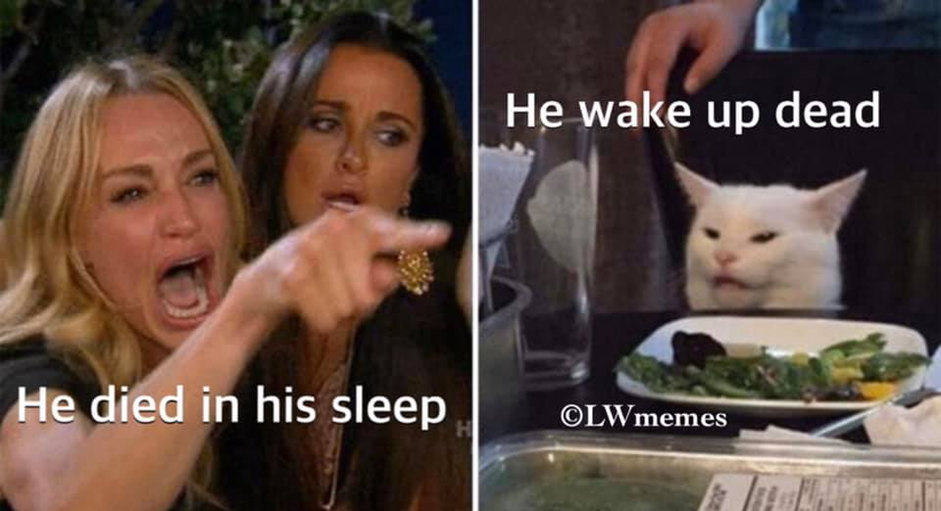
My favourite Trinidadian English Creole memes are those which use the ‘woman yelling at cat’ template. In them, there’s an angry lady, saying, “This is the correct thingword!” And then the cat hissing a response at her. What I thought was really interesting, and why I love those memes in particular is because the angry lady would say something in standard British or American English and that cat would give a response in Trinidadian English Creole. My favourite one is where the lady says, “He died in his sleep”. The cat hisses back, “He wake up dead” , which is how people in Trinidad say someone died in their sleep. It’s funny, yes, but there is an entire discourse which develops under the memes, and people always support the cat. The result is that Trinidadian English Creole is seen as powerful, and is validated by meme users because, as one poster wrote, “The cat is always correct.” The content creators claim authority and ownership that defies even established scholarly thinking like Kachru and Mair.
How does the notion of ownership feature in social media work that you’ve done?
W
k: The research that led me to focus on #BlackGirlMagic the hashtag was drawn from my experience of travelling in my early twenties. There was a lot of racism and anti-blackness that I’d encountered on my trip that I hadn’t quite prepared myself for. It mostly came from white British people, which was a very direct, entitled, and overtly disrespectful form of racism. But it also came from the people that lived in Thailand, which manifested in colourism. I saw billboards that would advertise skin whitening creams and would have conversations with people who, although were not being prejudiced and rude towards me, were inadvertently being colourist as they told me how they don’t want to have dark skin and they want to make sure that they’re covered up when the sun is out. So, these were the kind of experiences that I was having when I was there, and my skin complexion was quite dark at the time, and I loved it. However, I was hyper-aware of the context that I was in and who I was around, and how simply being there and being in that space was an act of refusal. I was hypervisible in that space. At the time I uploaded selfies onto Instagram that highlighted my darker skin complexion and used the #BlackGirlMagic hashtag to insert myself into that public conversation. This was in the very early stages of the hashtag’s usage, which was very different from where it went and what it became. I used the hashtag to firstly emphasise that my skin is beautiful and to accept and honour my beauty as a Black woman. This was especially important for me while I was travelling and being in spaces where blackness was not loved. So that’s a quick insight into how my research began.
From there, I began to think more expansively about Black women’s #BlackGirlMagic selfies and meaning making. I was primarily interested in beauty within my articulation of #BlackGirlMagic, and I explored the ways that Black women would use these selfies to accentuate and celebrate their skin tones and hair textures. To relate this to the question of ownership, I started the research for this quite early on in the life cycle of the hashtag, from around 2016 until 2020 with the majority of my focus being on 2018-19. Over that time period the hashtag’s usage had completely changed. While it began as a sociopolitical statement and an intentional celebration of Black women, it quickly became connotated with Instagram influencers, digital trends, and people who had products to sell. It was used by people that were not Black women, including white men and Asian women. It was used as a way to draw people in and to increase the quantity of people looking at their images. It became a signal for exposure. It became commodified.
So when I’m thinking about ownership, I’m thinking about how these ideas and cultures might start off with these particular intentions for celebration, connection, and subversion. For example: “This is how we find community”. “This is how we learn to love ourselves”. “This is how we refuse and respond”. But then, very quickly, it becomes pulled into the corporate machinery of social media and it doesn’t have those same meanings anymore.
G: Where does this leave us, then? We’ve talked about the place of The Black Atlantic in our scholarship, diaspora and memes. And we’ve especially focussed on how memes emerge as what Gilroy calls “means of cultural representation available to racially subordinated people”. They allow Black people to lay claim to aspects of cultural capital we are often denied: language and beauty. Although memes are rooted in the ludic, to dismiss them as “nothing other than a playful, parodic, cavalcade of Rabelaisian subversion”, to borrow again from Gilroy, would be to undermine the critical work they do in generating and maintaining both individual and community identities. Memes are circulated principally via social media, creating a diasporic space that makes possible certain kinds of borderlessness, quite different from those Gilroy documented: there are no music halls to be visited, no physical homeland upon which Black feet can tread. In these digital participatory forms, performances of Black identity are not limited to iconic singers like Jimi Hendrix or authors like Zora Neale Hurston, but extend to the quotidian creativity of the individual Black subject. Studying social media, then, allows for an engagement with and an appreciation of a diversity of Black voices not always easily visible, though certainly mentioned, in The Black Atlantic. Though scholars in the fields of Black Studies and World Englishes approach social media data in fundamentally different ways, this exchange highlights the ways in ways in which The Black Atlantic can- and in the case of World Englishes should- contribute to contemporary scholarship across a range of disciplines.
REFERENCES
Anna Everett, Digital Diaspora: A Race for Cyberspace, Albany: SUNY Press, 2009.
Julia S. Zachery and Duchess Harris, ed., Black Girl Magic: Beyond the Hashtag: Twenty-First Century Acts of Self-Definition, Tucson: University of Arizona Press, 2019.
Brai B. Kachru, “World Englishes and applied linguistics,” World Englishes 9,1 (1990).
Christian Mair, “The World System of Englishes: Accounting for the transnational importance of mobile and mediated vernaculars,” English World-Wide 34,3 (2013).
Francesca Sobande, The Digital Lives of Black Women in Britain, London: Palgrave Macmillan, 2020.
Francesca Sobande, “Memes, Digital Remix Culture, and (Re)Mediating British Politics,” Progressive Review 26, 2 (2019).
Rianna Walcott, “A Tweet at the Table: Black British Women’s Identity Expression on Social Media,” PhD Diss. King’s College London (2022).
KEISHA BRUCE is a creative researcher and educator of media, technology, culture, and the spaces in between. After completing their PhD in Black Studies, keisha began a Postdoctoral Research Fellowship at UCL’s Institute of Advanced Studies (2022-23). Their scholarship has been published in Women’s Studies Quarterly, Feminist Media Studies, and Journal of Postcolonial Writing.
GUYANNE WILSON is the Quirk Lecturer in English Linguistics at UCL. She is the author of Language Identities and Ideologies on Facebook and TikTok: A Southern Caribbean Perspective (Cambridge, 2024) and the co-editor, with Michael Westphal, of New Englishes, New Methods (John Benjamins, 2023). Guyanne currently serves on the editorial board of the journal English World-Wide.
***
Series editor is LARA CHOKSEY
Proofreading by MARTHE LISSON
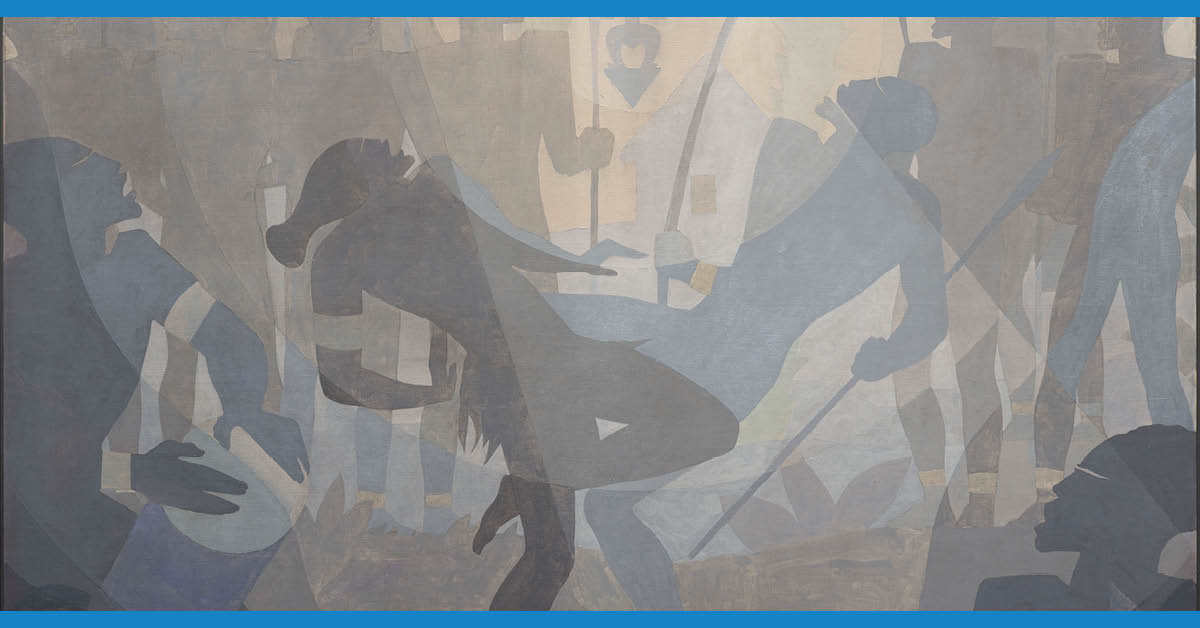
Lead Image: Detail Aspects of Negro Life: The Negro in an African Setting (1934), Aaron Douglas.
The painting is in the collection of the New York Public Library, Schomburg Center for Research in Black Culture, Art and Artifacts Division
Categories