


EXHIBITION
Seeds of Exchange: Canton and London in the 1700s
at the Garden Museum
Review by:
HELENE SCHULZE
12 MARCH 2026
Have you ever wondered where the plants in your (London) garden come from? They might have been imported by British botanists and the East India Company! That itself is not the problem, but that most endeavours within the imperial context – like, for example, the accretion of knowledge of foreign plants – were not possible without native interlocutors and collaborators and their knowledge. The narrative, however, tends to be that of the single explorer accruing the knowledge of foreign lands and plants entirely by himself.
The exhibition at the Garden Museum is aiming to break up this narrative and presents the artistic and research outcomes of a collaboration between British botanist John Bradby Blake, Cantonese artist Mak Sau 麥秀 and cultural mediator Whang At Tong 黃遏東 in the eighteenth century. As much as Helene Schulze recommends visiting Seeds of Exchange, she is left with questions and is wondering whether that collaboration was truly an exchange?
It was the fig that drew me in. Mak Sau’s 麥秀 Ficus hispida looks noticeably different to the figs growing in my garden in Tottenham. His intricate botanical drawing depicts the green, more bulbous fig clustered on leafless branches, whereas mine grow into fat, purple, tear-drop shaped fruits, nestled within the leafy canopy. Ficus hispida is native across Southeast Asia, down along Indonesia, across to Papua New Guinea and the northern territories of Australia. Sau’s watercolour is spectacular, each detail drawn out, the tree and its fruits dissected bit-by-bit to give you as full an understanding of the plant as possible on a single page. We see the texture and form of the bark, the way the figs bunch together, the morphology of the leaf and cross sections of the fig fruit, each flower, seed and gall clearly identifiable. The bit that charmed me most was the depiction of the tiny wasps growing inside the fruit. [The watercolour of the fig is at the bottom right in the picture below.]

Ficus hispida has a symbiotic relationship with a particular fig wasp, Ceratosolen solmsi. This wasp lays its eggs within the fig, whose flowers are hidden inside the fruit. These flowers are pollinated by the wasp as it lays its eggs, allowing both the reproduction of the fig, as well as a safe nest for the emerging wasp larvae. Once hatched, some wasps chew through the fig walls so that they can travel to other fig trees where the process begins afresh.
The watercolour dates back to 1771-3 and is listed as a coproduction between Mak Sau 麥秀, an artist from Canton (now Guangzhou) and John Bradby Blake, British botanist and imperial officer, employed by the British East India Company. The working relationship and knowledge exchange between the two as well as local interlocutor and cultural mediator, Whang At Tong 黃遏東, during Bradby Blake’s stay in Canton 1766-1773 are the focus of the new exhibition, Seeds of Exchange: Canton and London in the 1700s now open at the Garden Museum.


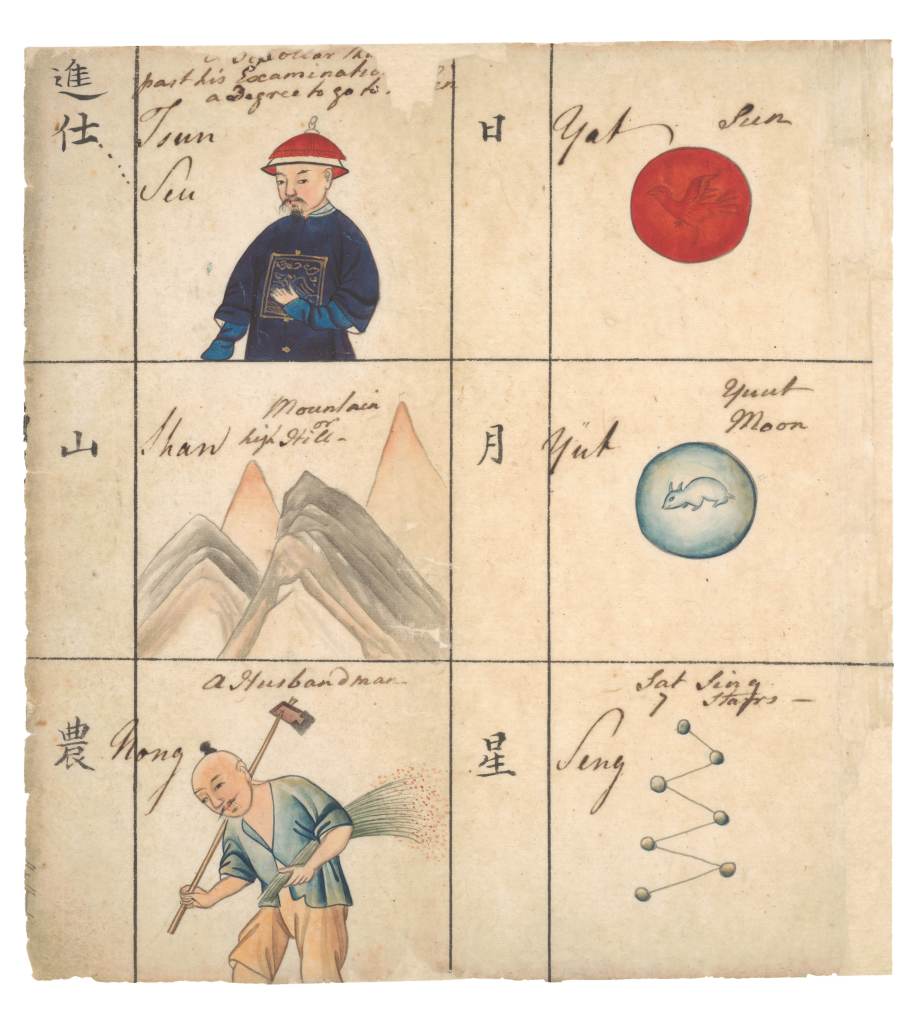
For the first time in 235 years, John Bradby Blake’s archive is coupled with the botanical illustrations created in the 1700s in Canton. Together, the three men built a substantial body of scientific and commercially useful work, translating and interpreting Chinese plants, their horticultural requirements and useful medicinal, culinary or material properties. Central to this three-way collaboration was to create a shared linguistic and nomenclatural understanding of the plants, processes and instruments used. Together, Mak Sau 麥秀, Whang At Tong 黃遏東 and John Bradby Blake developed what the curators call an ‘illustrated vocabulary,’ a fascinating document comprising of 300 entries with Chinese characters and Cantonese and English words, finding a shared language rooted in Chinese botanical traditions.


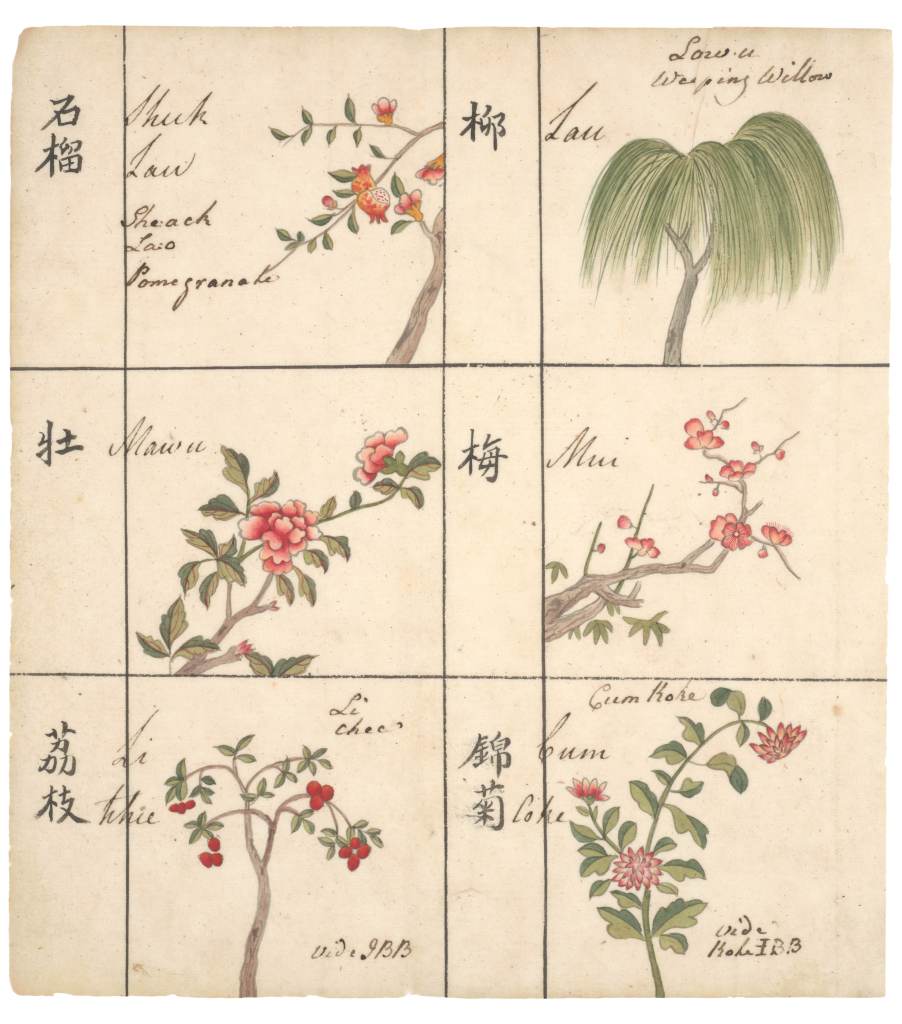
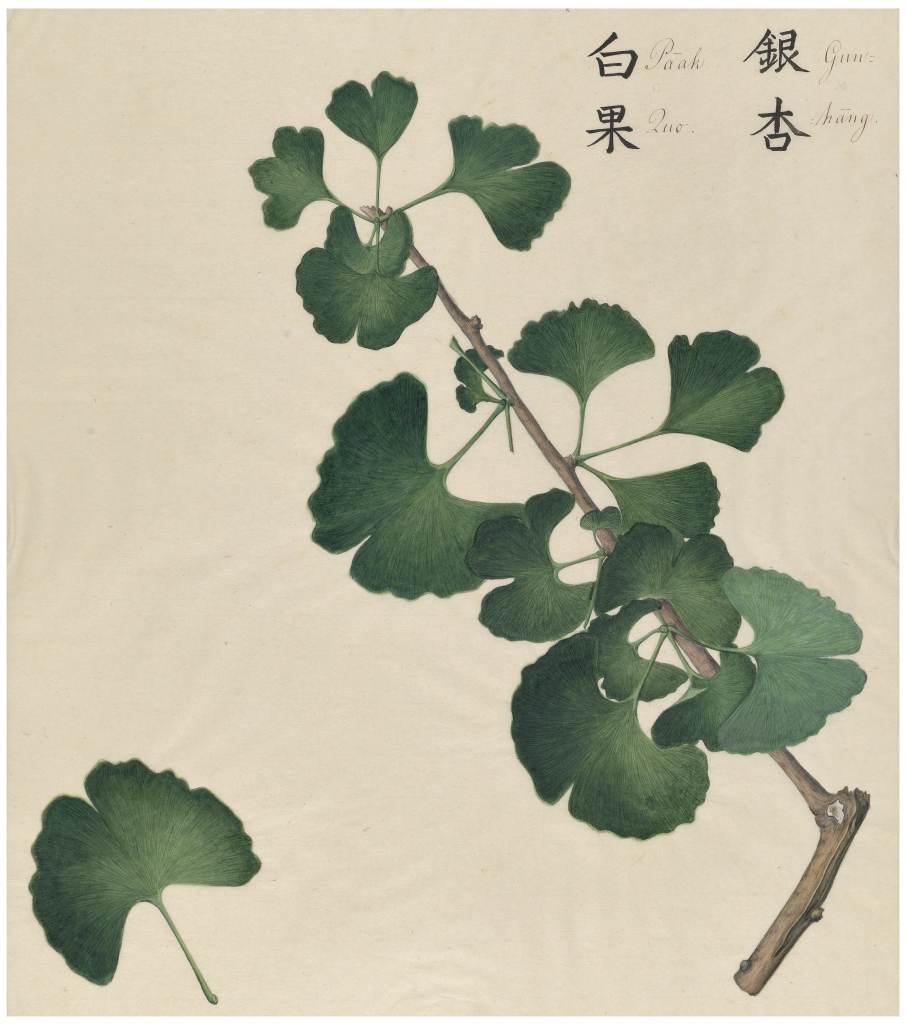
Mak Sau’s 麥秀 drawings are the real heart of the exhibition, elucidating the rich botanical worlds of Canton – tea, turmeric, gingko, ylang ylang, pomelo, persimmon, kumquat and camellia are all presented intricately on beautifully preserved watercolours. On each sheet, the depicted variety is named in Cantonese characters, next to an English phonetic spelling and on the card beside, the Latin binomial by which many plants are identified now, and the common name. The images were created over long stretches of time, with Mak Sau 麥秀 returning to them as the season shifted to add details as the plant grew and changed. These specifics make the exhibition a recognition of the original names of plants by their local stewards that became quickly enfolded into the British imperial project. Frequently, this anglicisation process, as plants were brought back to Britain, commodified and some redistributed around the world in the form of plantation agriculture, involved the near total erasure of original names and Indigenous plant knowledge holders from which botanical information was gleaned by colonial officers. Whilst the names of many imperial botanists are widely known like Joseph Banks and Robert Brown, the names of their local interlocutors are often absent from archival material of the imperial expeditions. This absence is what Seeds of Exchange, I think, is most centrally trying to address.
“This exhibition tells the story of a botanical collaboration that crossed cultures, languages and unequal systems of power in the eighteenth century,” the curators write and throughout Mak Sau 麥秀 and Whang At Tong 黃遏東 are referred to as collaborators, contributors and coproducers, their botanical and artistic expertise emphasised. The only two large oil paintings in the exhibition depict Whang At Tong 黃遏東 during visits to London, painted by by Sir Joshua Reynolds. Whang At Tong 黃遏東 aided John Bradby Blake in the knowledge, identification and naming of Chinese plants, interpreting and translating the knowledge within Chinese herbals and traditions. These curatorial decisions to give face, name and recognition to local experts central in the archiving and transfer of botanical knowledge make for a welcome change. Still, I find myself wanting a little more.
We find out a little about unequal power relations and authorial recognition but what would have interested me would have been more detail about the nature of the relations between these three men. Were Mak Sau 麥秀 and Whang At Tong 黃遏東 employed by Bradby Blake? Who were they before Bradby Blake arrived? I wanted to know about their background, their experiences. Missing was the larger context of this shared work. We find out that after Bradby Blake’s death, Whang At Tong 黃遏東 travelled to London to continue the project alongside Bradby Blake’s father, meeting members of the Society for the Arts, Manufactures and Commerce as well as Joseph Banks, at the time Director of Royal Botanic Gardens, Kew. This shows a rare foray of international botanical experts into British intellectual circles. “His involvement after 1773 [Bradby Blake’s death],” the curators write, “demonstrates continuity of authorship and authority.” For me, this needs more explanation. I am not sure whether it necessarily shows a continuity of authority, but I’m willing to believe it, I just need a bit more to go on. The terms of the relationship would be a good place to start.
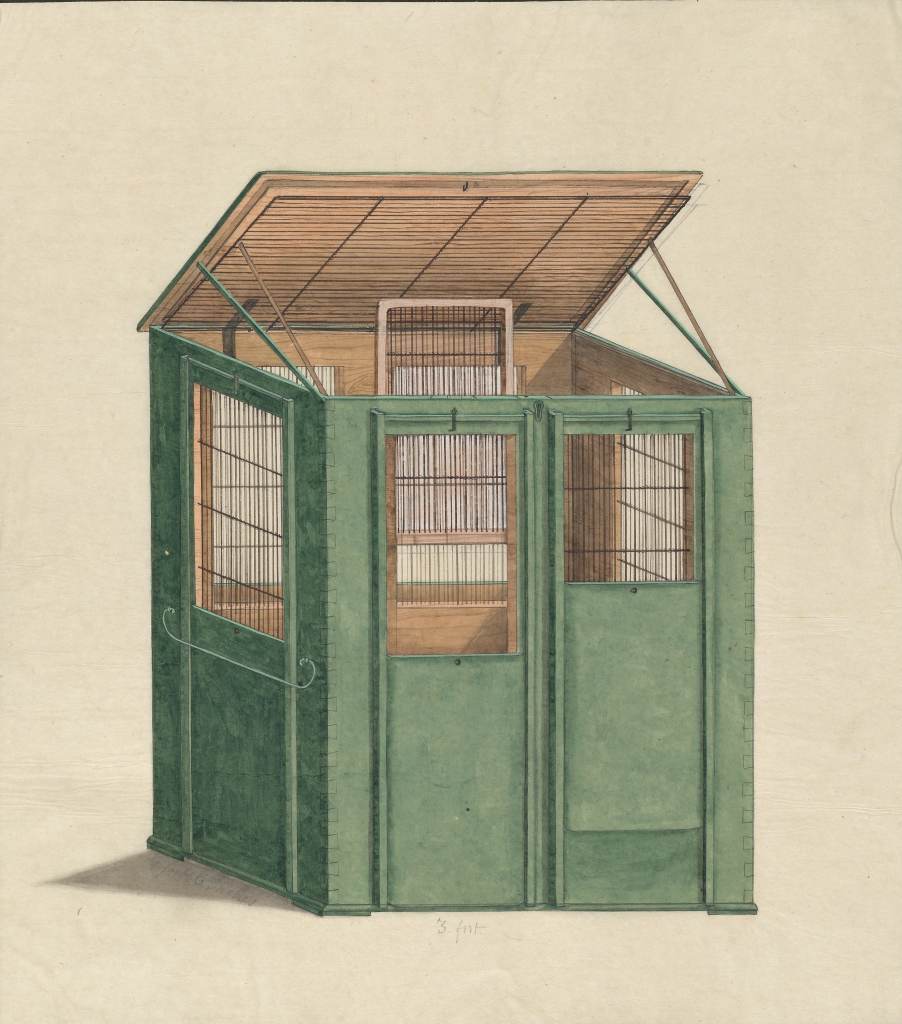
The plants at the heart of this collaboration were brought back to London often in beautifully thought-through custom-built seed and plant boxes to maximise chances of survival on the long journey. The designs of these boxes can be viewed in the exhibition alongside archival material highlighting the distances some of those transported seeds travelled, ending up at Kew Gardens or Chelsea Physic Garden. It is clear these findings were important for the British imperial project and I found myself wanting guidance about the particular significance of the varieties identified. What happened with those seeds after they made their way to Kew Gardens? How did they shape British imperial exploits? What was the London-Canton relationship like in the aftermath? By the end of the 1700s, tea was one of Britain’s most profitable commodities, controlled primarily by the East India Company. How did Bradby Blake fit into that?
I see the desire to centre a less extractive scientific and more artistic collaboration between Mak Sau 麥秀, Whang At Tong 黃遏東 and John Bradby Blake, a rarity for our times and important to note. Yet I wonder if the absence of details of the colonial context within which this relationship emerged, risks overegging the almost friendshiply nature of a relationship which fundamentally remained nestled within the East India Company, which whilst it was forging profitable trade routes with China (through Canton), in other parts of the continent was increasingly oriented around political, military and territorial control to build British wealth and power.
Ultimately, the exhibition is well worth a visit. The botanical illustrations are stunning, and it is a pleasure to find out about a few of the Indigenous interlocutors who were essential to botanical missions like those of Bradby Blake. It decentres the colonial botanist as an alone-standing figure, the sole expert, instead situating him within a web of exchange and learning. It presents scientific knowledge as the outcome of careful coproduction, prolonged mutual engagement and trust. The endeavour to gradually flesh out our imperial history with grounded stories of individuals and relationships which played important roles, beyond the likes of Joseph Banks, is an important one. These histories live on, of course, both geopolitically on a global level, but also on a smaller level in the camellias, gingkos and chillis growing in back gardens across the UK today.
Seeds of Exchange: Canton and London in the 1700s is on view at the Garden Museum until 10 May 2026. More information
HELENE SCHULZE is completing a PhD in the UCL Department of Geography, exploring the legacies of colonial botany and contemporary border regimes on urban seed systems in London. She is part of the collective behind the London Freedom Seed Bank, a grassroots seed network, and helps run the Garden of Earthly Delights, a community garden in Hackney.
Edited by NICHOLAS LACKENBY
Lead image: Garden Scene, Watercolours and ink on pith paper, Guangzhou, China 1850-1870
© Victoria and Albert Museum, London
Categories