


ESSAY
When the Footnote Fails:
Internet Meme Cultures and the Epistemic Limits
of Academic Language
by Ishan Tripathi
What happens when the footnote fails?
Not in the technical sense of missing citations, but in its epistemic role as a metaphor for scholarly knowledge. What happens when academic language, long seen as the guarantor of scholarly rigour, becomes insufficient for the knowledge production that now circulates online?
The footnote falters, especially in internet meme cultures.1 It has not kept pace with the affective charge, vernacular rhythm, and speculative logics of digital expression. In Indian meme publics, academic theory does not wait to be peer-reviewed – it arrives already remixed, in the form of ‘shitposting,’ glitch edits, caption chains. What emerges in these spaces is a failure of academic containment. The academic apparatus cannot hold the meme’s polyvocality. The internet meme does not need our citation and refuses to wait. It is already halfway to the next glitch, dragging epistemology behind it.2
This essay is not about internet memes as objects of study. It is about the epistemic failure of academic language to contain what internet memes do. Drawing on internet meme studies, the essay argues that internet memes, particularly those emerging from marginalised Indian digital subjectivities that remain underexplored in academic scholarship, are vital cultural texts and vernacular methods that theorise rhythm, sarcasm, silence and refusal. They pose questions of caste fatigue, queer survival, platform anxiety and identity glitch.
To comprehensively understand these dynamics, we must attend to Indian internet memetic publics, where caste hierarchies and algorithmic constraints collide to produce complex visual grammars. They refuse singular legibility, instead inviting what Bradley E. Wiggins calls ‘enthymematic’ interpretation – a participatory, in-group logic of meaning-making that demands shared context to ‘fill in the blanks’.3
What, then, does it mean to bring this memetic logic into the academy, a space that has yet to pay much attention to these publics?
In what follows, I offer a speculative, situated answer. Across three interlinked provocations, I map how internet memes challenge academic discourse, as well as gesturing towards the figure of the ‘speculative academic’ – a scholar shaped by glitch, refusal and internet meme-world epistemologies. In Section I, I theorise the internet meme as a post-disciplinary method: a vernacular, counter-academic form. I trace internet meme genres within Indian digital cultures that articulate anti-caste, queer and precarious theories-in-motion. Section II, by contrast, offers a call to experiment – to let memetic logics infect our scholarly habits and mutate academic language toward glitch, refusal and speculative futures.
I. Error 404 – Citation Refused: Memes, Archives and Epistemic Disobedience
In academia, the footnote and its parent ideology – scholarly citation – are sacred. They are premised on accountability, on leading the reader back to the source, origin and evidence. But what if the object of study refuses origin altogether? What if it has mutated six times in three hours, been reposted across private WhatsApp groups, translated into Hinglish (a mix of Hindi and English) and then repurposed with ironic comments? The rapidly evolving nature of Indian internet memetic culture sits uneasily with the academy.
Internet memes operate through group-specific exclusivity, not meant to be universally understood. As Idil Galip argues, meme-makers are platform-native cultural workers whose labour is relational.4 They intend to initiate a ‘vibe’, a spiral, a ping of recognition. It is non-pedagogical in design, and its power lies in its momentary legibility to a specific digital subjectivity – often caste- or class-marked, queer-coded and politically entangled. It says: you had to be there. This exclusivity principle contrasts sharply with the nature of footnotes, which insist on total recall: the ability to reconstruct origin and meaning, demanding that all knowledge be archived, categorised and owned. It is not that Indian internet memes escape the archive; they characteristically refuse to behave inside it.
Even though internet memes are a predominant component of Indian digital life, there is an absence of public internet meme archival projects that keep track of how they emerge, circulate, or transform.5 Unlike platforms such as Know Your Meme (for the anglophone and dominantly Euro-Americancentric internet meme cultures), which trace internet meme genealogy, variations and cultural significance, India lacks an equivalent infrastructure for memetic historiography. This absence is an epistemological gap that reflects whose digital cultures are considered worthy of preservation, theorisation, and citation. Of course, this produces a paradox: even as memes resist being fully captured by archival logics, their exclusion from archives compounds the risk that caste-oppressed and queer meme publics are erased from scholarly memory. They glitch the academic apparatus both by refusing it and by being overlooked within it. As a result, Indian meme publics – especially those emerging from non-metropolitan, queer and anti-caste contexts – exist in an accelerated present, where formats mutate rapidly but memory is unstable. What gets remembered often aligns with dominant linguistic, caste and regional norms. The lack of internet memetic archiving thus compounds a broader crisis of representation: without databases, memes become even harder to study and understand as forms of situated knowledge. This tension is instructive rather than contradictory: memes trouble the archive not only by refusing it but also by exposing the politics of what is (and isn’t) preserved. Their uncontainable nature and their neglect are two sides of the same epistemic violence.
The archive writes “the law of what can be said”, as Michel Foucault puts it.6 Internet meme scholars in academia can only speak of the examples and memes at their disposal, and it is the archive that provides them with these. Does that mean that we cannot talk about Indian internet memes because there is no archive to refer to while citing them? And if an archive does emerge, should we only talk about those internet memes that can be cited as belonging to the archive? As Jacques Derrida observed, to agree to these conditions would be to commit “archival violence”.7 This archival violence is pronounced in caste-conscious internet meme publics, where memetic participation is often an act of survival, assertion and refusal. To expect formal citation in such spaces is to misread the conditions of digital labour, where caste, regionality, bandwidth, linguistic code-switching and algorithmic visibility all shape what gets posted – and what gets seen.
Academic culture often privileges stable narrative arcs to make sense of digital phenomena – a structure that Indian internet memes routinely disrupt. As Wiggins argues, scholarship often over-relies on linear cause-effect logics, flattening the semiotic multivalence of memes into fixed typologies.8 But Indian internet memes resist narrative. They are recursive, circular and often incomprehensible outside their context. Even their visuals glitch the eye: compressed screenshots, corrupted file quality, TikTok voiceovers layered onto Tweets – all of these speak to a culture of excess. This poses a crisis for the footnote as a metaphor for how knowledge is authorised. To cite is to claim that meaning can be located. But these internet memes refuse the bibliographical logic of citation, instead living by the circulation logics of in-group specificity and virality.
Crucially, though, Indian internet meme publics are also distinctively shaped by the structures of caste hierarchies. From algorithmic visibility to archival infrastructures, platform ecologies are encoded with caste norms. Meme virality in India is structured by caste: who controls the tools, who speaks in dominant registers and who is permitted opacity. Caste is the invisible infrastructure of memes’ circulation and survival.
To demonstrate, consider a meme below, which I created:

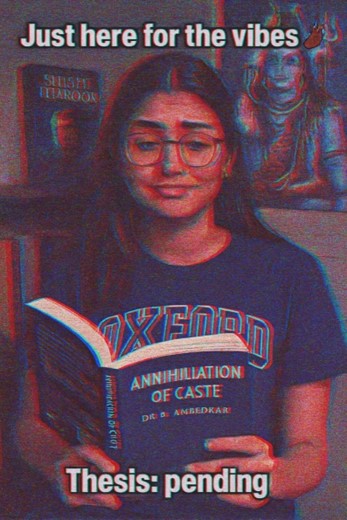
What would an academic reading of the meme look like?
This meme satirises the performative appropriation of anti-caste knowledge by upper-caste scholars in academia. The use of feminine emoji (🤌🏿) and the internet vernacular highlights the affective detachment often present in upper-caste feminism.9
Correct, perhaps. But also wrong. It kills the joke – and worse, it kills the anti-caste anger that animates the joke. It does not locate the strategic positioning of the Shashi Tharoor book and the Shiva poster in the background, which identifies the scholar in the meme as an upper-caste person leveraging their performative anti-caste stance to further their academic career. Furthermore, suppose I had not mentioned that this is a meme that I created. In that case, there is no citational information for scholars to determine the caste positionality of this internet meme creator and what politics is being satirised here through the glitchy aesthetics of the meme. The academic reading of this internet meme thus risks flattening the institutionally marginalised anti-caste political stance into a trace.
The point is not that memes resist interpretation altogether, but that conventional academic readings often foreclose their excess, glitch and anger. To read this meme solely through the lens of feminist theory or semiotic analysis is to strip it of its platformed context, visual cues and memetic intent. It is also to overlook how memes like this one are circulated, misread and co-opted within stratified digital publics. This leads us to a broader question of circulation and reception.
Limor Shifman argues that internet memes gain digital momentum through circulation chains – the accumulation of remixes, reinterpretations and context collapse.10 In Indian meme cultures, this chain is often interrupted by algorithmic discrimination, shadow-banning and platform-specific marginalisation as internet memetic ecologies are deeply caste-coded and shaped by access to platforms, linguistic registers and algorithmic visibility – all of which are structured by caste-class positionality. These inequalities also shape how the internet memes are received and interpreted across publics. If we follow Nissenbaum and Shifman’s concept of memes as ‘contested cultural capital’, it becomes evident that memetic value is never stable; it fluctuates across publics, shaped by shifting dynamics of visibility and recognition.11 In the Indian context, this contestation also becomes epistemological. Memetic boundaries are defined by caste, region, history, language and survival. What is hailed as ‘ironic brilliance’ in upper-caste pages often appears as epistemic violence to caste marginalised readers. This is where the glitch becomes method. As Legacy Russell writes in Glitch Feminism (2020), the glitch is not just an error but a refusal of normative systems – gender, race, interface.12 In Indian internet meme cultures, glitch aesthetics manifested through broken fonts, low-res screenshots and misaligned captions have become a refusal of platform polish and upper-caste legibility. The internet memetic glitch is thus an attempt at para-academic knowledge production. Meme genres here become semiotic battlegrounds. And those battlegrounds demand that we see memes as methods of world-making – not in a utopian sense, but as tactical futurities stitched together with affect, emoji and glitch.
In the absence of the footnote, then, what should the Indian internet meme scholar do? What do we do with an internet meme that cannot be archived or footnoted? Do the anti-caste politics of the meme operating under platform logics not deserve academic attention just because there is no archive to locate this internet meme template, and no citational information available to be footnoted in an academic work? If the absence of citation renders a meme academically unusable, we risk building a future where marginalised memetic publics from caste-oppressed and queer communities are erased from scholarly memory. But what if we saw memes not as failures of scholarship, but as vernacular methods of thinking otherwise? I am inclined to believe that the singular academic interpretation of the internet meme provided above is enticing enough to warrant critical academic attention. At the same time, however, paying scholarly attention to Indian internet memes risks further heightening the epistemological dissonance between internet memetic logics and academic methods.
As Galip argues, memetic labour in marginalised digital publics often arises from exhaustion and infrastructural disenfranchisement. Extracting meaning without contextual solidarity risks replicating those asymmetries.13 Such critical interpretation of an internet meme runs the risk of flattening its social world, its vernacular registers and its political precarity. In turn, this can lead to disproportionate scholarly attention being placed on internet memes that conform to platform logics (and which achieve broader readership) by sacrificing their socio-political and cultural specificity.
Perhaps, the task, then, is not just to interpret memes academically, but to let memes alter academic methods. If memes operate through glitch, remix, refusal, and speculative repetition, then academic writing might do well to adopt some of those rhythms. What would a methodology look like that privileges response over reference and affective resonance over evidentiary verification? This is not to abandon scholarly rigour, but to expand our epistemic forms so they can account for platformed, precarious, politically saturated forms of cultural production. In the internet meme’s refusal to be fixed, explained or properly footnoted, we glimpse an alternative mode of knowing that privileges intuition, resonance, and feeling. Internet memes remind us that language is always already broken and that to write the future means to write through glitch, contradiction and surplus. The Indian internet meme scholar, in particular, might need to move with memetic publics rather than observe them from a citational distance.

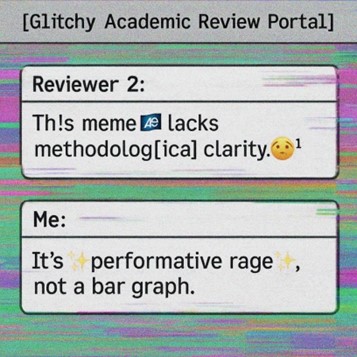
This means making internet memes, remixing them and sometimes refusing to translate them into academic coherence. It means taking the aesthetics of irony, dissonance and platform exhaustion seriously as methodological tools. It means exploring the idea that the footnote – our most trusted epistemic tool – may be the wrong instrument for this cultural moment.
The meme may not need the footnote. The scholar may need to meme. This is where I turn to the speculative academic, as a method born from internet memetic life.
II. Epistemic Disobedience and the Speculative Academic
This section speaks to two audiences at once. To scholars and institutions alike, it is a provocation: what would it mean to acknowledge that the citational hallways of academic knowledge are not hospitable to memes, and that memes demand other epistemic architectures altogether? To scholars at the margins, it is a speculative invitation: what might it look like to meme without explanation? If the current academic language cannot hold these futures, perhaps it must glitch.
What would it mean to write scholarship that does not just study internet memes from an academic distance but also writes like a meme?
It is more than a stylistic question – it is political and epistemological. I will draw on Walter Mignolo’s concept of ‘epistemic disobedience’ to offer a speculative answer.14 Mignolo calls for epistemic disobedience as a refusal of Western scholarly modes of knowing that masquerade as universal. To meme as a scholar is to recognise that epistemic stability tied to clarity, citation, and coherence is a disciplinary fantasy. This provocation animates what I call the speculative academic – a scholar who allows internet memetic logics to glitch the academic language. The speculative academic draws from the lineage of Black feminist thought, Dalit critique, decolonial theory and queer method but reworks these traditions through the glitchy grammar of internet memes.15
In Galip’s framing, platformed creativity involves aesthetic expression with affective self-fashioning. Internet meme-makers perform selves – fragmented, tactical, ironic, constantly reauthored through likes, reposts and platform constraints.16 The speculative academic must perform differently as a situated processor of internet memes’ affective charge. The glitch, in this context, is not an error. It is a tactic. It is what Critical Meme Reader II terms memetic tactility – a mode of thinking where rupture becomes method and interruption becomes insight.17
So, what happens when the scholar writes like a meme?

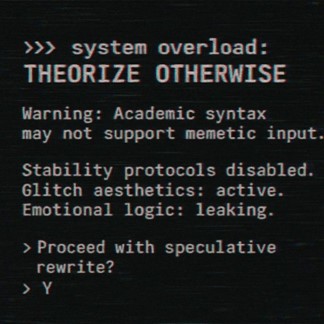
This glitchy interlude is not a parody of scholarship; it is scholarship. It stages a meme-native epistemology that does not theorise in the conventional sense, but performs theory in memetic form: compressed, layered, sarcastic, semi-legible.
Writing as a speculative academic is to claim internet memes as speculative acts of world-making. In this sense, the speculative academic does not translate memes into footnotes but translates the impulse of memes into form – into syntax, citation style, section breaks, failures, jokes and opacity. Their research does not flatten memes into ‘data’. It lets them glitch the prose.
To return to Galip’s framing of affective self-fashioning, for the speculative academic, this means refusing to elevate one’s writing above the digital life-worlds it seeks to understand. It means acknowledging that the internet meme may be a truthful document of the now. And perhaps of the future.
In this vision, a speculative academic method might use footnotes that interrupt instead of explain, deploy screenshotting as a digital ethnographic tool to collect digital ephemera, as Galip frames it.18 Speak in emoji and lowercase to match the vernacular. Include platform-native text forms (captions, alt-text, shitpost syntax) as part of the scholarly toolkit. Embrace disorientation as a valid mode of transmission.
Conclusion: This Footnote has Expired
Internet memes will outpace this essay. They already have. But that is precisely the point. If academic institutions cling to linearity, legibility and citation as guarantors of knowledge, they will continue to fail the meme. In doing so, they will also fail the queer, anti-caste, precarious digital subjectivities for whom the meme is a method and a refusal. The question is no longer whether academic language can ‘catch up’ with internet memetic culture. The question is whether academia can survive its refusal to change.
Because it is not memes that risk obsolescence, but academic language itself, if it clings to linearity and citation while the future is already being typed in comment threads, meme templates, and glitch remixes.

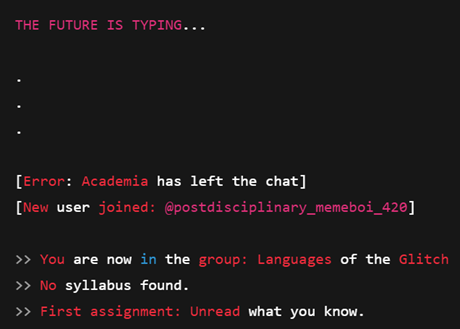
Internet memes will invariably inform the languages of the future. The internet meme survives because it adapts. It fails forward and refuses clarity; it is a reparative glitch. As a speculative academic might argue, the future of scholarly discourse should be multimodal and multi-attuned: to precarity, platform cultures, affective rhythms, in-group nuance and to that which does not translate. If the footnote fails the meme, let that failure be instructive. Let us build languages of the future not on the ruins of viral culture, but from within its logic – its chaos, contradiction and untranslatability. To write with memes, then, as memes, through memes, is speculative fidelity. That is epistemic disobedience. The meme’s refusal does not close academic knowledge down; it opens a glitch-language in which futures are already being written.
ISHAN TRIPATHI is a researcher working at the intersections of digital culture, postcolonial theory, and caste critique. Their forthcoming work includes essays in Scaffold: A Literary Journal and Women’s Studies (Taylor & Francis). They hold an M.A. in Modern and Contemporary Literature from the University of Manchester.
***
Edited by JOSH WEEKS
Proofreading by FLORA SAGERS
Lead image (background) by Michael Dziedzic via Unsplash.
Categories