Concrete Memories
OTHER CITIES: LONDON MEMORYSCAPE
Concrete Memories:
On Exile and the City
by Saba Zavarei
16 October 2025
What does exile do the memories of our home?
In this personal essay, Saba Zavarei reflects on how certain concrete structures in London remind her of places in her Iranian hometown Ekbatan and how she experiences being caught between here and there. And what happens to these memories of home when that home is attacked? Watching scenes from the Israeli attack on Ekbatan in June this year on her phone, did her memories persist or were they, like buildings, turned into rubble?
Orange Concrete
A lone window is lit. Twelve stories are dark. It is a warm summer night. Leaves still, stray cats asleep, crickets chirp. All on an anonymous video. If I were there I might have gone for an evening stroll. Like I used to. Maybe I would have been the one filming the building and the single bright window. Four seconds into the video, the whole block lights up reflecting flares. The concrete glows orange, the sky with it. For one second. Then all falls back into black. Quiet night again. Had I been there, I might have been jogging through the pedestrian area then suddenly stopped by the giant roar. Seven seconds later, a loud noise, a massive explosion, somewhere behind the camera. Like a storm, tearing the sky. Street dogs bark, terrified.
21 seconds on a vertical frame. A very ordinary night in Ekbatan, western Tehran, shredded by rockets and missiles. I watch it from thousands of kilometers away, feeling paralysed. It appears on social media on 24 June 2025 – the eleventh day since Israel’s attack on Iran and the start of the war between the two countries, one day before the fragile ceasefire. I save the video on my phone. I pause at second 4, I take a screenshot, I stare. Again and again.
Orange reflections on concrete takes me back to my childhood. The bonfires and fireworks of the last Tuesday of the year, Charshanbe-suri. We built huge fires, and jumped over them , while singing: Zardi-e man az to, sorkhi-e to az man! (My yellowness to you, and your redness to me!) Asking the fire to take our pains and worries, and give us instead its energy, its passion. The reflections clung to ground level walls and cobblestones, playful, dancing with our shadows. We were filled with joy and hope, thinking we were getting ready for a better year, a better future.


Now this orange freezes my blood, stops my breath. Death glows. Destruction roars. Outside my window in London, a lazy wind stirs the branches. Buildings slumber in the dark. Magpies rest in their nests. Foxes drift to their secret shelters. I look back at the screen. Rockets shatter dreams. Fear falls from the sky. Whose eyes am I seeing through? Whose memory is this?
Ekbatan was always my home. A small, modern town of tens of thousands in western Tehran. Built from scratch, in a brutal, modern style – exposed concrete and sharp angles. On countless evenings, I had seen scenes identical to the one in the video, concrete blocks in the quiet night. I know it well enough to hear the crickets in my mind, to sense where cats usually hide, to smell the leaves on a hot summer night.
In the feverish rush of Tehran’s demolition and construction since the 1990s, Ekbatan was always a safe place. When alleyways became highways, and concrete bridges and tunnels tore the city’s fabric, Ekbatan remained a haven for children, the elderly, the cats and the trees. While Tehran wrestled with its ever-changing identities amid constant development, Ekbatan remained steadfast in its modern, barren simplicity. It offered a safe place for our childhoods and gave us room to resist all the cultural chaos we were forced to navigate, above all the state’s imposition of an Islamic identity. When I left Tehran for London, I believed – on some level – that no matter what happened and however fast things vanished, these buildings, trees, and streets would, at least, will preserve our stories. They would remember that we were there.
Through years of living abroad, Ekbatan has remained a point of return – a place where I might revisit my former selves if exile were ever to end. I stare at the orange concrete in the screenshot I captured from the video, struck by the horror of losing connection to my past selves. Memories surge – years, months, days. Thousands of kilometres away, my body is safe, but my memories are not. My mind warns me; a chasm opens within. As Gilloch and Kilby write in Trauma and memory in the city: “It is precisely when memories seem most endangered that they present themselves most profoundly and powerfully to us. […] We fear we are in the city of lost things, but we must remember, too, that it is only at last sight that they speak most eloquently to us. […].”1
Images and stories of people fleeing their homes rush through my mind. Those I know, those I know not, leaving everything behind. If I were there? My tearful eyes blur any vision beyond this image. When our homes are abandoned, our streets empty, what happens to our memories? Who will remember our stories? “In the dialectics of demolition, there will always be the debris, the loose threads, the drips, the dust – these are the remains of last things, these are what we must come to love most of all, these are the stuff of which memories are made.”2
Cityscapes Within
Concrete surfaces reflect London’s August sun, a rare warm glow brightening the brutalist blocks. My heart warms. In my mind’s eye, the Barbican towers blend into Ekbatan apartments – heavy masses balanced on slender pillars. The open ground floors beneath the lifted buildings call me to play, jump, run – to be a child again. The space is porous; each step carries me effortlessly, to the other side of a block. Under the stairs we made a lab, to inspect the insects we caught. On the smooth surfaces of pilotis level, we skated through endless summer afternoons. Concrete framed our boredom, our adventures, our dreams.

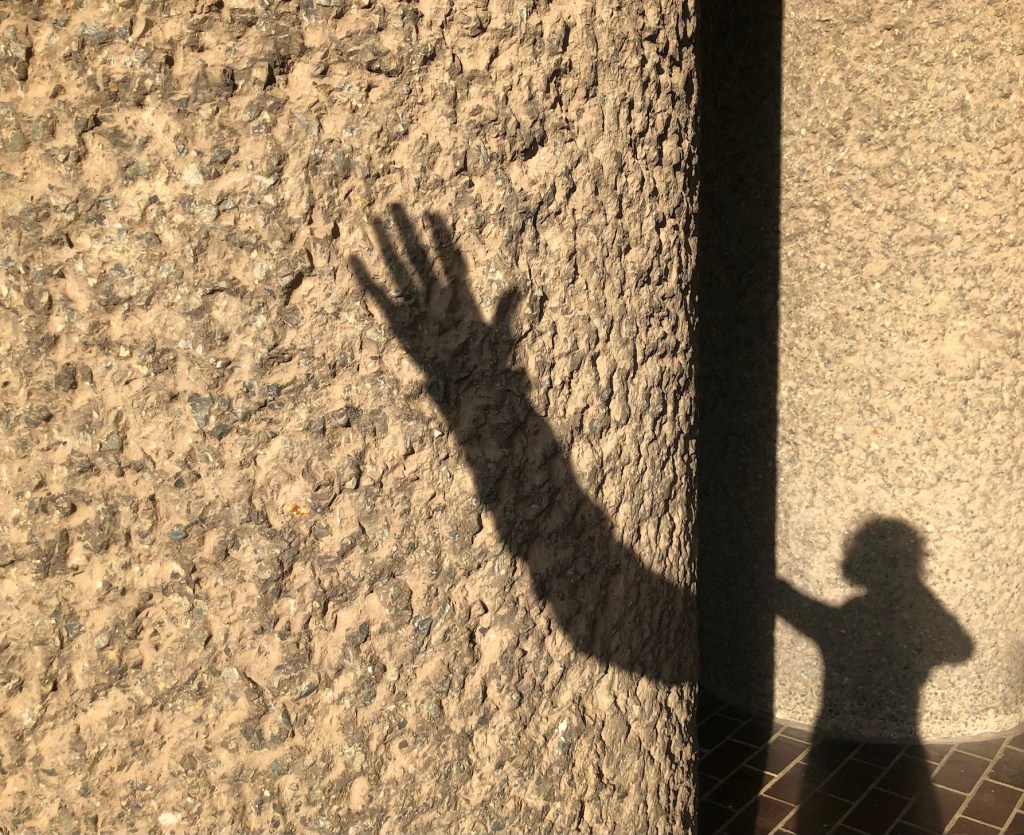
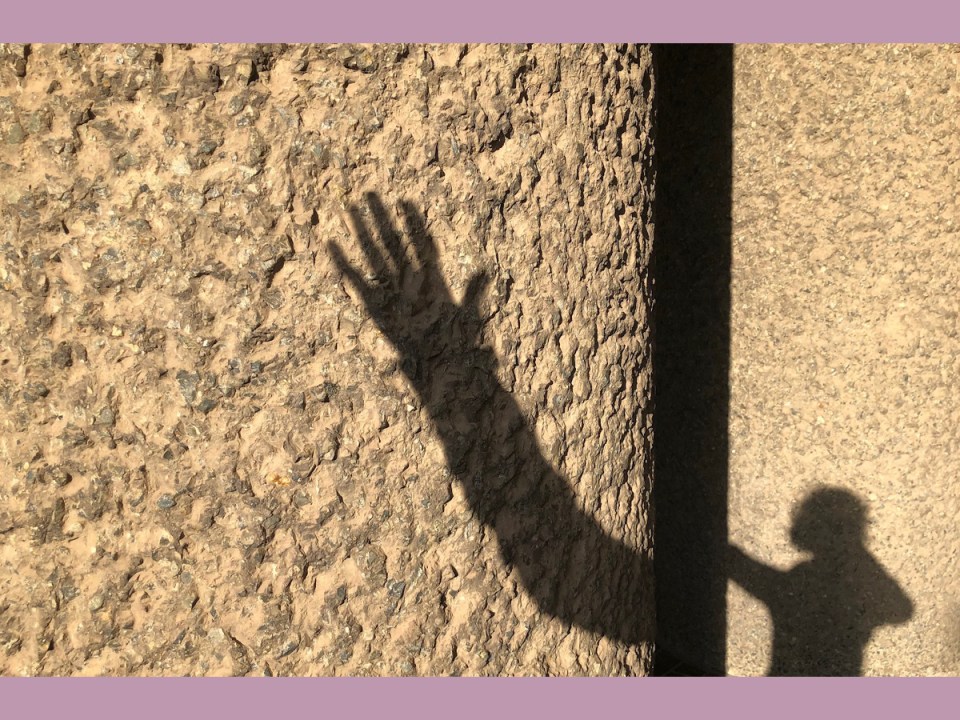
I run my fingers across the concrete, and I am back at the Barbican. The concrete’s surface is hammered, studded with larger pebbles. I remember how Adrian Forty in his remarkable book Concrete and Culture: a Material History beautifully shows that since the rise of concrete in the twentieth century, countries have sought to create their own distinctive versions, imbuing the material with “national characters” to craft spatial difference. Where did the concrete used in Ekbatan cocame from, I wonder. I step back from its surface , and find myself floating in a hybrid space – Tehran and London intertwine, past and present fold together.
The meaning of place keeps changing. My bodily experience shifts with it. Lived experience acts as a performative layer reshaping these buildings. Displaced memories of exile find new homes. A sense of continuity emerges, a joyous echo of childhood. Concrete – with its brutal reputation – becomes a safe space, a surface to project my buried memories, to breathe my lost past, to inhabit my selves, old and new.
I remember how architecture theorist Neil Leach complicates the meaning of place. To him, it is through “mirroring between the subject and the environment over time”, that identification with a specific place occurs. To him this is a reciprocal relation in which both “interjection” and “projection” happen, and the subject plays both the “screen” and the “projector” roles.4 Thus, buildings do not have “inherent meaning”. Rather, meaning needs to be projected onto them, or as Walter Benjamin suggests, buildings need to be appropriated: “for Benjamin, these ‘appropriations’ are reinforced by habit. Here memory plays a crucial role. Over a period of time, the sensory impulses leave their mark, traces of their reception. These traces are themselves not forgotten, but constitute a type of archive of memorised sensory experiences.”5
We find fragments of our pasts in urban spaces, and together we assemble our selves, partly here, partly there. Or as Leach states, we are “the sum total of the places we have visited, lived in, and formed attachments to.”6
Places for Memories
Darkness presses against my London window. Outside, buildings slumber, magpies and foxes nestled in their trees and secret shelters. Yet my mind stretches across continents – Tehran is awake, another sleepless night, the city tending its wounds in the fragile quiet since the missiles fell silent. A tentative ceasefire hangs in the air, fleeting and uncertain. Perhaps those who fled in the past twelve days dare, even briefly, to dream of return.
I close the door behind me to go to work, wishing my friends will soon open theirs to return home. Years in exile have taught me to carry my memories with me, finding fragments of space for them wherever I can. I walk on concrete surfaces, touch the cold walls, pour my childhood into London through my steps and my warm fingertips, giving my stories a place to live. In reclaiming the spaces around me, my mind bridges the everyday with the lived, layering meaning upon concrete. The surfaces echo both the Barbican and the towers of Ekbatan, and in this blurry accumulation, a sense of belonging persists. Concrete frames our boredom, our adventures, our dreams—and through it, memory endures, carrying the past across continents, across time.
SABA ZAVAREI is an artist and researcher. At the intersection of performance studies and human geography, she explores the relationship between bodies and public spaces, and how bodies produce, use or transgress their everyday spaces. She is an associate lecturer at Goldsmiths, founding editor at Konesh, and a visiting research fellow at IAS.
***
Edited by ZOLTÁN KÉKESI, MARTHE LISSON
Proofreading by NICHOLAS LACKENBY
Lead image (detail) © Saba Zavarei
Categories
One thought on “Concrete Memories” Leave a comment ›