Portia Zvavahera: Zvakazarurwa at Kettle’s Yard
LONG REVIEW: EXHIBITION
Portia Zvavahera: Zvakazarurwa
at Kettle’s Yard
by Marthe Lisson
19 December 2024
Zvakazarurwa means ‘revelations,’ a word whose meaning offers a prism of associations and connections within the artist’s work and practice. A strong sense of revelation also extended itself outwards and onto the author of this review who was entranced by the many layers Portia Zvavahera creates on her canvases and by her overall visual language.
We start the tour outside the exhibition. Curator Tamar Garb, Professor in the History of Art at UCL and the Founding Director of the Institute of Advanced Studies, is introducing us to the artist whose work we will be looking at in detail in a few minutes. Portia Zvavahera was born and raised in Harare where she still lives and works. She first studied at the National Gallery of Zimbabwe, then at the Harare Polytechnic and in 2006 graduated with a diploma in fine arts. The education she went through is one derived from British-colonial times and has similarities with the British education system these days; the art education she received in Zimbabwe, while attuned to local traditions and materials, is one engaged with contemporary practices globally. There is a continued need to remind ourselves that artists like Zvavahera, while living in distinct cultural contexts and space do not inhabit a world that is fundamentally different to our own and Garb knows about the importance of this context.
“We are not talking about somebody who is formed exclusively by village life,” Garb emphasises, “or who started to work intuitively with craft practices there. We are talking about somebody who is connected through their education and through their art education exposure to debates, to ideas, to technologies and techniques and notions of what contemporary art practice is on a global scale which very much positions her in conversation with contemporary artists worldwide.”
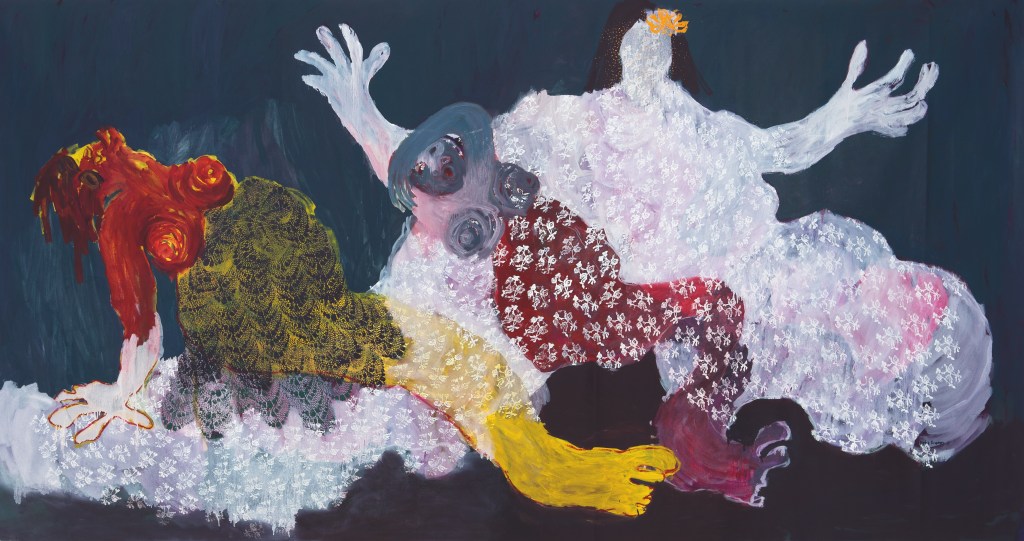
The shelves in Zvavahera’s studio include books on European painting and she uses Google Images for image research like everybody else around the world. References to other artists populate her work, either consciously or unconsciously. Decorative elements remind us of the work of Gustav Klimt; the colour palette of Francis Bacon; or the composition and the enlarged distorted upwards-moving figures in Embraced and Protected in You (2016) make us think of Pablo Picasso’s Guernica.
Part of her mixing of cultures is the prominence she gives to her mother tongue, Shona. “I’m always thinking in Shona. […] The English titles come because people want to understand what I mean. I dream in Shona and everything is Shona,” Zvavahera told writer Sinazo Chiya in 20171. Unsurprisingly then, she insisted to title the exhibition in Shona: Zvakazarurwa. Zvakazarurwa means ‘revelations,’ a word whose meaning offers a prism of associations and connections within her work and practice. There is the religious connection to the Book of Revelations in the Bible; there are spiritual associations between her dreams and the subject matters in her paintings; there are the actual layers of paint on her canvases that obscure and reveal. In the best case, her work is a revelation to those who first encounter it, as it was to the author of this review.
The exhibition traces Zvavahera’s work from 2012 to 2024 and a compelling technical evolution. Over the years, Zvavahera developed an elaborate and complex way of composing her canvases and combining painting, printing and batik. Trying to decipher which layer on her canvases was applied first is almost impossible. Her compositions require meticulous planning; with the yet unstretched canvas on the floor, kneeling and using an oil crayon, she starts by outlining the figures and shapes. She then paints, always with printer’s ink, adds printed elements and batik. She always leaves an area on the canvas white.

Zvavahera’s work is autobiographical, the subject matters stem from her lived experience and her dreams. However, she is not an illustrator; she extracts and distils the energies and emotions of moments and events; she abstracts them. Formally, too, her work flirts strongly with abstraction while remaining figurative. One of the earliest paintings on display, Labour Ward (2012) draws on the artist’s own experience of giving birth. Three naked women are lying on single beds lined up close to each other. The women’s body language is that of pain and discomfort, two of them cling to the bars of the bed frame, the expression on their faces is distorted from pain. The colours oscillate between urgency and calm. The bed in the centre of the canvas is a dark, not an alarmingly bright, red. The woman on the right is a ghostly white, pale from the pain, devoid of energy. At the same time, the shades of green and blue create an atmosphere of calm. Again, Zvavahera is not an illustrator. She painted the sense of community and solidarity that she felt with other women on the ward. Going through the pain together gave her strength and a feeling of safety.
The figures in Zvavahera’s paintings are almost exclusively female and mostly surrogates for the artist herself. Other figures might be her children and members of her family. They are dressed in colourfully patterned fabrics, reminiscent of the wax print fabrics that women in Harare wear every day. In her canvases too, she uses print to depict fabric; working with block and card print, stencils or actual lace. She dips it in ink and presses it onto the canvas.
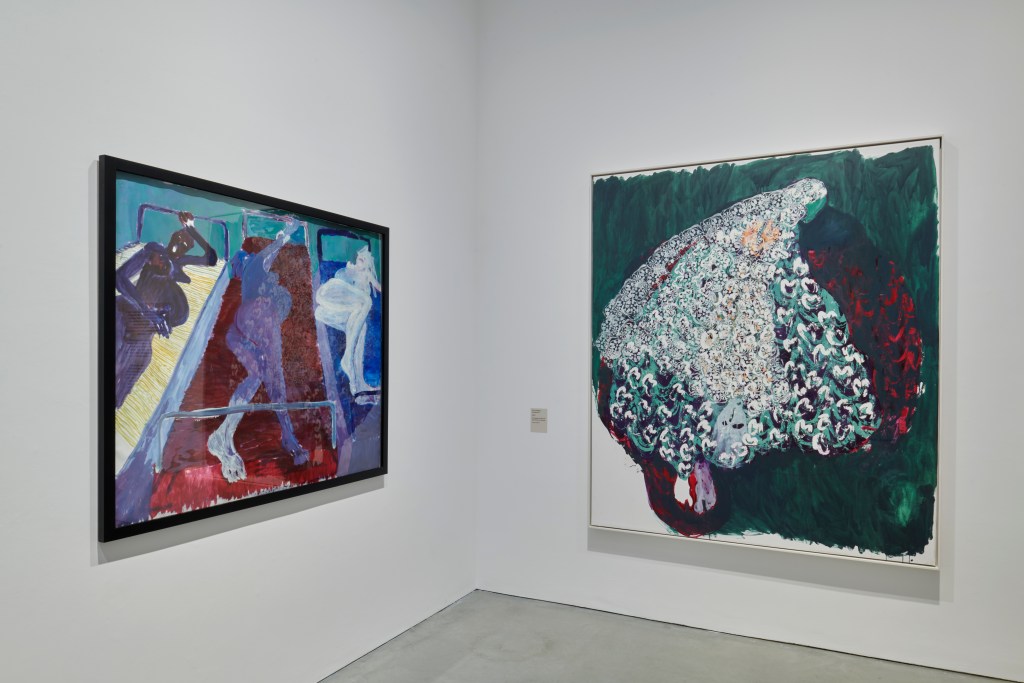
The depiction of brides, with veils of lace, forms a whole body of work within Zvavahera’s oeuvre and is an expression of her long-standing fascination with wedding dresses and the veil. Handidi Kuzviona (2016) and This is Where I Travelled (2) (2020) mark the beginning of the exhibition as if to unveil – to reveal – what more there is to come. Around 2018 Zvavahera started to incorporate batik into her work, adding another layer of patterns; often feather-like or star-like shapes that cover bigger areas of the canvas.
Zvavahera seems to be drawn to repetition; visually, in her use of patterns, but then the artistic practice itself is an act of repetition, too. Whether it is the act of painting or printing, or the daily showing-up in the studio. The act of repetition is a ritual, a meditation, praying. Zvavahera is a devoted Christian and praying a part of her daily life. Her belief and her practice are, in fact, inseparable. Christian iconography is threaded through her work; kneeling and praying figures, angels and, in her early work especially, the cross are recurring elements. Inseparable from her belief, too, and thus from her practice, are her dreams. For Zvavahera, dreams are messages from God and her paintings are embodiments of what she has been seeing in her sleep, “the things that I have been allowed to see about my life.” [Kettle Yard’s interview with the artist]. They are revelations to her, and she reveals those revelations to us viewers by distilling and reinterpreting them on her canvases – Zvakazarurwa.

There is Too Much Darkness (2023), for example, is an explosion of shades of pink. In the centre lies a figure on her back, it is Zvavahera, almost disappearing into the background and covered with a layer of leaves of batik. An angel, reminiscent of late medieval, early Renaissance angels, is extending its arms to protect her from the two larger-than-life rats that are crawling towards her. In the dream, that Zvavahera had when she was pregnant, rats appeared wanting to take the baby from her womb. This nightmare has been keeping her busy for the last two years and found expression in a number of paintings. Another one is The Energy Present (2024).

It is Tamar Garb’s favourite painting in the exhibition and the end of the tour. Although she is not sure whether Zvavahera works through her dreams to reach catharsis, the threat in this painting seems contained. The rats’ heads are stuck on poles, like a warning from French Revolution times. The figure at the centre of the canvas is not disappearing into the background anymore but is painted in the same black-violet as the rats. It seems, the human figure, again Zvavahera, is filled with confidence now, her energy can fight off the danger and the rats cannot reach her anymore.
Portia Zvavahera: Zvakazarurwa is on view at Kettle’s Yard until 16 February 2016. It is organised in collaboration with the Fruitmarket, Edinburgh where it will open on 1 March 2025.
MARTHE LISSON is the editor of Think Pieces. A musicologist by training who is deeply rooted in the art world.
Editing & proofreading by LEE GRIEVESON
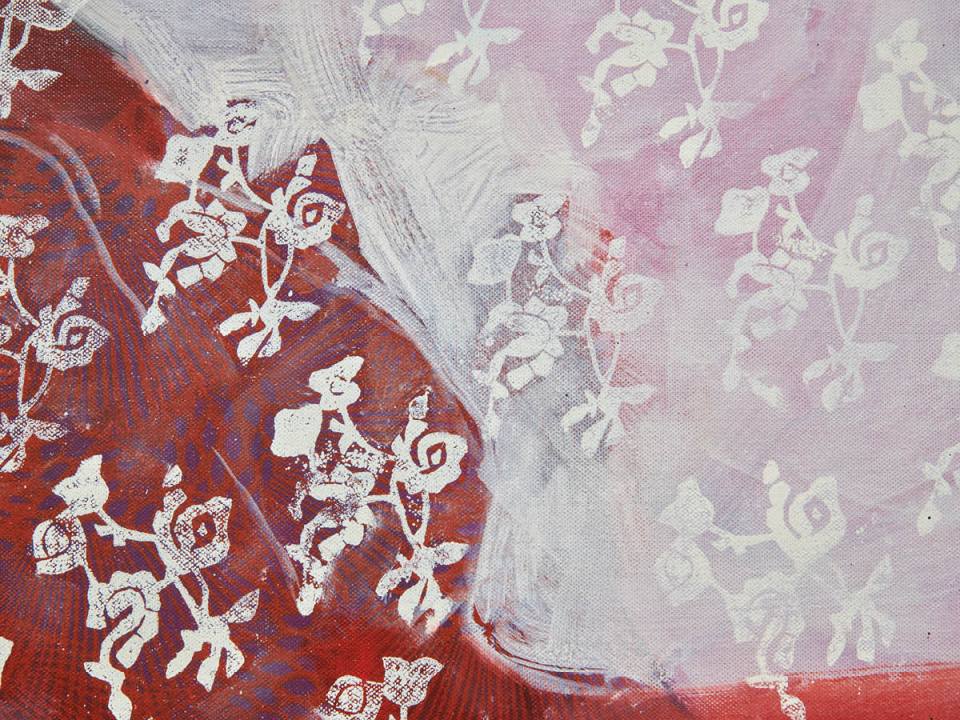
Lead Image: Detail of Portia Zvavahera, Embraced and Protected in You, 2016. Photo: Jo Underhill
Categories